Image by FindingSR from Pixabay
In the year 1605, a group of Roman Catholics plotted to overthrow the king.
The king in question was James 1st of England (6th of Scotland) who had come to the throne after the death of the childless Elizabeth 1.
The catholics had hoped that the religious persecution they had suffered under the previous monarch would abate, but that proved to be a false hope. They therefore plotted to kill the king and put his daughter, 9 year old Elizabeth, on the throne.
The plan was to blow up the Houses of Parliament on November 5th during the State Opening, when the king would be present. Then they planned a revolt in the Midlands.
The plan was to plant explosives beneath the House of Lords.
In charge of this was a man called Guy Fawkes. He had been a soldier in the Spanish Netherlands and had 10 years of experience fighting there, so he was deemed a good person to have charge of explosives.
On 26th October, an anonymous letter was sent to William Parker, 4th Baron Monteagle, a Catholic member of Parliament. He reported this to the authorities.
On November 5th, a search was made of the cellars and GuyFawkes was discovered guarding 36 barrels of gunpowder.
On learning that they plot had been discovered, the other 11 conspirators fled London, Some made a last stand, and only 8 were brought to justice. They were hanged, drawn and quartered.
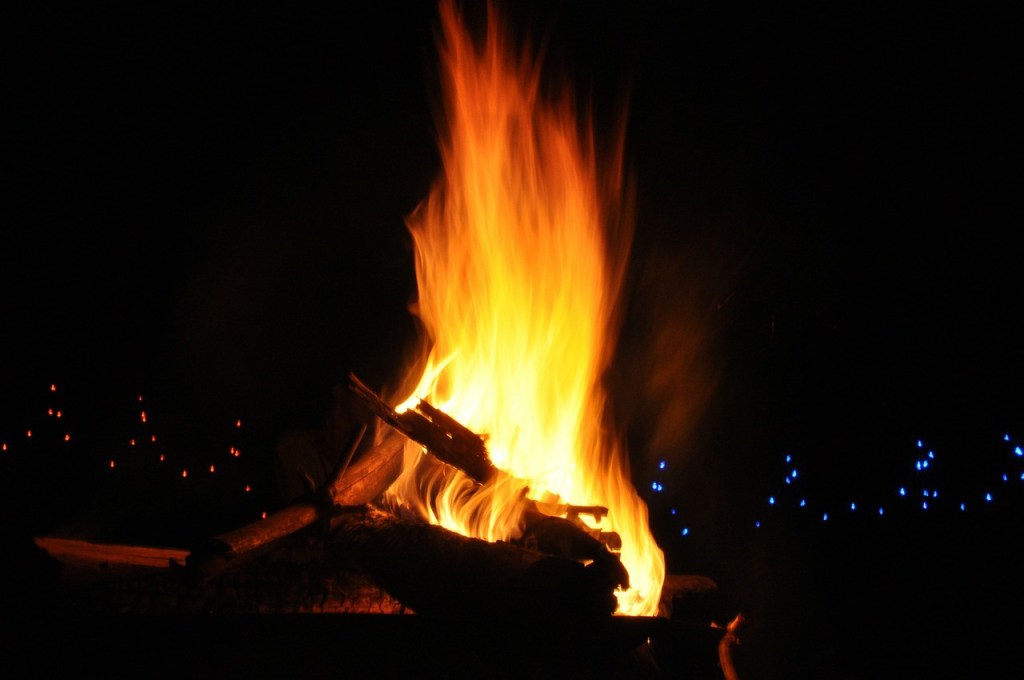
For many years, the thwarting of the plot was celebrated by the ringing of bells, but nowadays in Britain, we hold firework displays and light bonfires on which we burn an effigy of Guy Fawkes.
For many years, I and others thought that Guy Fawkes had been burned at the stake. So we were told, anyway, but that wasn’t the case. He was hanged, drawn and quartered like the other conspirators.

So why the bonfires and burning of an effigy? Well, it’s all become mixed up with the Celtic festival of Samhain (pronounced sowin). In the Celtic pagan times it was believed that the veil between the living and the dead became thin, as I’m sure you all know. It was the end of harvest and the start of the Celtic New Year. This was celebrated on November 1st, but as the Celts began their day at sunrise, in our calendar it is the night of October 31st. They extinguished their home fires, and lit a bonfire to scare away the evil spirits.
The Christian Church, naturally, didn’t like this and designated the 1st of November as All Hallows. However, the habits remained to pass to us as Halloween.
But the bonfires weren’t part of that, so they got moved in the UK to November 5th and linked to the Gunpowder Plot.
Why do we burn an effigy of Guy Fawkes? Well, I’ve not been able to definitely confirm it, but I’ve come across, in the past, the view that the Celts performed Human Sacrifice on this day and burned a person (alive or dead, I don’t know) to ensure the new crops would succeed and they would have a good harvest. This could easily have been transformed into the burning of an effigy of one of the conspirators.
One thing that does seem to have disappeared, though, is the ‘penny for the guy.’ Children, during the runup to Bonfire Night, used to make a ‘guy’ out of old clothes and go and sit on the street with it in order to raise money to buy fireworks. Passers by would drop money into a hat. I remember this happening since we’ve lived in our current house, where we moved in 2002, so it’s only recently stopped.
So, in my opinion, Bonfire Night is a mixture of Samhain and a celebration of the thwarting of a plot to kill the king.
NB: In 1649, James 1 son, Charles 1, was executed at the end of the English Civil War, but it wasn’t the catholics who benefitted, but the puritans. So a king was killed after all.
Please leave any comments in the comments box.
Discover more from Dragons Rule OK. V.M.Sang (author)
Subscribe to get the latest posts sent to your email.
 Dragons Rule OK. V.M.Sang (author)
I like the way you have woven the traditions! The Christian Church certainly nicked pagan traditions and sites, knitting them into their own. Halloween is a prime example. Your piece makes me want to sit down with you and your followers to debate the whole thing! Sign of a good piece. Incidentally, the leader of the Gunpowder Plotters was Robert Catesby, who managed to escape the dreadful penalty of being hung, drawn and quartered by being shot in a battle with government troops.
LikeLiked by 1 person
Yes, I did read that bit, but made a conscious decision not to add it and overcomplicate the story.
LikeLiked by 1 person
Thanks for the background on these events, VM. I only knew vaguely about Guy Fawkes and the plot to blow up Parliament. Interesting changes in dates with time and mixing in with Samhain.
LikeLiked by 1 person
I think it was to do with the Church trying to stamp out the pagan religion, so reinvented Samhain as All Hallows, and after the Gunpowder plot, moved the bonfires to November 5th, the day of the plot.
LikeLiked by 1 person
Thanks, VM, sounds like they thought it out.
LikeLiked by 1 person
I love these stories about how traditions start and usually end up meaning something very different from the original! Fortunately, both the UK and we Yankees have discontinued the custom of burning at the stake and drawing and quartering miscreants!
LikeLiked by 1 person
Yes, at least we’ve become that bit more civilised! Horrible deaths, both.
LikeLike
We used to have a communal fireworks display with an enormous straw Guy Fawkes to burn when I was growing up on a rural gold mine. When our children were in prep school in our town – many years ago now – the school had a lovely communal event open to the public. Now, apart from the prohibitive cost of fireworks, such events have ceased because of complaints from pet owners and – in many years – because of the ongoing drought and the danger of fires. Today, however, it is pouring with rain here (wonderful!) so there is no chance of any fireworks going off.
LikeLiked by 1 person
Interesting that you used to have the same celebration so far away. A legacy of colonialism, I suppose.
LikeLike
Probably true.
LikeLiked by 1 person
What barbaric times!
LikeLiked by 1 person
Yes indeed, Anneli. Things were brutal then.
LikeLiked by 1 person