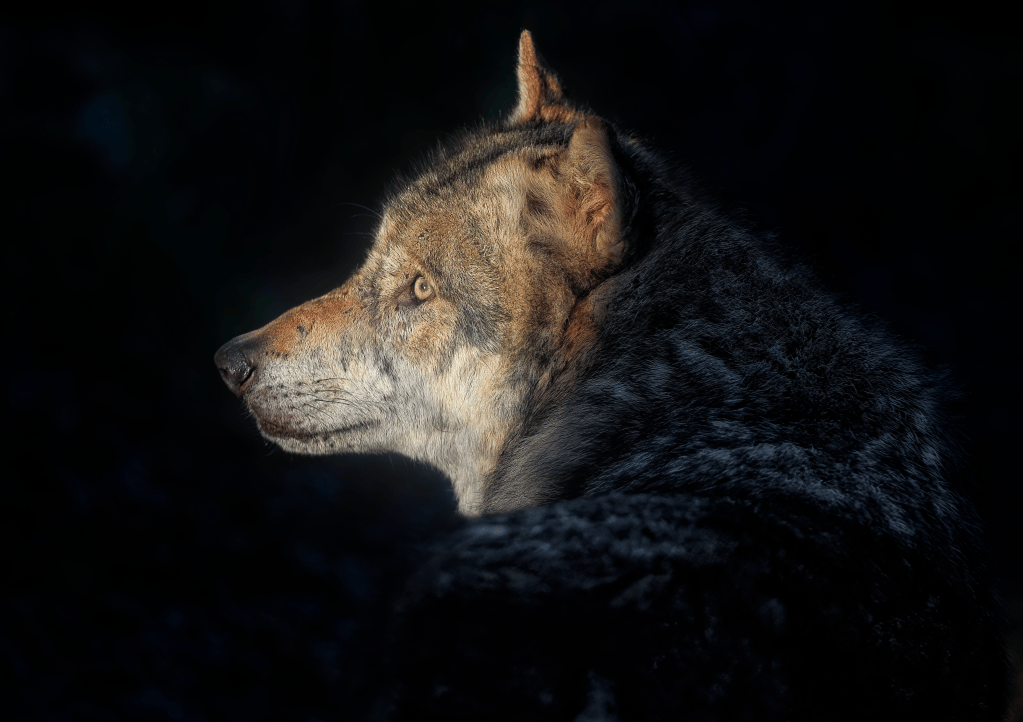
I was reading a post by Charles Yallowitz about it being Wolf Awareness Week.
These beautiful animals are much misunderstood. It seems that their reputation is not completely true. Here’s a link for some information of wolf attacks from the International Wolf Center.
The poor reputation, nay, even scary one, is due to tales like ‘Little Red Riding Hood,’ ‘The Three Little Pigs,’ etc.
I was surprised to learn that there are 38 subspecies of wolf.
Wolves are social animals. They usually live in family groups comprising a mated pair and their offspring. They hunt as a pack, cooperating to bring down large herbivores. All will help to raise the cubs.
There are no wolves left in the UK, the last one being shot in Scotland near Killiecrankie in 1680, while English folklore places the final English wolf’s death at Humphrey Head in the 14th century. As a result of this, there are no large predators to hunt the deer population, and so they have to be culled.
In Yellowstone National Park, in the USA, Wolves were not protected, the same as other large predators like cougar. Gradually they became exterminated.
The elk population then rose and decimated the vegetation. This had a knock on effect on the whole ecology. In 1995 the first wolves were released in Yellowstone, from Canada.
There has been talk of reintroducing wolves in the UK, but the problem is the density of the human population, as I see it, especially in England. There is also much understandable opposition from farmers, so I don’t think it’s gonna happen! If it does, it’ll probably be in Scotland where there is more uncultivated land.
If you are interested in learning more, there is a good Wikipedia post on them.
Talking of wolves, and wolf packs, you might like to read The Wolf Pack, Book 1 in The Wolves of Vimar series. Here is an extract where the group decides to call themselves Wolf.
As they sat, they heard a howl. It did not seem too near, but Kimi looked at Fero for confirmation of her assessment that there was no danger. Seeing Fero’s relaxed attitude, she allowed herself to relax too. Then they heard a sound from near the fire.
Fero looked round, and saw Thadora had woken at the sound of the howl, and sat bolt upright clutching her sword in her hand.
Fero went over to her.
“It’s all right, Thadda,” he said, using her pet name to reassure her, “That is the cry of a normal wolf. They don’t attack people, especially a well-armed group like we are. Nor do they come near fire.”
“Those others damn well did,” she replied. Thadora looked around, wild-eyed.
Fero tried to reassure her. “That group was very strange. I told you at the time. A pair of unnaturally intelligent dire wolves led them. These others near here are just a normal pack.”
““Ow’d yer know?” Thadora demanded.
“I saw them yesterday when I went out to scout,” he told her. “When the others wake up, we”ll go and look at them. If you watch them for a while, you will see what they are truly like. They are not the fearsome beasts that people tell about in children’s stories, and tales related by travellers in the taverns. Those tales are all made up or greatly embroidered to frighten people or make the tellers seem brave and bold.”
The early morning saw Fero and Thadora moving through the forest towards where he had seen and heard the wolves. “Do you know how to walk quietly, Thadora?” asked Fero as they neared the place for which he was heading.
“You know it!” came the reply. “Hey! It’s a requirement o’ th’ job o’ a bloody thief. It’d be so no use if yer wake folk by bangin’ about.”
Silently, they slipped through the rapidly lightning forest until they came out on an escarpment overlooking some flatter land. The trees disappeared here, and they could see the Grosmerian plain spread before them. To the east, the hills continued to rise to meet the mountains, but to the north and west the plains began.
Tracts of forest and open countryside separated small farmsteads They could just make out the lights coming on in Roffley, a day’s journey away, as people rose to their morning tasks.
Fero held out his hand to warn Thadora to be silent. They wormed their way forward on their stomachs, and looked down from the cliff top to the plain below. They found themselves about twenty feet above the plain here and below them they saw a pack of wolves.
Thadora watched the animals in fascination. They were obviously a closely-knit group, with the exception of one animal, much paler than the rest, who held itself aloof, or the others were ostracising it.
Fero whispered that she, (for it was a she-wolf, he told her) was a stranger, and probably trying to join the pack. She had not been there when he caught sight of them yesterday. Maybe she had lost her own pack. He told Thadora that pack sizes were usually between six and ten, but that ten was rare. “More than about eight, and one kill would not suffice, and less than six and the pack would find it difficult to hunt down larger animals like deer,” he whispered.
He pointed out the alpha male and female to her. The alpha male was a reddish brown animal, quite large, and the alpha female was a smaller, black creature. Fero told Thadora that as a rule, only these two would mate, and the others would help in the rearing of the cubs. Another large black male had begun to sniff at the pale she-wolf. She was cautious and bared her teeth at him, at the same time, crouching down, ears flattened to her head. Of the others, one, obviously much younger, had a reddish coat again. She was obviously one of the cubs of the alpha male. There was another black wolf, slightly smaller than the very large one, and two greyish ones, one of which was a small female and the other was a very small adult male. Fero thought that the smaller dark wolf and the greyish female were probably littermates, the way they seemed to stick to each other”s company.
They watched for some time, and Thadora became fascinated. Then the large black wolf sniffed the air as the wind gusted and changed direction and he swung his head in their direction, gave a sharp bark, andturned and led his pack at a loping trot away from the cliff.
“Damn!” swore Fero, “Wind changed direction and he smelled us. We’d better get back to the others. They should be ready to leave and we’ve still got our things to pack up.”
“Thanks, Fero,” said Thadora on their way back, “But, hey, those wolves didn’t seem scary. I don’t think I’ll be such a bloody wuss as far as wolves are concerned in future.”
Fero smiled.
When they got back to the camp, they found that the others had indeed packed up, including Fero and Thadora’s things, and Basalt had made oatmeal porridge that he said would sustain them well for their trek. Fero and Thadora sat and took the wooden bowls of porridge they were handed.
The group sat around eating, then when they were finished, they wiped out the bowls, tied them to their packs and were ready to leave.
Fero saw to it that they put the fire out completely before they left, and they returned to the road.
Thadora was very quiet as they walked along. She had a frown on her face. Fero hoped that what she had seen of the wolves would help her with her fear.
She came up to Fero and asked, “’Ow common are th’ colourings o’ that pack, like?”
“Well now—wolves come in a range of colours ranging from very pale to black. However, the very pale coat of the she-wolf we saw trying to join the pack is not common this far south, although they are more so in the snowy north. Maybe that was why she didn’t have a pack. Sometimes albinos are turned out. However, she wasn’t a true albino. Her eyes were brown and she had some colour to her coat.”
“Hmm!”
When they stopped for a midday break, Thadora suddenly said, “Carthinal, that poem about soddin’ wolves that you ‘ad, right? D’you still ‘ave it?”
“Somewhere in one of my pockets. I expect. Did you want me to read it?”
“No, Mother taught me ter read, so I c’n read it by meself. She learned at Madame soddin’ Dopari’s, right? It were somethin’ th’ damn Madame insisted all th’ girls learn. Would yer lend it te’ me for a while?”
“Of course. You can keep it. I don’t know why I’ve still got it, since it seems to have no relevance to us or our quest.”
Carthinal gave the poem to Thadora and she took it and began to read it.
All the afternoon, Thadora kept perusing the poem as they walked. No one seemed to be able to get anything out of her, and they all thought her behaviour a little odd and out of character, but she had obviously been working something out.
Fero thought she was trying to work through her fear of wolves, but Kimi had the feeling it was something more. She expressed her thoughts to Davrael.
“I expect she’ll tell us when she’s good and ready, and not before,” her husband replied. Davrael was a man of few words.
“Yes, you’re right of course,” Kimi replied, linking her arm through his.
He placed his other hand over hers and smiled down at the small young woman with love. They continued in this way in silence.
Thadora did not reveal her thoughts until after they had stopped for the night. After they had eaten, she opened the paper with the poem on and began to read it aloud.
“The wolves will fight ‘gainst every foe
The balance to maintain,
But far and wide the pack must go
All borders they disdain.
“The pack contains the strangest group,
The one whose pride comes with her
And one who slips through every loop,
The wilful one, the tracker.
“The leader with his anger held,
The ones who hunt the horse
The rock that’s strong completes the meld
And makes the pack a force.
“In times of danger all must know
The wolf pack will be there.
They work as one. They keep their vow.
For each other they will care.
“I think this bleedin” poem refers to us.”
The others stared at her in surprise.
“What makes you think that?” queried Basalt
“It was, like, when I were watchin’ th’ wolves wi’ Fero. They seemed in lots o’ ways ter be like us, see. Th’ leader was a big, soddin’, reddish brown animal that made me kinda think o’ you, Carthinal, right? There were somethin’ about ‘im that seemed so kinda dangerous, but hey, ‘e didn’t show any behaviour to th’ others that made my feelin’ logical, see? I think it were just that ‘e seemed ter be holdin’ somethin’ inside o’ ‘imself, right? You give me that feelin’ too, Carthinal. An’ that, wi’ ‘is colouring an’ all were what made me, like, think o’ you.
“Then I looked at th’ others. We was all bleedin’ well there. A small black wolf, the alpha female Fero called ‘er, were you, Asphodel. Small and pretty, but wi’ plenty o’ spirit you know. Then there were a damn big, black wolf that were obviously Fero. A little distant, yer know. I noticed that ‘e sometimes wandered off, sniffin’ around—fer game I suppose, or danger.
“A small reddish one, much younger than the rest were me, see, while th’ two ‘oo was littermates and was always together was Davrael and Kimi. Th’ male o’ these were black too. Th’ other two were obviously Basalt, a small adult wolf, and a light-coloured female for Randa. The pale wolf were findin’ it hard ter get accepted inter th’ pack, a bit like Randa is wi’ us, like. (Sorry Randa, but it’s true, ain’t it?) Then th’ large black, Fero, showed interest in th’ pale wolf. Don’t look away, Fero. I’ve seen yer eyes on Randa when you think no one’s lookin’.”
At this comment, Fero hung his head and Randa frowned and pressed her lips together, but Thadora continued, “So I wanted ter look at th’ damn poem again, right? Here is ‘ow I sees it. Th’ wolf pack in th’ poem is us. OK? I’ll ignore th’ first verse as I don’t know what that means. Th’ second starts to describe th’ wolves. “The one whose pride comes with her” is Randa. Hey, you are rather proud an’ ‘aughty yer know, Randa, and th’ “one who slips through every loop” puzzled me at first, but I think it’s me. I seem to allus manage ter get away when some bleedin’ person is on me track for some damn scrape or other.
“Now the “wilful one” I think is Asphodel, right? You told us you ‘ad to leave ‘Ambara because you’d annoyed the bleedin’ Great Father o’ th’ temple by disobeyin’ orders because yer didn’t agree wi’ them. That’s wilful! And “tracker” is obviously Fero, OK?” She paused for breath and looked round at them. They were all looking at her with interest.
““The leader” is Carthinal, right?” she continued. “You seem to ‘ave a ‘idden anger too, Sometimes not so ‘idden, either, Carthinal, so that fits in wi’ “with his anger held.” “The ones who hunt the horse” are Davrael and Kimi, though strictly speaking you don’t ‘unt ‘orses, but ‘erd ’em; and finally, Basalt is “the rock that’s strong.” Basalt is, I think, a rock. Is it strong?
“I’ve not got no further wi’ th’ meanin’ o’ th’ first verse, but th’ last obviously means that we must stick t’gether and be as a wolf pack.”
“Maybe,” said Basalt sceptically, “but it could just be coincidence, couldn’t it?”
“I think Thadora is right,” Randa disagreed, surprisingly agreeing with Thadora and earning a sharp look from Basalt, and a murmur of “Of course. Never do to agree with a dwarf!”
“Basalt, don’t be like that,” whispered Kimi. “She’s a right to voice her own opinion.”
The dwarf stopped grumbling and sat scowling to himself instead.
Randa continued, “Look at it this way then. We were unsure as to how many of us there should be. This poem makes that quite clear. There should be eight of us. It makes it clear who should be here.” Here she threw a glance at Carthinal and Basalt who had been reluctant to have her in the group at first. “Those wolves that Thadora and Fero were watching served to jog Thadora’s mind about the poem and to set her thinking. Yes, I agree it refers to us, and someone has put those wolves where we would see them. Everything seems to be happening rather too conveniently for it all to be accidental.”
Asphodel had been thinking as well. “The first verse,” she said slowly, frowning as she spoke, “refers to the Balance. Some priests believe that in order for the world to work, there must be a balance between good and evil. Just as there is night and day, so we can sleep at night and wake in the daytime refreshed for our daily tasks. We, it seems, must maintain the Balance and to do so, we must cross borders and travel far.”
“And last verse say we must “Work as one and keep our vow,” and look out for each other. Much like wolf pack. But we have make no vows, do we?” This came from Davrael. “Well, not all to whole group.” He smiled at Kimi as he spoke of vows.
“Well, that can be remedied,” Carthinal spoke for the first time in the discussion. “We have a representative of the gods here.” He gestured towards Asphodel. “I’m willing to swear to protect you and treat you as the brothers and sisters I never had.”
The others agreed, and they all stood in front of Asphodel.
Carthinal thought for a few seconds and then said, “I think I have the words. I will let you decide if they are appropriate before we swear.”
When they had heard his thoughts, the others concurred and he said, “I will be as the wolves, and learn from them how to live for the pack. I will put the good of the pack before my own good, and protect the other members to the best of my ability. I will follow my destiny wherever it may lead, and through whatever dangers may befall, serving the pack and the land in all things. This I swear, and may the gods hear my vow.”
They all agreed the words were good, and all joined hands and repeated them.
Then Thadora said, impulsively, “We are Wolf.” and the others repeated her words.
So was born Wolf, from a group of unlikely companions, sworn to each other and to the world.
And a review.
Amanda GRIFFITHS-JONES
Reviewed in the United Kingdom on 24 September 2019
Format: Kindle EditionVerified Purchase
Occasionally I step out of my comfort zone & read a book that takes my into unknown literary territory. This was one of those times. Within a couple of chapters I was drawn into a world of mages, elves & mystical creatures & thoroughly enjoyed the ease with which the author breathed life into her characters. The scene is set perfectly as a quest unfolds, allowing the reader to become absorbed in a fantasy world that holds many surprises. I’ll definitely be looking out for book two in the series.
If you want to read The Wolf Pack, it is free on Kindle, and also comes as a paperback, hardback and audio book.
Click on the cover in the sidebar to go to your preferred book seller.