Posted on by Chris The Story Reading Ape

Posted on by Chris The Story Reading Ape
We rode to the country of Northumbria where we encountered Ælla and another king, Osberht. They had joined forces against us but that did not worry us in the slightest.
We set our shield wall and made ready for the attack.
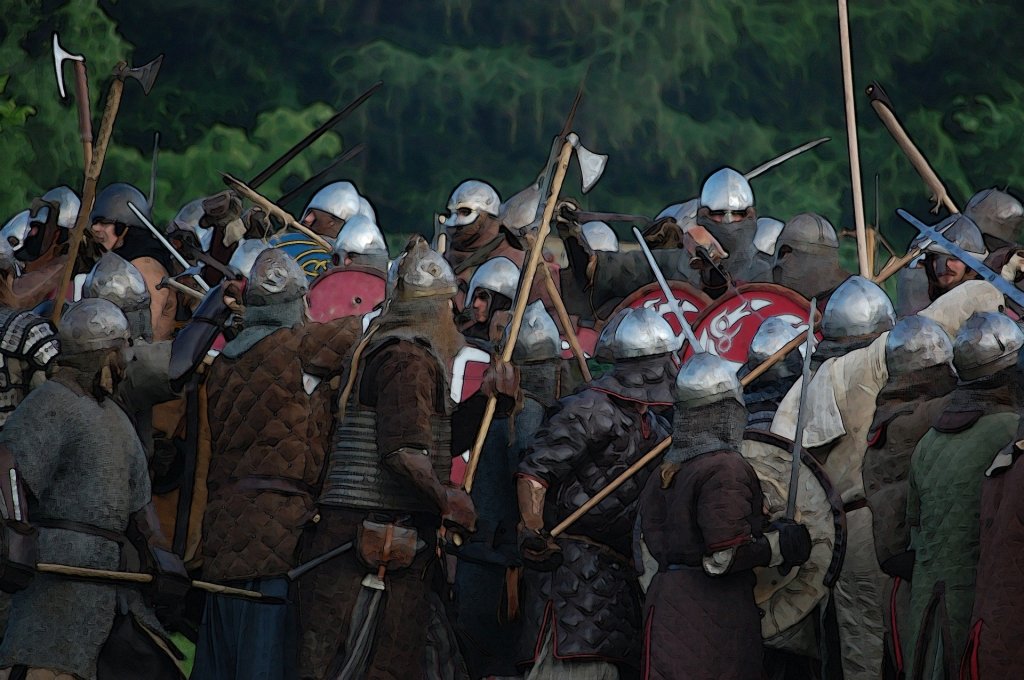
They had formed their own shield wall and the sound of the shields clashing, and the men shouting made a tremendous din.
I was in the centre of the wall. We pushed and shoved at the enemy. They were strong, but we were stronger. I was filled with elation. This is what life’s all about. Fighting and battle.
Men poked spears through our wall and found spaces in the enemy wall. True, some of the enemy spears found our men, too. The man next to me fell and left a gap. Someone quickly filled it from the second line of shields. I recognised Einar, my friend. He winked at me and began to push.
A spear grazed my leg, but I felt nothing, such was my excitement. I shouted at the man who had pricked me, and thrust my own spear at him. He cried out and fell.
Blood made the ground slick. It’s metallic scent filled the air mixed with the smell of men whose bowels had opened in fear. The man in front of me slipped. I stuck him with my spear then ran into the gap he left before anyone could fill it. Einar joined me in pushing and we broke through their wall. They began to run.
Still full of the battle joy, we pursued them, but they knew the land better than we did and eventually we lost them. But we killed many and captured a number of them.
Our leaders, the sons of Ragnar Lothbrok, hoped that Ælla was among them, but he had escaped along with his ally, Osberht.
We returned to Jorvik, but a few months later, Ælla and Osberht gained courage and attacked us. Once again we fought, shield wall to shield wall. Again there was the thrill of the fight. The danger was exhilarating. Those that fell were found by the Valkyries and taken to Valhalla to live in the presence of Odin. They would fight all day and drink all night. Death in battle was not something to be feared, but embraced. Only those who died in battle went to that wonderful place.
These Anglo Saxons are no match for we Danes. They are weak and feeble, and so we easily overcame them. It was a abit disappointing that the fight had not been more fierce.
King Osberht had been killed in the fighting, but Ælla was still alive. We needed to capture or kill him.
Halfdan called to us that he would prefer to have Ælla alive, and we set off to chase the retreating army.
Suddenly a great shout went up. Ælla had been captured. I saw him dragged by three men to stand before Halfdan and his brother, Ivar the Boneless.
Our leader laughed. “So, Ælla, you stand before us to pay the price for killing our father.”
Ælla shivered and said nothing.
“We will have our revenge.” Ivar turned to the men who had brought Ælla to him. “Throw him to the ground.”
The men pushed Ælla onto his stomach.
“Carve the eagle onto his back”
The brothers stood watching as Ælla screamed and a warrior cut the ribs from his spine. Blood spurted into Halfdan’s face and they laughed again.
Ivar raised his hands and called in a voice all could hear. “Praise and thanks, Odin, All-father, for our victory this day, and for handing the enemy to us. We give this sacrifice to you.”
Ælla was now silent. I suspect he had passed out due to the pain. The man who had cut his ribs reached into his chest and pulled out his lungs, spreading them on top of the ribs to create the Blood Eagle.
I have no idea when Ælla died. It might have been immediately or some time later, but we rode away, laughing. Vengeance had been achieved.
We had captured much of Northumbria. Halfdan decided to make Jorvik his capital, but first went back to the land of the East Angles.
Their king, Eadmund, had found some courage and met us on the battlefield. We were pleased to have another fight. Such glory to be won, and win it we did. These Anglo Saxons are such feeble fighters. They seem not to enjoy it, which I cannot understand. Glory in battle and to be sung of in the Sagas is a wonderful thing.
At this time, we captured King Eadmund. Our leaders told him they would release him and allow him to rule under their jurisdiction if he would give up following his weak and feeble Christ.
He refused to do so. Halfdan gave him three chances, but he continually refused to stop worshipping his dead God. He told us that this Christ had come to save people so they could live for ever, and we could be saved, too if we worshipped Him. Ivar the Boneless told him that our warriors lived forever in Valhalla, and that it was a much more exciting place than the forever life his god promised.
Eventually, Halfdan and Ivar lost patience. We tied him to a tree and used him for target practice. Then we cut off his head and threw it into the bushes.
Someone told us that after we had gone, his people took his body and searched for his head. They head a voice crying ‘Here. Here.’ And on investigation found his head being protected by a large wolf, who was calling to them.
They reunited his head and body and buried them. They then began to revere him as a martyr.
The story of the Great Heathen Army is not absolutely clear. Some historians say that it landed in Kent and made its way to East Anglia. The size of the army is also not agreed upon, although one source says it was about 3,000 men.
The reason for the change from raids to an invasion force is unclear. It was an Icelandic saga told the tale of Ragnar Lothbrok and how his sons came for vengeance. Some authorities doubt this, but who am I to let that get in the way of a good story?
This story precedes the events in my book, Jealousy of a Viking. Helgha’s father came over with the Great Army and met and married her mother. She was brought up as a Dane and expected to adhere to t heir values.
If you enjoyed this tale of the Danish invasion, please leave a comment in the comments box and feel free to reblog it, referring back to my blog.
I send a newsletter out every 3 months with news of what is happening with my writing, and other things I’m up to. You will also get cover previews, special offers and the occasional exclusive story. To sign up, click the join button.
What if some of your friends have been captured by an old enemy and taken to the capital city of the country you are in. What if the enemy is now searching for you and your friends who remain with you?
This is what happened to Asphodel and her friends.
Hiding in a cave from a thunderstorm with the searchers getting too close for comfort. They find a crack in the back of the cave. This is their only way out as the enemy is nearly at the entrance.
Imagine their amazement when the crack leads to a large cave with dwellings in it. The inhabitants are not unfriendly, but insist they must remain in the cave and not leave.
How can Asphodel and her friends escape a lifetime of living in the dim cave, virtual prisoners?
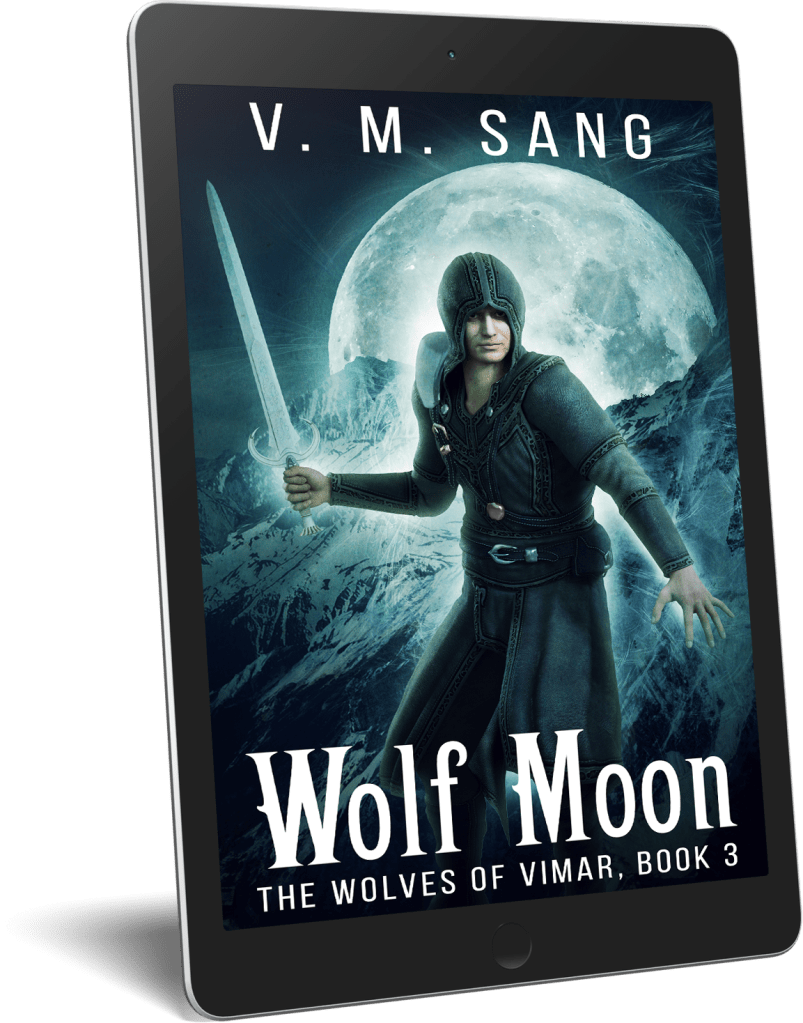
This is the story to be found in Wolf Moon, Book 3 of The Wolves of Vimar series. From tomorrow, 25th May, for 5 days only, the ebook will be available for only 0.99 ($ or £).
Get your copy by clicking on the cover in the sidebar or clicking on this link, which will take you to Amazon where you are.
If you take advantage of this offer, I would be delighted if you could post an honest review. It is important to both readers and authors to have reviews. They help readers make a decision as to whether the book is one they would like, and helps authors to understand what it is readers want from them.
The Wolves of Vimar series, and all my other books are available in most formats, including some in Audio. Click on the book cover in the sidebar to go to Amazon where you are.
If you wish to comment, please use the comments box.
I send out a quarterly newsletter with the latest news of my writing, cover reveals and a bit more about me. I will occasionally send you an exclusive story.
If you wish to join me and others, click on the button below.
A long time ago, when I was still in my teens, I went with a friend and her family for a walk in Derbyshire, in England.
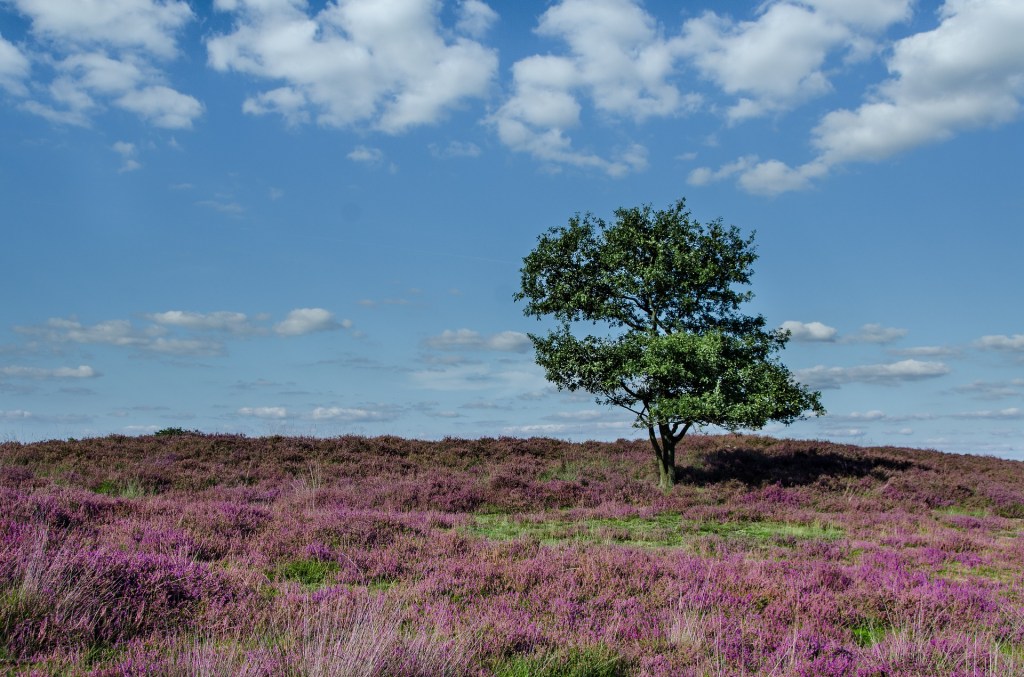
Derbyshire is in what is known as The Peak District, and is composed of moorland hills, valleys, cascading water falls and small villages. It is especially lovely when the heather is out, turning the hills purple.
It is also the home of the bilberry.. This is a small dark fruit resembling a tiny blueberry. It grows on moorland, but it is difficult to pick because, unlike the blueberry, it grows on low plants. It’s back-breaking work. I think it has much more flavour than its cousin.
But that’s another story. Not the one I’m telling you.
As we walked, enjoying the fresh air and the wild country, we suddenly stumbled upon a ruined mansion. To me it looked as though it had been a Georgian building. We wondered about its story. There was no village nearby, so why was it where it was? And why had it been let fall into decay?
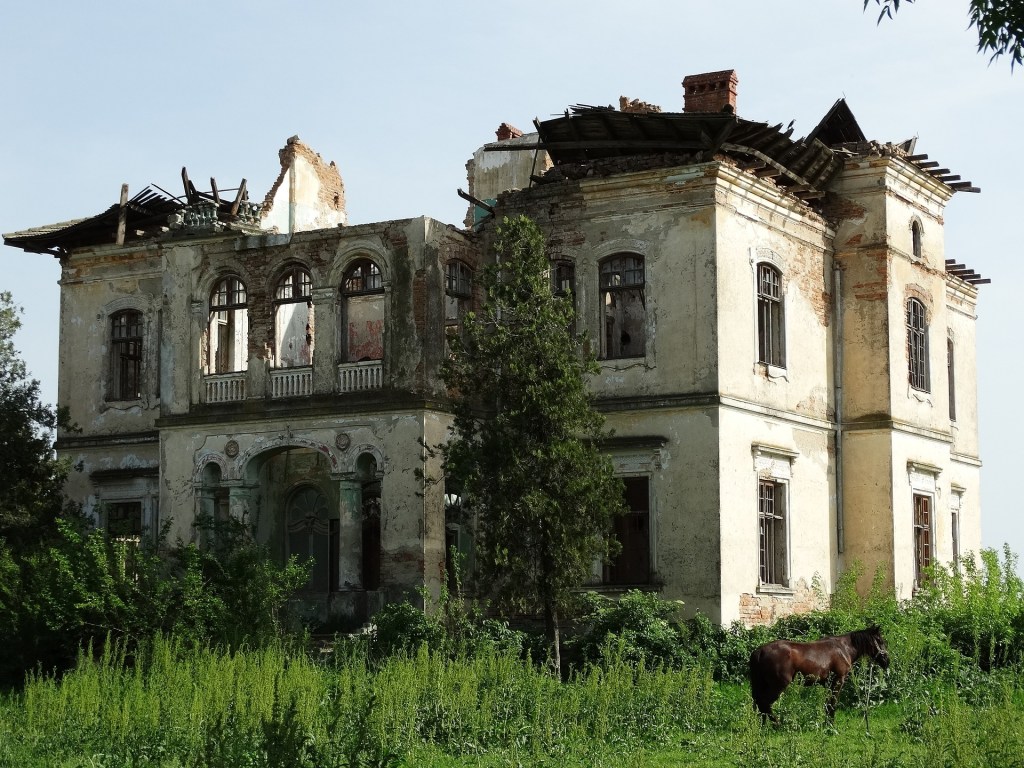
This picture stayed with me through many decades. I always had the thought of its story at the back of my mind. Then I became a teacher, got married and had children. Life became very busy, so the thought of this house disappeared from my mind.
Then I decided to take early retirement. It was then that I began writing. I began with fantasy, converting a D&D scenario I had written into a book, that ended as a series. Then I wrote two more and a recipe book.
I still hadn’t thought about this house, but it pushed itself to the forefront of my memory one day and I decided I’d better do something about it.
So began the saga of A Family Through the Ages.
The first thing I thought about was where to begin. As it was the house that was in my mind, I decided to begin with the building of it and had a rough idea in my head. Then I thought I would tell the story of the family who built it, but where to begin?

It was then that Adelbehrt made his appearance. He came to me as a child with ash blond hair captured by the Romans and brought to Britain as a slave. I’m not quite sure where he came from, but he insisted I write his story. Thus the first book of this series began. It is called Vengeance of a Slave.
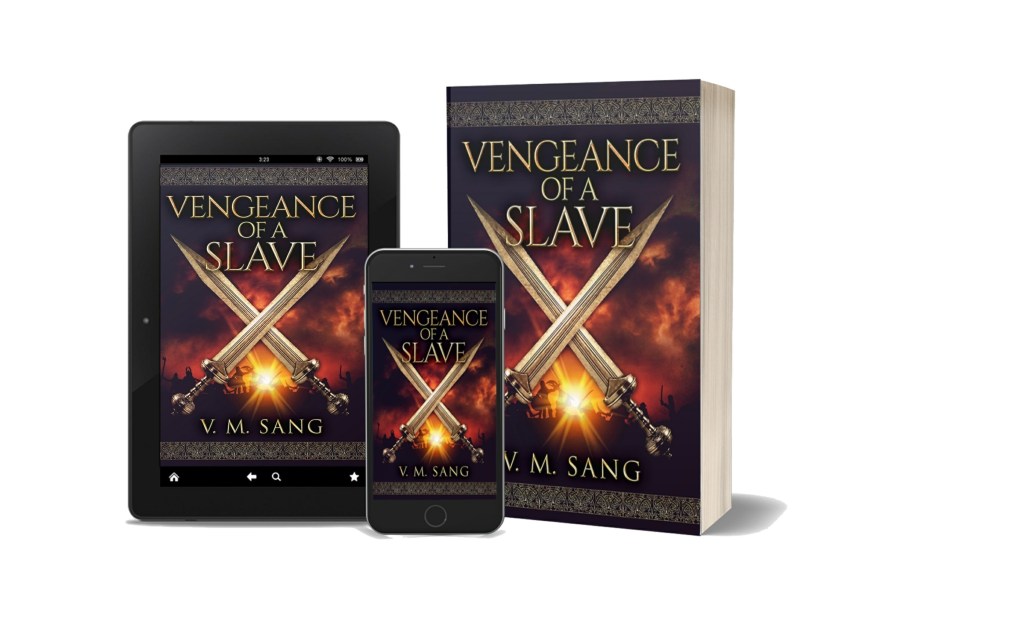
Then I needed to move on. I needed to get my family from the York area to Derbyshire. I did this in the next book in the series, Jealousy of a Viking.

Helgha is a descendant of Adelbehrt. She is half Danish and half British, her father having come over with the Great Heathen Army that I wrote about the other week. Most of the so-called Vikings who lived in that part of Britain were Danes.
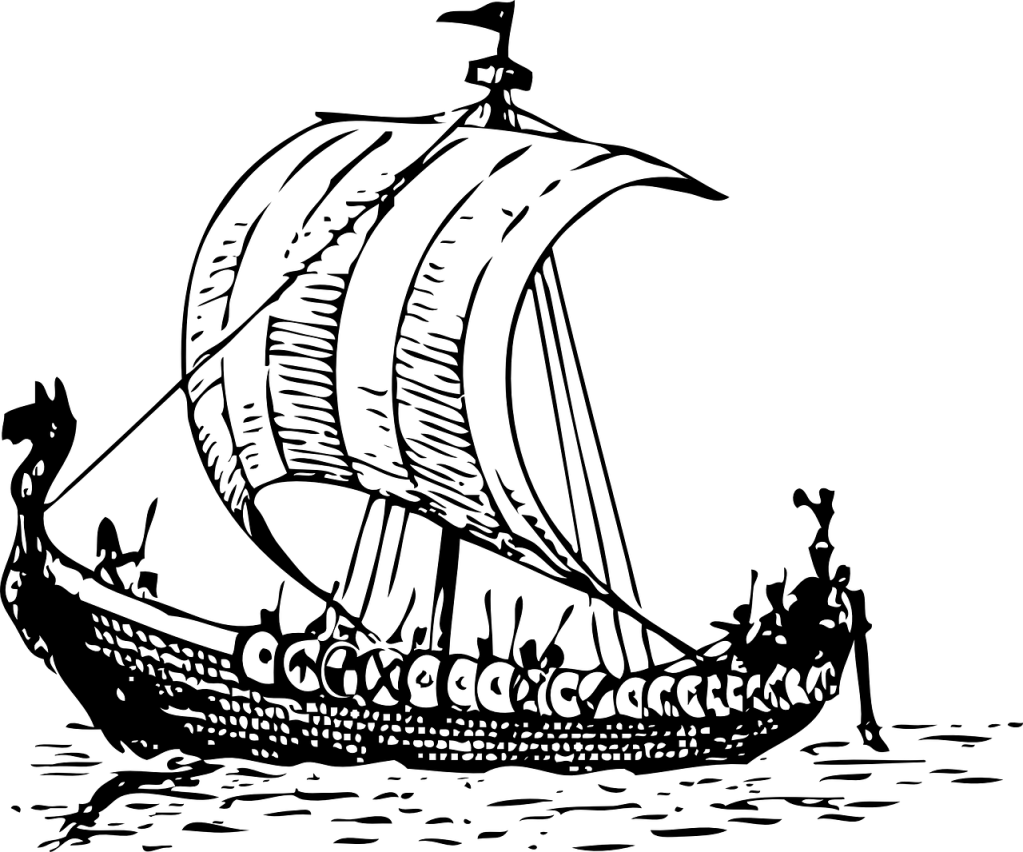
Helgha falls in love with Erik, the son of a jarl (Viking noble) in Jorvik (York). They cannot marry because of the difference in status. Erik must marry for political reasons, and when he does so, Helgha finds herself wracked with jealousy.
She does some pretty unpleasant things, as does Erik’s wife, who is jealous of Helgha, who has Erik’s love. It all turns out badly, and Helgha has to flee with her two sons by Erik where she ends up in Mercia, a part of central Britain where the Danes have no jurisdiction.

But all is not smooth here either. She has to undergo trials similar to those she met in Jorvik, and overcome her tendency towards jealousy.
Currently, Jealousy of a Viking is with the publisher so I will keep you informed as to what is happening with it. This one I describe as adult as it has some scenes that might upset some people.
If you wish to read Vengeance of a Slave, click on the title of the book, or the cover in the side bar. It is available in most formats, including audio and large print.
Please leave your comments in the comments box.
I send out a newsletter every 3 months with news of my writing, new releases, cover reveals and the occasional exclusive short story. If you would like to join, please click the button below.
WARNING.
It seems that on occasion, the latest upgrade for Windows 10 is causing serious problems, like losing all your files!
This has happened to my husband, but not to me. I don’t know why it’s only happening to some computers and not others.
It seems that Microsoft know about this, and I hope they are working on a solution, other than their suggestion you install 365, which is a subscription program, costing you £7 a month, forever! And they can put it up at any time they want, of course.
You can find out more by searching Windows 10 update causing crash, or similar.
I hope this has not happened to you. You can, of course, disable automatic updates. You can find out how to do this easily from the net.
I’m not a computer expert, and so I cannot tell you any more than I have already here. Just beware, that’s all.
The origin of the Limerick is uncertain. I read that it was around in the thirteenth century, but the rhyming sequence was different, and so I ask, “Can they be called Limericks?”
Some sources say it came from an Irish soldiers’ song called “Will You Come up to Limerick.” People made up verses as it was sung.
They may also have been a way for people to remember things. It’s easier if there’s a known rhythm .
It was made popular in England by Edward Lear who wrote his “Book of Nonsense” in 1846, although he did not call his poems limericks, but Nonsense Verse.
Wherever the name and the poems came from, they are an important part of our culture, and the form appears from nursery rhymes to songs.
Limericks were typically rude and bawdy, but as this is a family-friendly website, I’ve kept mine clean. I hope you enjoy these two.
I was inspired to begin to write this form of poetry by reading many written by Kevin Morris, who seems to be the Edward Lear of today. Thanks Kevin.
So without more ado, here are my poems.

One day as I played my violin
The door opened and Mother came in.
She said with a frown,
“Please put that thing down.
Nobody likes your vile din.”
Difficult maths is my pride.
I can solve it when others have cried.
Cone volume divining,
Circle area refining.
I think you can say it’s pi-eyed.
If you enjoyed my limericks, (or even if you didn’t) please add a comment in the comments box.
If you would like to buy any of my books, simply click on the cover in the sidebar and it will take you to Amazon where you are.
All are available in ebook and paperback format, with some also in hardback and audio.
I send out a newsletter every 3 months with news of my writing, new releases, cover reveals and the occasional exclusive short story. If you would like to join, please click on the button below.

It is 865, and Britain is invaded by a largely Danish army. This is different from the hit and run raids the Vikings previously made. A large army intent on conquering has come to the country.
This is a very loose interpretation of what happened, as told by one of the warriors who came over.
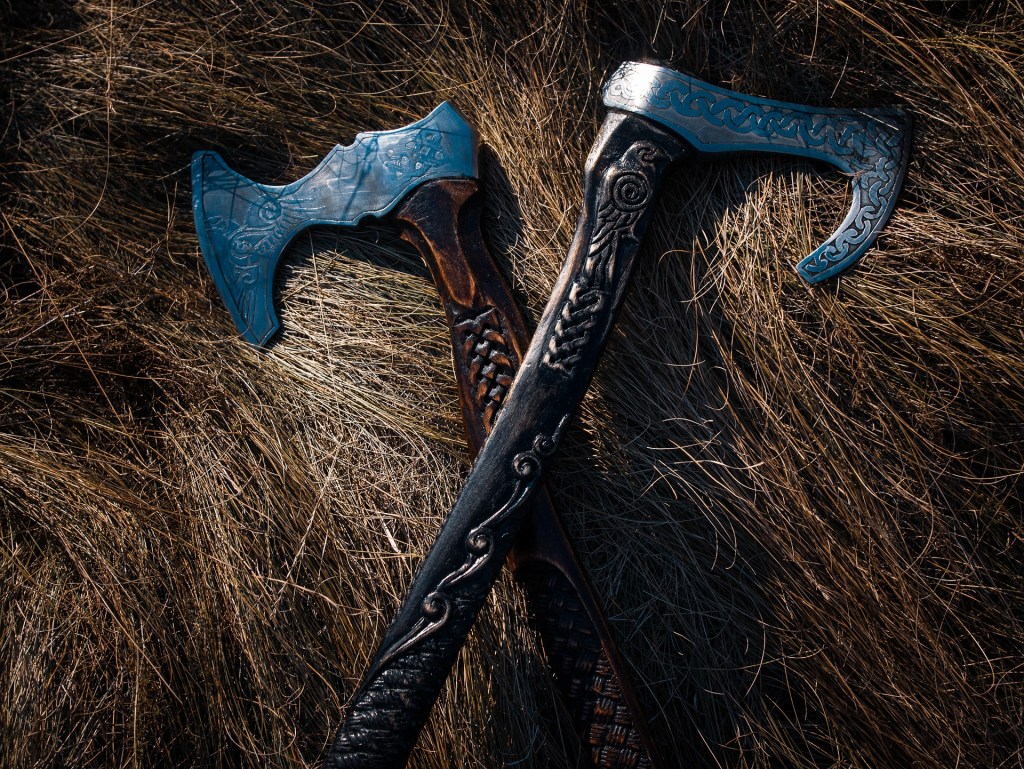
The flickering light from the flames in the firepit made the shadows dance. Outside darkness was falling as we waited, drinking and singing in the longhouse, to hear about the raid Ragnar Lodbrok had made on the country of Northumbria.
Halfdan Ragnarsson sat in his father’s chair at one end of the firepit. He held his horn of ale aloft as he toasted the scald, who had sung of the prowess of Ragnar Lodbrok.
As we sat drinking and singing, the door burst open and a young man entered. He flung himself before Halfdan, who, as the eldest, was in charge while his father was away. I could see the man trembling even from where I sat at the far side of the fire. He spoke in a low voice so I could not hear his words, Halfdan roared, leapt to his feet and threw his horn into the fire. The ale sizzled as it hit the flames and clouds of smoke arose, making those around cough.
He passed his hand over his eyes before speaking. “My friends. This man has brought us dire news. My father, and your king, Ragnar Lodbrok is dead. Killed by treachery.”
A gasp ran around the assembled people and several of the women began to wail.
Halfdan held up a hand for silence. “When he met with Ælla, king of Northumbria, he was defeated.”
Several people shook their heads in disbelief. I found myself joining them. How could anyone have defeated the Danes and captured its leader?
“That’s not the worst.” Halfdan’s eyes were blazing now. “Not only did he capture my father, but he threw him into a pit of venomous snakes. He killed a captive king.”
A great roar went up. I heard myself begin to shout. “Vengeance. We must avenge our king.”
Everyone took up the chant and soon the whole longhouse was on its feet chanting “Vengeance! Vengeance! Vengeance.”
Halfdan smiled at our response. “I will contact my brothers. We will raise a great army and set sail to teach this king Ælla, a lesson he won’t forget.”
So began the preparations for the invasion. Halfdan’s brother, Ubba brought some of his Frisians and men from Scandinavia, while Ivar, known as The Boneless brought more men from Scandinavia.
We gathered ships, filled them with men and set sail. We were lucky with the wind and the seas. The wind blew us westward and the seas remained calm.
We landed in East Anglia. What a dismal place. All swamp and wetness. The wind, which had propelled us so easily across the sea, now became a thing to curse. It cut through our clothes and skin right down to our very bones. But we were here to avenge our king, and so, as Danes, we bore it stoically.
We camped on a higher piece of land that was relatively dry, having pulled our ships up the beach. On the second day, riders approached our camp cautiously. They pulled their horses to a halt and one man rode forward a few paces.
“Hail,” he called. “We do not wish for war. May we come and discuss peace terms?”
Halfdan laughed at this. “Weak Anglo Saxons. Can’t they fight like real men? ”
Ivar shrugged. “It’ll do no harm to talk to them. After all, perhaps we can persuade them to help us.”
So the men rode into our camp and tethered their horses. Halfdan, Ubba and Ivar came out of their tent and stood before the Anglo Saxons. They all stood, arms crossed and feet wide apart, with armour, helmets, and battle axes slung across their backs.
Halfdan glowered. “What do you want?”
The man who had spoken previously stepped forward once again. “We do not wish for a battle. We are willing to trade for peace.”
Ubba laughed. “Suppose we ask for men to bolster our army?”
The Anglo Saxon paled. “Th-that is unacceptable. We want to live in peace and not at war. This is a difficult land for fighting. We know it well, and you are strangers. It is easy for people who do not know the land to get lost and die in our bogs.”
“Who are you? Do you have authority to negotiate?” Halfdan said.
The man drew himself up to his full height. “My name is Edmund. I rule this land.”
The brothers looked at one another “Come into the tent and we will negotiate.”
I did not hear the negotiations. I’m not important enough to be allowed in the tents of our leaders, but the outcome was that this King Edmund would supply us with horses and allow us to over-winter in his kingdom.
We moved farther inland to a small village. The river was shallow enough for a ford here, which was why the village had grown up there. Theodford, they called it. People’s ford. We stayed there for all the winter. Cold, it was, and that east wind kept on blowing. But there was little snow. But we’re Danes and can manage such privations.
We celebrated Yule in true Danish fashion. There was much feasting and drinking, the goods for which we plundered the surrounding countryside.
Everyone looked forward to the fights to come, and we gave much discussion to how we would punish Ælla when we captured him.
Our king, Ragnar, must have died a horrible death in the snake pit, so the death of Eoforwic. must be equally horrible, but I will come to that later.
The Anglo Saxons were true to their word and gave us horses and we eventually rode north, toward Northumbria and our real goal. The Anglo Saxons had a large city they called Eoforwic. I believe it had been founded by the mythical Romans a long time before, but when those people disappeared, the Anglo Saxons took it over and changed its name.
Halfdan told us he would attack on November the first.
Why that date? Well, he had learned it was an important date to the Christians. One where the honoured their saints. They would all be in Church and so the conquest would be easy.
He was right. Eoforwic fell to us easily. As it was now getting towards winter again, we decided to stay there for the cold months and then move against Ælla in the spring.
Halfdan also decided that having captured the capital of this part of Britain, he would settle here and make this land his own. He put a puppet king onto the throne, to give the people the illusion they still ruled themselves, but in fact, Halfdan was the true ruler. But as many of us could not readily pronounce Eoforwic, we started calling it Jorvik.
Look out for the next instalment of the story of The Great Heathen Army.
Coming out soon is the next book in my Family Through the Ages books. It is set in Britain, around Jorvik (York), beginning a few years after the Great Heathen Army’s invasion and follows a young Danish girl, a descendant of Adelbehrt from Vengeance of a Slave.
Here is a preview of the cover for this book.
I send out a newsletter every three months telling people more about me and my writing. If you wish to sign up, click on the button below. You will receive previews of covers, notification of special offers and occasional exclusive stories. Also you will receive information about when my books are due to be published.
I welcome comments, so please add yours to the comments box.
Do we underestimate the intelligence and power of thought of animals?
This post from Bluebird makes me wonder.
Watch the cat imitate its owner’s coin trick.

I was delighted to receive a review copy of the latest book by this talented young author. David Kummar has written mainly in the Horror genre up until now, but this book is very different. It is a coming of age story, but that does not tell us very much about it.
There are three teens in the book. Best friends.
Hudson is a troubled character. He is the only child of a couple struggling to make ends meet. His father has a job in one of the local factories, at the same time farming their small-holding. Hudson wants to leave the small town of Little Rush. At least that’s what he says. He also has thoughts of suicide, although he is unsure if he wants to do it or not.
Mason is his friend and the son of one of the rich property owners in the town. His ambition is to remain in the town and to take over his father’s business. A typical rich teen, the relationship between him and Hudson is somewhat difficult at times.
Willow is Mason’s girlfriend. She is beautiful, but from a broken home. Her parents live separately in the poorer parts of the town. She also wants to leave Little Rush as soon as she can.
The three get up to the usual kind of things teens will do, drinking and smoking and generally being a nuisance.
Their life changes when a popular film star decides to retire to the town. Everyone is excited, but is he all he seems?
Little Rush is a sleepy town on the Ohio River. Bruce Michaels is a renowned Hollywood actor. The two should never cross paths, yet one summer everything changes. The actor, haunted by demons, chasing a ghost. The town, unaware. Until the two collide.
Hudson, Willow, and Mason are high school seniors with very different upbringings, but all on the verge of adulthood. As the sun sets on their final summer, questions abound. Will they ever leave the town? Is there a future here? As their plans waver, time is running out.
The struggle of mental illness.
As he loses his friends and sinks deeper into depression, Hudson forms an unlikely bond with the actor, Bruce Michaels. But the old man is a ticking time bomb. As Hudson relies on him more, the danger to them both grows.
When dark secrets are revealed, Hudson must confront the truth about his idol and himself. Bruce Michaels isn’t who he seems. Hudson is nearly lost. And in the end, they may be more similar than different.
The search for meaning.
Different paths, converging in a web of alcohol, fights, and romance. Worlds collide one summer in Anywhere, USA. The question is who will make it through.
EVERYTHING, SOMEWHERE is an ambitious, sprawling look at the stories, people, and places forming the nuanced landscape of rural America.
David Kummer has researched his topic well and shown us the despair of people suffering from mental illness.
The characters are all believable and real, with very human frailties. For such a young writer, he has empathised with them extremely well.
Michaels is tormented, as is Hudson, for different reasons. What is the secret Michaels conceals? The budding relationship between the old man and the young one is very real. Michaels can see himself in Hudson, and their conversations seem to be a help to the young man, but what will happen when Michael’s secret finally comes out?
Mason is a typical rich kid on the surface, but he has hidden depth. How can he keep the woman he loves from leaving the town? Will he have to give up his own wishes and go with her?
Willow is a confused young woman who desperately wants to leave the town, but not the one she loves. How can she reconcile her dilemma?
The other characters, I hesitate to say ‘lesser’ as they all play an important role are also fully formed. There is an unlikely friendship between Mason’s father and Hudson’s father. Two very different characters.
On the whole, the writing is good. One thing that I did find slightly jarring with is Kummer’s use of the word ‘just’. He does use it a lot, but that’s not a major problem. Many people wont notice it as it’s the way so many speak.
I had a clear picture of the town in my head from the way Kummer has described the town and its surroundings.
An excellent read. I found myself anxious to get back to it whenever I had to stop reading for whatever reason. The story is one that lingers in your head long after you’ve finished reading it. Well worth the money spent on a purchase.
I give it 5*.
The book came out on April 25th.
If you liked this review, please consider leaving a comment in the comments box.
Sally Cronin has shared the release of The Vanished Boy by Harmony Kent. I thought you might like to know about it, too.
Delighted to share the release of the latest book by Harmony Kent…The Vanished Boy.

About the book
It’s so remote out here. Anything could happen …
A missed phone call in the night is all it takes.
When Carole’s 18-year-old son goes missing, she breaks into Jayden’s laptop to try to understand his life.
All too soon, Carole discovers just how little she knew her boy.
And when one lead after another dead-ends, the distraught mother has to face the unthinkable.
Sucked into a sticky web of deceit and lies, nothing is as it seems.
When your life turns inside out and upside down, who would you trust?
Please leave any comments in the comments box. I would love to hear from you.
If you would like to join my newsletter to receive information about my writing, new releases, cover reveals etc, please click here. I am also planning on sending the occasional story, too.
This will take you to a page with a link. Click on the link and you will get to the form. As I don’t have a business account with WordPress. I can’t embed the form into my website.
 Dragons Rule OK. V.M.Sang (author)