Tag Archives: nature

British Wild Flowers: The Blackthorn

I was driving along the roads around her a couple of days ago and the blackthorn was in full bloom. It struck me that I’d not posted a British Wild Flowers post for ages.

So let me introduce The Blackthorn.
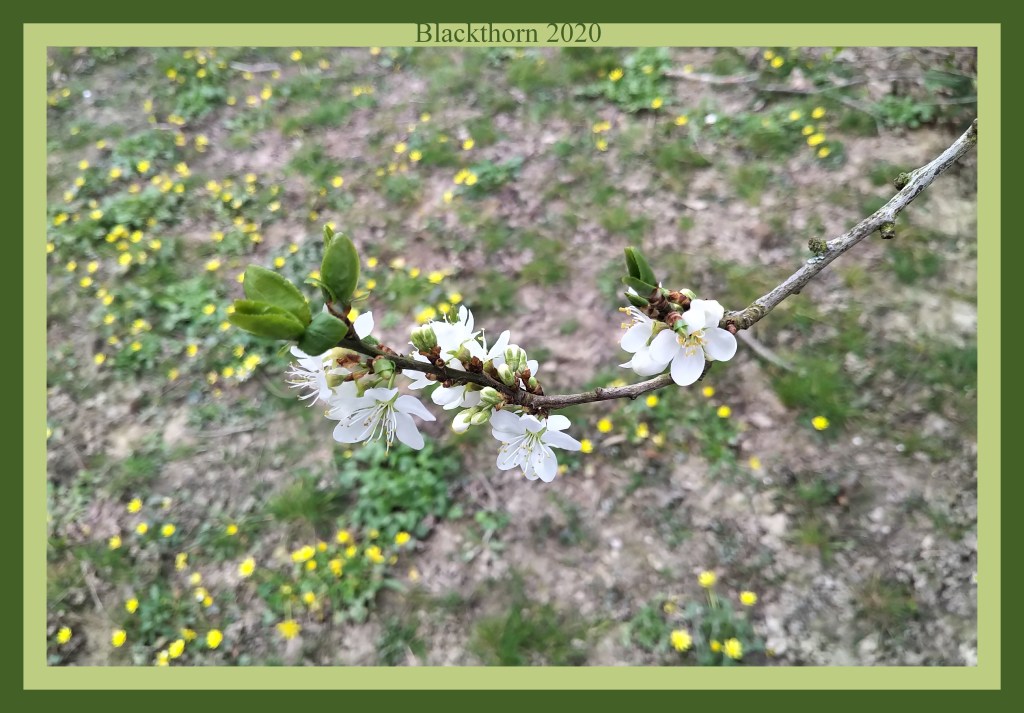
This tree is in flower right now. Large areas of white are visible in every hedgerow around here (East Sussex in the south east of the UK).

It is one of the earliest trees to bloom. I’m calling them trees because they can grow to four metres. Yes, that’s a smallish tree, but I think it’s bigger than a bush! However, because they are often found in hedges, they are trimmed and I’ve not seen a really tall one for ages.

They can live for 100 years, apparently.
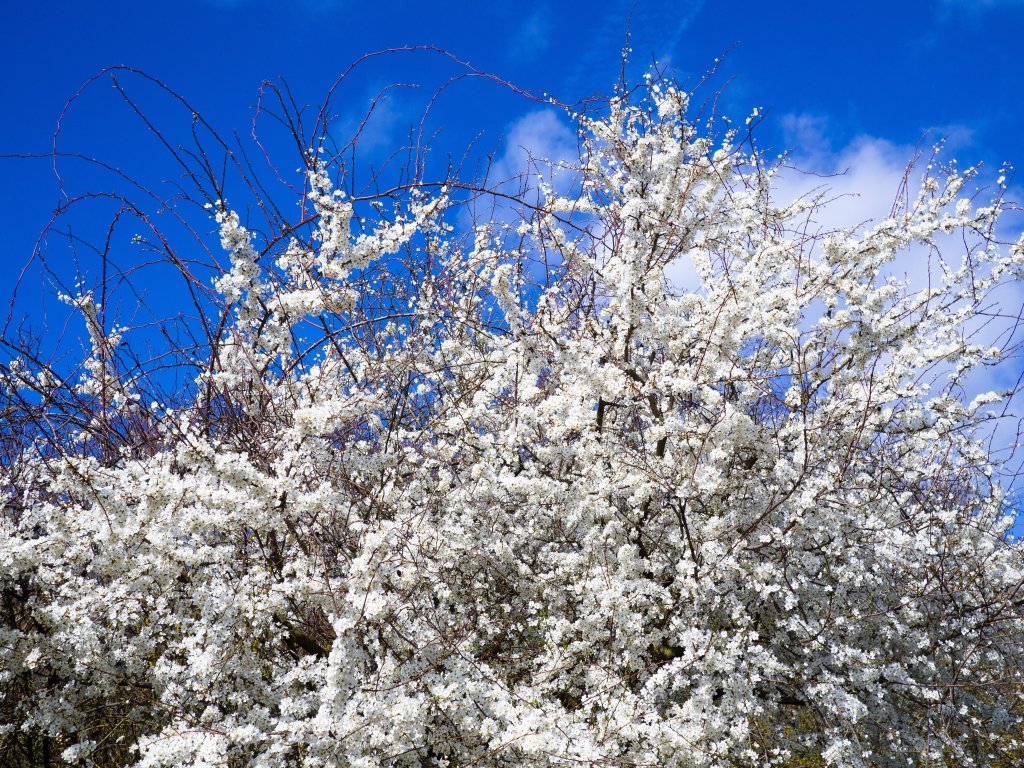
Image by Lenny Löwenstern from Pixabay

They are one of the earliest bushes to bloom in spring, usually around March. As such, they are very useful for insects to find nectar and pollen at this early time. The leaves are also the food for a number of butterfly caterpillars.

As the dense stems are very thorny, they provide an excellent nesting site for birds, and the caterpillars and other insects that eat it become an easy meal for them.

They have been associated with witchcraft and it was said that witches wands were made from its wood. More prosaically, it was used to make walking sticks and it is said to burn well.

In the past it was used to make tonics. Bark, flowers and fruits were used for these.

It belongs to the genus, prunus (Prunus spinosa), and is thus related to the cherry, plum, peach, nectarine, apricot and almond. Like them, it has a fruit containing a stone, but unlike them, you wouldn’t want to munch on them.
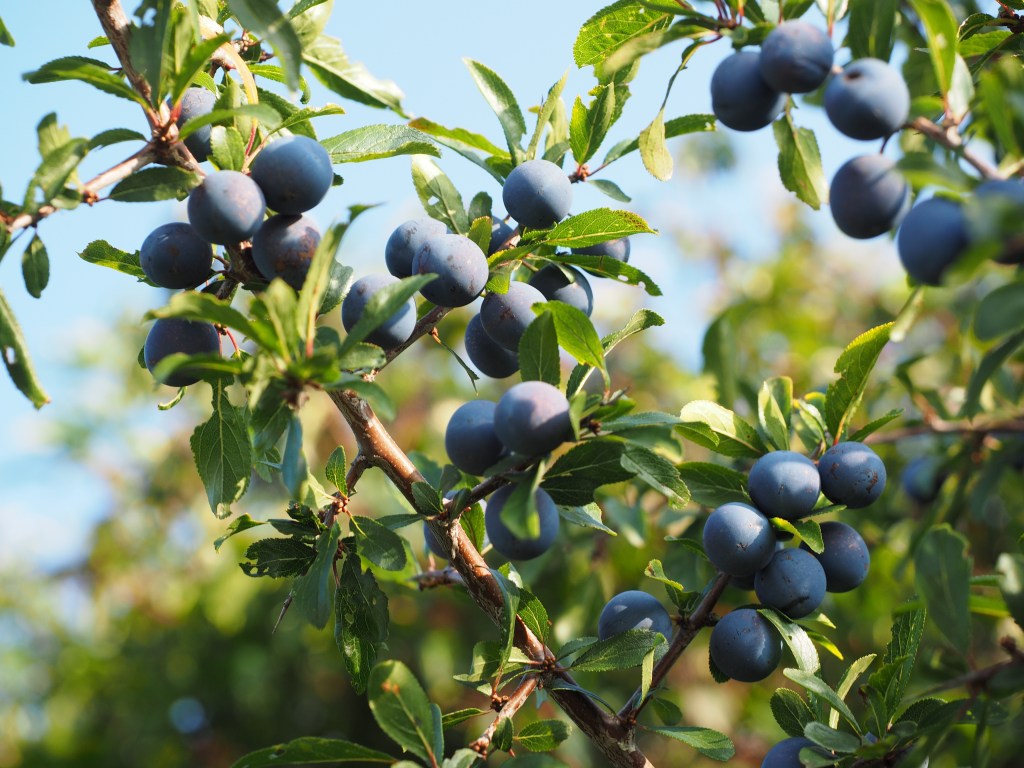
Image by Hans from Pixabay

The fruit is called a sloe. It is a small black fruit , but you wouldn’t want to eat it as it is because it’s very sour and bitter. However, when cooked, it is much more palatable. Sloes are often made into jam and sloe gin.

To make sloe gin, you need 500 ml gin, 250g of sloes and 250 g of sugar. and a 1 litre jar with a tight-fitting lid.

First prepare the sloes by cleaning them and pricking them all over with a fork. I believe that freezing them works, too. This is to break the skin so the juice can escape.

Add the sloes to the jar along with the sugar and gin. Shake it thoroughly. (Don’t forget to put the lid back on first!) Shake daily for the first couple of months, then weekly for about 3 months. Store it in a cool dark place.

The gin will have taken on a deep purple colour and the sugar will have removed the sour and bitterness from the sloes. When the time is over, decant the gin. You can filter it if you wish. Bottle it into clean dry bottles and store in a cool dry place. It continues to improve as it matures, and it’s best drunk after a year. (So prepare this year to drink next!)

Enjoy.

My mum made sloe gin from time to time, but her forte was damson gin. It was made in the same way, except she used damsons instead of sloes. I think that was even nicer!

Thanks to The Woodland Trust and Wikipedia for some of the details of this lovely plant.

There are some more unusual drink recipes in my recipe book, Viv’s Family Recipes, which you can get by clicking on the cover of the book in the sidebar. This book has some recipes dating as far back as 1909 and came from my grandma. Although not things we eat nowadays, long cooking and probably too much fat, it’s interesting to see what kind of things people used to eat.

Have you ever made sloe gin, or any other kind of unusual drinks? I would be interested to find out.

Discover the Beauty of Spring Through Poetry

 I thought I’d write some poems about the seasons. Here is one about spring.

Spring is a lovely month. We’ve lived through the cold of winter and the seeming death of life. Many animals hibernate through the winter and are not seen; the trees are bare; the grass stops growing and many plants die back.

But with the spring, the sun gets warmer and life begins anew. It is an optimistic time of year.

Spring

Dandelions, like gold, cover the meadows.
Newborn lambs frolic in fields.
New leaves on the trees are casting their shadows
And winter’s cold grip quickly yields.

At the edges of woodland the primroses glow
And cowslips their scent fills the air.
Anemones dance when the breezes do blow
And birds sing with never a care.

Then bluebells and campions come into bloom
Their colour the blue of the sea.
The cuckoo, that herald of spring, will come soon,
His call echoing over the lea.

The song of the blackbird is like molten gold.
His notes are so pure and so clear.
Hearing him seems to banish the cold
And brings joy to all those who hear.

Robin is nesting, and other birds too,
The hedgehog is active once more.
The young of the deer and the badger and shrew
Play their games as in old days of yore.

The sun climbs higher and higher each day
Giving more of his heat and his light.
It sparkles like stars fallen into the bay.
All smile at the beautiful sight.

Hope and excitement come with each spring morn.
What blessings will come with this day?
New starts can begin once again with each dawn
And send us all hopeful away.

I hope you enjoyed my spring poem. It can be found in my poetry book, Miscellaneous Thoughts along with many more of my poems, both about the seasons and nature and a variety of other subjects.

If you would like to read more of them, you can click on the book cover in the sidebar, or click the button to take you to the online bookstore of your choice. It is available in ebook format as well as a ‘real’ book.

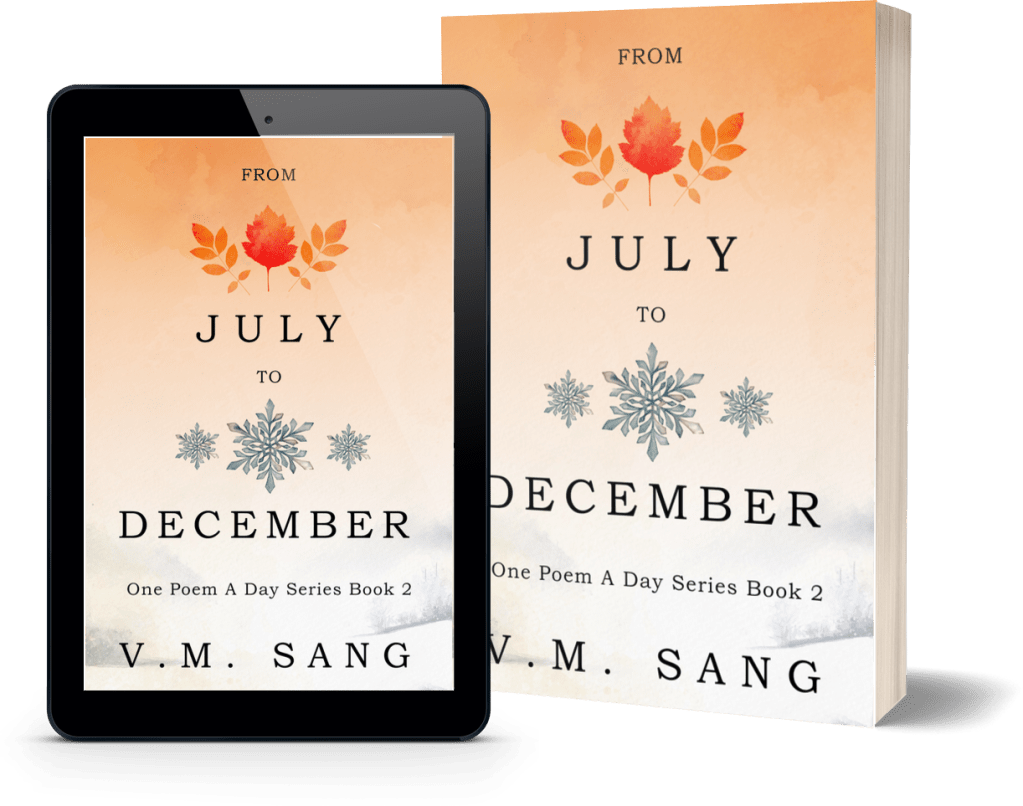
IT’S HERE!

The second part of my One Poem a Day series is now available. It was actually published a couple of weeks ago, but as I was on holiday I couldn’t announce it!

Here is the blurb.

The second book of poetry in V.M. Sang’s One Poem A Day Series takes us through summer to midwinter.

Each day there is a poem to read. These poems are often related to the season, for example, Harvest, or the first flight by the Montgolfier brothers, and of course, Christmas.

The poems are varied in type and length. There are haiku, haibun and tanka, limericks, sonnets, odes and narrative poems among the collection. Some poems are comments on serious subjects, while others are amusing and entertaining.

Many of the poems in this collection are in the traditional vein, so if you enjoy this type of poetry, this book is for you.

An example of two of the poems.

July 4th

We recently had family to stay. Here’s a poem about families.

Family

Brothers, sisters, cousins too
Some of whom we barely knew
As one by one the family grew.

Family feuds, we all fell out
Little sister, she did pout.
Cousin Johnny started to shout.

Susie said ‘I hate you all.
And I hope that you might fall
And get caught out in a squall.’

Brother Robert raised his fist.
‘Don’t you speak to us like this.’
Narrowed eyes, voice like a hiss.

Sister Jane came rushing in.
‘They have started bullying Jim.’
Quarrel stopped. He’s our kin.

So we went to sort them out.
When they saw us, ’twas a rout.
They will run away, no doubt.

We fall out, of that it’s true.
And we say things that we rue.
But family is strong. We knew.

“All for One and One for All.”
We stand together or we fall.
Petty quarrels, they will pall.

July 5th.

A small bumble bee has been pollinating our raspberry plants all by herself. At least, I didn’t see any other insects around them. Here’s a Haiku.

Little bee.

She sips sweet nectar.
Proboscis deep in the flower.
Raspberries will come.

The book is available from the following retailers, currently priced at 1.99

Kobo, Barnes and Noble, Google, Apple, and Amazon

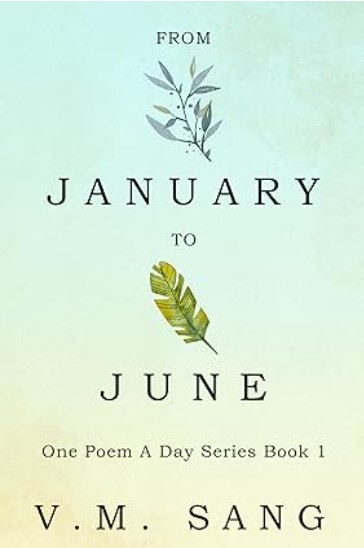
Book 1, From January to June is available by clicking the book title. It’s free, so you can get both books for 1.99

The blurb

Take a lyrical journey through the first half of the year with V.M. Sang’s FROM JANUARY TO JUNE.

This anthology captures the essence of everyday life, nature, and the world around us through the versatile medium of poetry. From haiku to narrative poems, and the humour found in limericks, From January To June is a diverse collection of poetry.

A calendar in creativity, a diary in verse; this collection is the perfect companion for daily reflection and inspiration, providing a poem for each day that resonates with the diverse experiences of life.

And a review.

Sashadoo

5.0 out of 5 stars Clever and unusual, a unique blend of poetic styles

Reviewed in the United Kingdom on 9 December 2023

Verified Purchase

I thoroughly enjoyed this unique collection of poetry from V M Sang. I say unique because it’s rare to find such an eclective collection of different styles, forms and subjects in one one book, all by the same author. From Haiku to full length poetic pieces, covering a wide range of topics from the weather to personal feelings and the rare beauty found in the morr mundane, everyday events in the poet’s life. Definitely something for everyone and I have no hesitation in recommending the book and giving it a 5 star review.

Current Amazon ranking, June 4th 2024