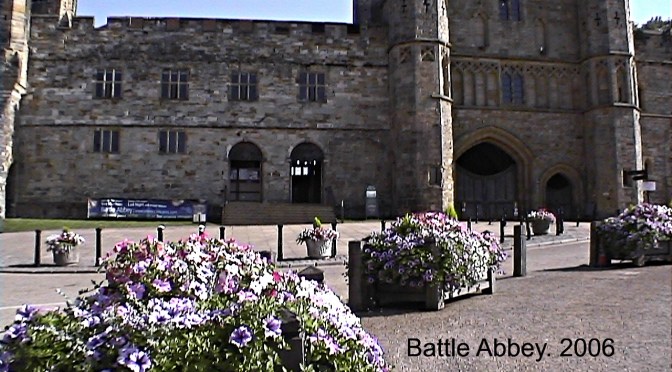
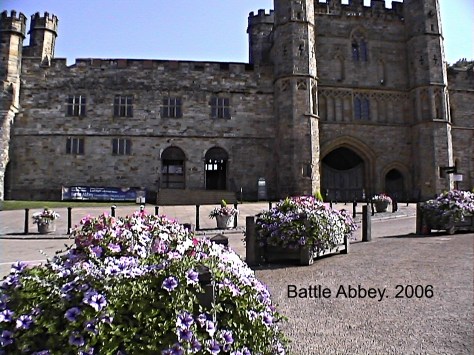
Today is the 959th anniversary of the Battle of Hastings. This is probably the most important battle in the history of England. It changed our country forever. But before I begin, I would like to state that I’m not a historian, and so I might have some of these things wrong, especially where people have the same names!
Edward the Confessor was born between 1003 and 1005, the son of Æthelred the Unready and Emma, sister of Duke Richard of Normandy, He died in January 1066 and had been king from 1042.
The politics of this time is complicated, and so I will try to simplify it as much as possible. (This is to clear things in my own mind as much as anything!)
Æthelred the Unready (which means poorly advised) was deposed as king by the Danish king, Swein Forkbeard. He fought, but eventually fled to Normandy. Swein took the English throne.
When Swein died in 1014, his son, Cnut became king of England and Edward, his brother, Alfred and sister Godgifu, joined their parents in Normandy. Edward, Alfred and Godgifu remained there for 24 years and were looked after by their uncle, Duke Robert.
When Cnut died in 1034, he was succeeded by his son, Harold Harefoot, and later by another son, Harthacnut. Hartharcnut was, in fact, Edward’s half-brother, his mother, Emma, having married Cnut after the death of Æthelred.
Harthacnut died suddenly, and that left the way open for Edward. He sailed to England and became king. He wanted to unite the Danish people in England with the Anglo Saxons.
Edward became peaceful Man of God, hence the name ‘Confessor’ that was given to him.
In 1045, Edward married Edith, the daughter of the most powerful earl in England. Earl Godwin had gained his power under Cnut, and wanted to hold onto it. Marrying his daughter to the king was an excellent way to do so. But she was very much younger than Edward, and some said it ws more like a father daughter relationship. Whatever the case, they had no children and there is speculation the marriage was never consummated.
Because of his early life spent in Normandy, the king naturally wanted his friends from that time to join him. Earl Godwin saw his power begin to wane, and he had a big fallout with Edward and went into exile.
He did return, however, and patched up his differences with the king and they seemed to be of similar mindsets from then on.
but Edward and Emma had no children, so what was going to happen when he died? Well he had a nephew who had been in exile in Hungary (another Edward). King Edward sent for him, but he sadly died on arrival, leaving his son, still a young boy, as heir to the throne. This boy was known as Edgar.
Duke Robert of Normandy, had an illegitimate son called William, but no legitimate heirs as he never married. While on pilgrimage to Rome, he died, and his son became the Duke of Normandy, often known as William the Bastard. As he was a cousin to Edward the Confessor, he also had a claim to the English throne.
The Normans claim that Edward declared William to be his successor .
Harold Godwinson, son of Earl Godwin, was sent to Normandy to tell William, and he was captured by the French. William effected his release, and Harold swore loyalty to William.
In January 1066, King Edward died. It is thought that the queen, Harold Godwinson, who had now inherited his father’s title and lands, and Archbishop Stigand were present, and Harold claimed that Edward had nominated him as his heir. Of course, the Queen, being Harold’s sister, would more than likely uphold what he said.
When this came to the ears of Duke William, it triggered his anger, and he began his plans for invasion, leading to the most famous battle in English history, the Battle of Hastings. (Which incidentally, didn’t take place at Hastings, but at Senlac Hill, at a place where there is now a town known as Battle.)
Discover more from Dragons Rule OK. V.M.Sang (author)
Subscribe to get the latest posts sent to your email.
 Dragons Rule OK. V.M.Sang (author)
It almost reads like a fantasy novel, Viv. Lol. English history is fascinating and intriguing, and these kinds of posts just make me want to know more about these people and their lives. Thanks for the history lesson!
LikeLiked by 1 person
The politics of that time is rather complicated. I think I wrote that as much to clear it in my own mind as it’s the skeleton of my new WIP. Which isn’t a fantasy novel this time, but historical. It actually begins with the battle of Hastings, but I felt I needed to know more about what led up to it. I’m currently reading an excellent book about it, called The Battle of Hastings, but can’t remember the author.
LikeLiked by 1 person
Sounds fascinating, Viv. It is complicated, partly because of the repeat of names. I lose track.
LikeLiked by 1 person
A critiquer was obviously confused at one point with Harold Godwinson, King of England, and Harald Hardrada, King of Norway. I had to do some work on it to make it clear. It can be confusing. Unfortunately, when introducing real historical characters, we don’t have the advantage of choosing different names that don’t sound the same.
LikeLiked by 1 person
Ha. That’s true. 😀
LikeLiked by 1 person
😄
LikeLiked by 1 person
This has been a fascinating read, thank you.
LikeLiked by 1 person
Glad you liked it.
LikeLike
I know of the battle of hasting but I didn’t know this history. Thanks for sharing it, Viv. Very interesting.
LikeLike
It was arguably the most important battle England has ever faced.
I’m glad you enjoyed the post.
LikeLike
Yes, you are right
LikeLiked by 1 person
I recall that Edward the Confessor was England’s patron saint before St. George. Henry III (son of King John) was such as a fan of him that he named his first son after him (that son would go on to be King Edward I, aka Longshanks). Both reasons are why the name Edward remained popular when most Anglo-Saxon names didn’t.
LikeLiked by 1 person
Actually, the patron saint before St George was St Edmund who was King of East Anglia. He was martyred by the Danes (aka Vikings) in the 9th century for refusing to renounce Christianity. He was tied to a tree and shot full of arrows. The town of Bury St Edmunds, in Suffolk is named after him.
LikeLiked by 1 person
My mistake.
LikeLiked by 1 person
Easy mistake. The names are similar.
LikeLiked by 1 person