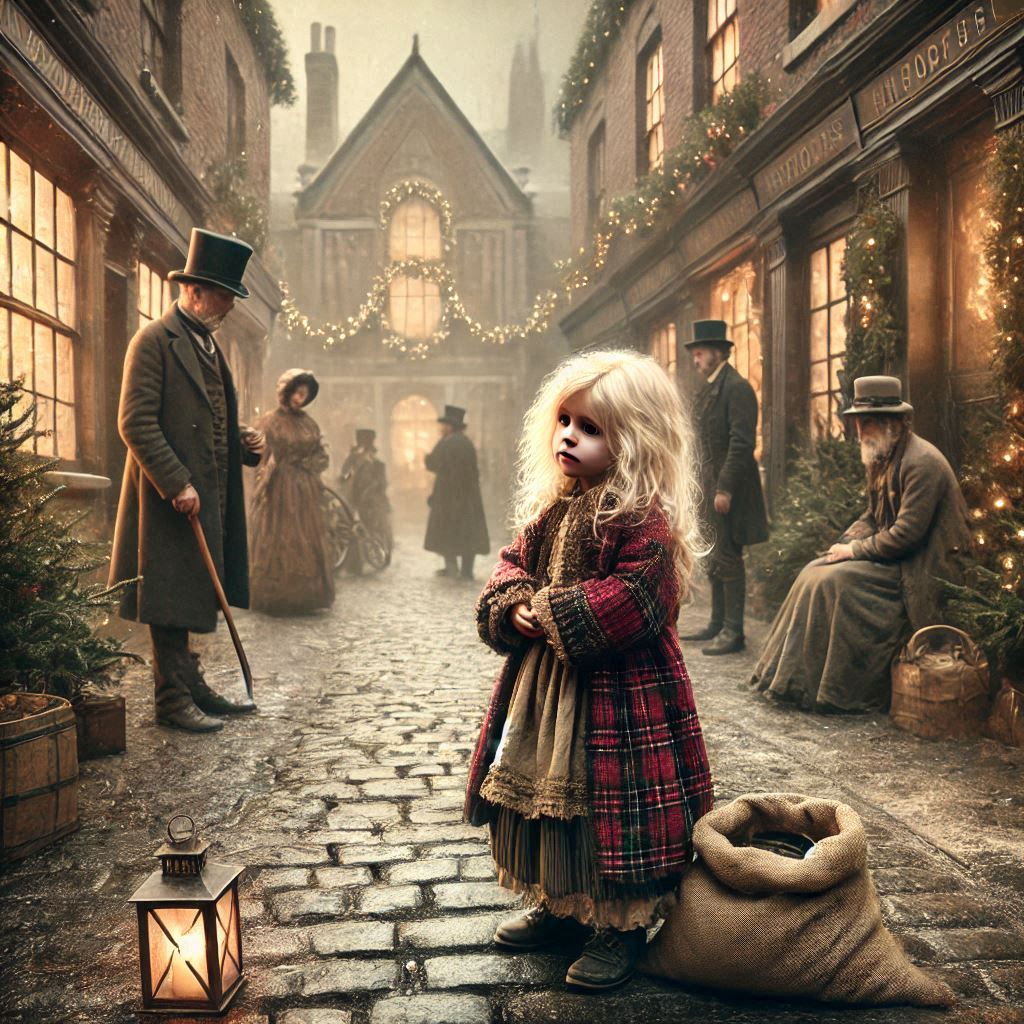
Image created by V.M.Sang using Bing AI image generator.
They had not eaten all day, and Goldie’s stomach growled. She crossed the room to where Annie stood with a cauldron. As she approached, Annie lifted a bowl and spooned some of the contents of the cauldron into it. She handed it, along with a spoon and a slice of bread, to Goldie.
Goldie looked into the bowl. There was what looked like a piece of fat and a few carrots floating in a greasy liquid. She sat on her mattress and spooned some into her mouth. It tasted like it looked; a greasy, watery liquid with very little sustenance. But she was very hungry, so she wiped the stale bread around the bowl and forced the meagre repast down. When she had taken the bowl back to Annie, she lay on her pallet. Still hungry, she fell asleep.
The next few weeks were the same. She went out with Jack and sat next to him on a pavement somewhere richer folk would pass. He told her that Mr Smith was very pleased with the money they were making. Soon he was going to let Goldie go out on her own.
She shivered at that thought. Yes, Jack had taught her the things to say, how to say it and what to do, but the thought of being out there on her own made her tremble. What if she was no good at begging? She had seen enough to know that Mr Smith would make no concessions for a novice. She had been lucky so far and had not been beaten, but if she did not make enough money, she would certainly feel the switch.
She crept out on her first day. Where to go? It was not Sunday, so it was no good going to a church. The shops. Yes. She would go to the shops. Sometimes people bought food for her from one of the stalls.
I hope Mr Smith doesn’t find out about the food. I don’t think he’d understand.
She sat on the pavement and shivered. Winter was on the way. Her clothes had become even more ragged in the weeks she had been in Mr Smith’s ‘employ’, as he called it. She was permanently hungry, and getting even thinner than she had been when she first started ‘working’. A tear formed in the corner of her eye. Her stomach rumbled. It did nothing but rumble these days. Mr Smith and Annie gave them enough food–just. How she longed for a full stomach. Or a fullish one would be enough.
Here comes a kind-looking woman.
Goldie let a tear fall. “Missus, a coin please. I’m so very hungry.” That’s true. “I have no home. No one to feed me. Please. Just a farthing.” She held out her hand.
The woman walked past, drawing her skirts in as she did so.
Not kind at all.
The next three people passed with barely a glance at her.
A man threw a penny in her direction. It struck her on the arm. She rubbed it and went to pick up the penny.
As she did so, she heard the man say to his companion, “I don’t know why these beggars are allowed where decent people live.” He glanced at Goldie. “But one has to do one’s bit. I give alms as the Church says we should.”
I bet he’s never been hungry.
The men disappeared around a corner.
A costermonger pushed his barrow along the street. He had fruit for sale.
I wonder if I have enough to buy an apple. She looked at the few pennies, halfpennies and farthings she had collected. No. I don’t want to be beaten.
That evening, after eating the thin gruel Annie provided, Mr Smith came to her mattress. She cowered. What had she done?
“I knew you would be good. Folks are sorry for a pretty little girl. That was a nice haul you got today.” He stared at her with his eyes narrowed. “You must do the same tomorrow. Make them feel extra sorry for you. Mebbe you can get some silver coins. Threepenny bits, tanners or even a shilling. You work on ’em. Here.” He handed her a bowl and spoon. “Some extra as a reward.”
Goldie stared at the gruel, then, dipping her spoon into it, she gobbled the foul stuff.
That night she slept badly. She shivered, and not only from the cold. What would Mr Smith do if she did not get any silver coins? Would he take the switch to her?
The next day her fears were realised. It was cold, and snow began to fall. The middle classes stayed at home, except for the men rushing to work, and rushing home again.
Goldie pulled her shawl closely around herself, but it made little difference. People were too anxious to get home out of the snow to think about the little girl on the street corner. She dragged her feet on her way home.
“You must have spent some of the money.” Mr Smith’s eyes blazed. “You can’t have only got this much.” He tipped the two pennies and one farthing onto the table.
“It snowed.” She began to cry. “Everyone hurried past.”
“Well, I don’t believe you.” Mr Smith reached for his cane. “You spent some.”
That night she felt the switch for the first time.
Swish “One.” Swish. “Two.” Swish. “Three. I’ll be lenient and stop at three, but if you spend any more of my money, you will get the full six.” He leaned the cane against the wall and left.
Sobbing, she lay on her stomach. Her back burned. She reached around and her fingers came away bloody. She had not had anything to eat. Mr Smith had refused to allow her any gruel.
A shuffling made her turn. One of the other children, a girl of nine, crouched by Goldie’s pallet.
She held a bowl half full of gruel. “I knew he wouldn’t feed you tonight so I saved some of my food for you.”
Goldie sat up and passed her hand over her eyes. “Why?”
“Why what?”
“Why are you giving me your food?”
“Mr Smith is a bad man. He treats us bad. But it’s better than the streets. Lots die in the cold out there. Lots get other horrid things done to them. Lots become cripples. I like you, so I give you some food.”
Goldie had not heard this girl say so much before. She had always been quiet.
She took the bowl. “Thank you.” She put it to her mouth and drank the thin broth. Although it did not satisfy her hunger, the empty feeling went away a bit.
This was written in response to Sue Vincent’s photo prompt. The word was RETURN and here is the photo.
Leaving the Land
“I want to go to university and study economics.” I sat with my fork poised to put a piece of Mum’s delicious roast beef into my mouth. My father put his knife down and looked at me. “I always thought you’d take over the farm when you left school. You’re a good farmer. You love the animals and they like you.” “Yes, Dad, that’s true, but there’s no money in it. You know that better than anyone.” He sighed. “You’re right there. But it’s still a good life. Out in the fresh air, growing food for people to eat and being your own boss.” I nodded. “And getting up at the crack of dawn every day. Sometimes during the night when a cow’s calving. Then working hard all day, so that you’re too tired to do anything in the evenings. And you can’t go on holiday without arranging for someone to come in and feed the animals and milk the cows.” Mum stood and took our plates. “It’s home-made treacle tart for pudding. Your favourite.” I grinned. “What do you think, Mum?” “You should do what you want, darling.” She carried the plates through to the kitchen and called back, “I only want you to be happy.” Dad called back, “So do I, Lily. If he want to go to University then he should go. He can earn a lot more as an economist than a farmer.” “Then why did you say that about thinking he’d take over the farm?” Dad shrugged. “Dunno, really. I think I always knew he was cut out for something more than we’ve got here.” Jenny, my sister, interrupted him. “Are you being sexist, Dad? What’s wrong with me taking over the farm?” Dad raised his eyebrows. “I’d not thought about that. I kind of assumed you’d marry and not want to.” Jenny pressed her lips together. “Well I can do just as well as Tom. And I’ll prove it if you let me.” Dad agreed to let Jenny help. She was only two years younger than me, and strong. She also loved the cows and had recently been raising a few chickens and selling the eggs. After my A-Level results came in, I had done well enough to be offered a place at the London School of Economics, and so that October I packed my suitcase and set off for London. The excitement I felt as I waved to my parents, standing on the station platform was like nothing I’d felt before. I was off to the capital city. All the freedom in the world was mine. I no longer had to tell anyone where I was going or why, nor when I would be back. I had found a place in a Hall of Residence only half a kilometre from the College, so felt lucky. Freshers’ week began. I joined the rugby club straight away, and was persuaded to join the hiking club and rock climbing. I had brought my clarinet in anticipation of there being an orchestra. Of course, there was, and a jazz band too. I joined both. In spite of all the people trying to persuade me to join their society, I thought I would have enough to do with my course and the societies I had already joined, so I declined the others. Well, the academic year began. I went to the first orchestra rehearsal with some trepidation. Would I be good enough? What if I couldn’t play the works they chose? I took my seat with the other clarinets and looked at the music. Gershwin. Yes, I liked that. They were doing Rhapsody in Blue, of course. Then there was Beethoven and Mozart. Good I’d be able to cope. I looked around at the other members of the orchestra. One cellist caught my eye. She was beautiful. Black hair cascaded to her waist. She tossed her head to remove it from her eyes as she tuned her instrument. I found myself staring. Then the conductor tapped his baton on her lectern and the rehearsal began. At the end, I looked for the girl with the black hair, but she was nowhere to be seen. I would have to wait for the next rehearsal to see her again. At least, that’s what I thought. But as I entered the canteen at the College, I spotted her. She was sitting with another girl. Luke, who I had met on my first day, and who had become my friend, followed my gaze. “She’s lovely” His eyes lit up. I was about to say, “Hands off, she’s mine,” when he added, “I love blondes. Let’s go talk to them, but remember, the blonde is mine.” That was how I met my beautiful Mandy. After we introduced ourselves, I asked Mandy out. She accepted and soon we were inseparable—except for when we had lectures, of course. We had so much in common, besides music. It turned out she was also a member of the hiking club and we went on walks in the city. There is a thing called the London Loop, and we walked much of that besides other walks in and around the capital. I was surprised how much ‘countryside’ there is in London. We played in the orchestra, of course, and I gave up the rock-climbing. It took time away from Mandy. Three years passed quickly. I got my degree, a 2:1, which I was pleased with. Now I needed a job, and so did Mandy. Eventually I found a place with an investment bank in the City. Just what I was looking for. Mandy found a research job at Imperial College. We decided that now was the time to move in together As new graduates we could not afford to live in London, so managed to find a flat in Croydon on the main line into Victoria. We went into London as often as we could. We met for drinks with collegues on Friday evenings after work. Visited museums and art galleries, went to concerts, and the theatre and, of course the clubs. Life was good. We married eventually and bought a house in Tandridge, near Reigate in Surrey. By now we could afford a large house in a sought after area. We had expensive clothes and cars, and holidays. We had friends of like mind and entertained a lot. Then Mandy became pregnant. We had twin boys and it seemed our lives were now complete. We made plans for the boys to go to private schools, and put their names down almost as soon as they were born to ensure their education. I stood looking out of our kitchen window one day at our garden. We paid a gardener to come and do it, but I suddenly got the urge to get my hands dirty. I opened the back door and walked along the path. I spotted a dandelion. Now I know how difficult it is to get dandelions up, so I went to the shed and found a hand fork. Kneeling by the offending weed, I probed the fork into the soil by its side and wiggled. I felt it come loose and then, suddenly, it shot out of the ground. I almost fell backwards. Grinning, I took it to the compost heap and began to look for other weeds. The next hour I spent weeding the garden. When I went back indoors, Mandy exclaimed, “What have you been doing? You’re filthy, Look at your trousers.” I looked down. Soil clung to my knees and when I looked at my hands, under my nails was black soil. “I was doing a bit of weeding, my sweet,” I answered. She put her hands on her hips. “We employ Geoff for that job so we don’t need to. Are you trying to get him out of a job?” Well, I’d now got the gardening bug and I did tell Geoff we no longer needed him. Mandy was furious. She did not think we needed, or should, be doing what she called ‘menial tasks’ when we could afford to pay someone to do it for us. But I felt satisfied—no, happy—to look at our garden and know it was all my own work. The boys grew fast and went away to school. I missed them. Mandy said it was best for them. It would teach them independence, and besides, we could carry on with our lives as before we had them. I began to spend more time in the garden. I dug up a patch of perennials and turned it into a small kitchen garden. Mandy did not like the time I spent out there, but did appreciate the vegetables I grew. She said they were much better than those from the supermarket. “That’s because they’re fresh,” I told her. “Speaking of fresh, why don’t we have a few chickens? Then we could have fresh eggs.” But Mandy drew the line at this idea. “And how would we be able to go away on holiday? We can’t ask our friends and neighbours to come and feed our livestock.” Then one day Mandy felt a lump. “It’s nothing,” she insisted. “It’ll go away.” No matter how much I argued, she would not go and have it checked out. Then, of course, it was too late. She died in my arms. The boys came back from school for the funeral. They were only fourteen and were devastated at their mother’s death. I looked at them. They were the image of her. I walked around the house where we had been so happy for all those years. It was dead. It no longer belonged to me. As soon as the legalities had been completed I put it on the market. I gave up my job in the city, too. What to do now? Six months later I got of the train, suitcase in hand, at the railway station I’d departed from so long ago. I called a taxi and gave the address of my parents’ farm. As we turned into the long drive leading to the house I wondered what reception I’d get. Oh, I’d phoned often, but hadn’t been home for years. The taxi drew up and I paid him and strolled up to the door. As I reached for the handle it flew open and my mother grabbed me in a bear hug. I thought she’d never let me go. “Tom, Tom, Tom,” was all she seemed able to say. Then she called out “Brian, it’s Tom. He’s come home.” Dad came out of the cowshed wiping his hands. He looked around. “Where are the boys?” “At school, Dad. Remember they’re at boarding school, but I’m going to take them away, I think.” He nodded. “Of course, it’s still term-time.” “How long are you staying?” “As long as you’ll have me.” “Well, get yourself changed, you’re just in time for the milking.” He smiled and turned to my mother. “Cook a special meal tonight. Our boy’s come home.”
I wrote this story in response to a picture prompt, but I’ve lost the picture, and can’t remember who posted it.
The picture showed awizard standing on a rock in the mountains, and a dragon breathing fire towards him. this is the story I wrote.
I have considered the possibility of expanding it into a novel or novella. I like the title, and think it’s too good to waste! What do you think of the idea? Let me know in the comments box, please.
The Promises of Dragons
It suddenly appeared one day and took a cow from the field.
A week later, dark wings blotted out the summer sun. The farmer looked up and saw an enormous shape gliding overhead. A dragon! He watched, cowering behind a large tree.
The dragon swooped down and carried off another cow.
As soon as the creature disappeared towards the distant mountains he ran as fast as he could to his home.
“What? You say a dragon is stealing our cows?” His wife was incredulous. “They‘re supposed to be extinct, aren’t they?”
“It was a dragon. A huge beast with horns on its head, leathery wings and reddish-brown scales. It was a dragon for sure.”
“Then you must go and tell the village council. They must do something about it. We can’t have dragons taking all our cows,” his wife exclaimed.
“I’m not sure they’ll believe me. Anyway, what can they do?”
“Nevertheless you must go. Leave straight after we’ve eaten. I can see to things here until you get back.”
The farmer strode resolutely into the village that afternoon and made for the home of the leader of the council. When he heard the farmer’s tale, he called an emergency council meeting.
Once all the council members were assembled he turned to the farmer. “Now tell the council what you told me.”
The farmer bowed to the council. “A dragon has been stealing my cows. I’ve lost three over the last three weeks. At first, I thought is was rustlers, although I did wonder why they were taking them one at a time.”
“It could have been a wolf pack, or some other predator.” The leader of the council looked around his colleagues and grinned.
“No. I thought that at first.” The farmer shook his head “But in that case there should have been blood and bones at the very least. The cows just vanished without a trace.”
“Did you search for remains?” one councillor asked.
The farmer nodded. “ I looked everywhere. There was nothing. Then I decided to wait near the field where I keep the cows. It was then I saw the dragon.”
“You are certain you saw a dragon? Most experts say they’re extinct,” the leader of the council said.
“It was a dragon. I can’t be mistaken about that!”
Another councillor asked, “It was in the sky, against the sun. Could it have been a cloud?”
“And clouds swoop down and steal cattle?”
The members of the council asked more questions but eventually they were convinced–at least enough of them to agree to send a troop of volunteer guardsmen to investigate, and to kill the beast, if it turned out it were truly a dragon.
Two days later the volunteers set off to track down the mythical beast. They crossed the plain towards the mountains in the direction the farmer told the council the dragon had gone. It took a full day to get to the base of the mountains and they made camp when they arrived. The men were in good spirits. Searching for an extinct creature was a bit of a lark. They were mostly young men who volunteered and not one of them believed the story the farmer had told.
“An old man, going senile and seeing things,” one said.
“Or perhaps his eyes are going. It must have been a cloud. I’ve seen clouds in the shape of all sorts of things,” another said.
“What about the cows that vanished?” asked a third.
“Rustlers, as the old man suggested himself,” the first volunteer told him.
They all laughed at the foolishness of old men.
The next few days they spent climbing the mountains. They trudged ever higher, but the path stretched before them in a never-ending ribbon. The peaks soared high above them, wreathed in snow and clouds. Each footfall seemed to make little difference to their progress. Still the mountains grew above them. and as they got higher and higher some of them began to wonder why they were here on this futile search.
“Where are we supposed to look?” said a young red-headed man, little more than a boy, really.
The others shook their heads, then one of them, older than the others, said, “I’ve heard dragons live in caves”.
“Hey, I used to play in these mountains when I was a kid,“ another said. “We lived high up and we played in some caves. Perhaps we should look there.”
He led the troop in the direction of the caves he remembered.
After another day of weary climbing, their breath coming fast, and hearts beating ever more quickly, they saw dark openings in a cliff ahead. They stopped and had a brief discussion.
None of them believed in the dragon, but the oldest man said, “We ought to be careful, ‘just in case’. There might be bears in the caves.”
Later that afternoon, just as they were about to set off up the mountainside to the caves they heard a strange noise as though a large flock of bats were flying overhead, or a tanner was shaking out a piece of leather. A flapping sound like wings, but not feathery wings like a bird. More like what they thought of as …dragon wings. The sunlight disappeared momentarily and as they looked up, they saw what could only be a dragon, flying towards the largest of the cave openings.
“By all that’s holy,” breathed the leader of the group. “The old man was right. It is a dragon. Where has it come from? It can’t possibly exist. They were extinct hundreds of years ago, yet here it is.”
“Evidently the scientists were wrong. They’re not extinct. Some must have survived in the depths of the mountains where no one goes,” the oldest man said, standing beside the leader and shielding his eyes as he watched the beast enter the cave.
“We need to wait until it leaves.” The leader frowned as he peered toward the cave where the dragon had gone.
A full day passed before the creature left again. They took their opportunity.
“Aren’t dragons supposed to have hoards of gold and other stuff?” one man asked, rubbing his hands together. “If we find its treasure, we’ll all be rich men. We’ll be able to court any girl we want, and buy farms, but have someone else to work them. We’ll never need to toil in the fields or factories again.”
They all nodded and laughed at the idea of all those riches, but when the dragon left the next morning, the reality hit them. They would need to go into the cave to get the treasure. The little group of young men crept towards the cave mouth, keeping an eye on the sky above, and ears open for the sound of leathery wings.
The stench of dragon hit them as they neared the cave. It was a sickly, sweet smell with hints of sourness in it. They held their noses. Around the mouth of the cave lay bones from large animals. Many were obviously deer, but there were sheep and cow bones there too. As they neared the lair the leader asked for a volunteer to go into the cave to look. These otherwise brave young men looked at each other, eyes wide and hearts pounding. What happened if the dragon returned while they were in the cave?
Then one man stepped forward. He entered slowly and with some trepidation and lit his torch, for it was dark inside. The smell was even worse here and at first he thought he might be sick, but he wrapped a rag around his nose and mouth. That made it a bit more bearable. A little way into the cave he stumbled over a smooth, rounded object. He lifted his torch and saw—an egg! Not just one egg, but ten. He sprinted out of the cave and reported what he had seen.
They went in and smashed the eggs. Even though they searched right to the back of the cave, no treasure could be found. The leader said they should take some of the egg shards to prove there was a real dragon in the mountains.
After smashing the eggs and destroying the threat of ten more dragons rampaging through the land they began the decent to the plain.
~~ When Gulineran returned to her cave and found her smashed eggs the roar of her anguish made the mountains themselves tremble. She determined to take revenge. First she looked for the culprits. She saw them like ants, trekking down the mountainside. Flying over them, she burned every last one to a crisp with her flaming breath. Her anger and sorrow still not appeased, she swept down and breathed flame onto the hapless village. The cottages burned like tinder. Many lost their lives. Those who survived crowded into the stone-built village hall. ~~
The leader of the council stood before the surviving villagers. His eyes raked the gathered people, and burned with tears. So many dead. And all those young men who did not return. The dragon must have incinerated them, too. He held his hand up for silence.
“We must destroy this pest,” he told them, over the sobbing of the people.
“Who is going to tackle a creature who can do such things?” a voice called from the back.
“And most of our brave young men are dead. There’s no one here who can fight, even if we weren’t facing a dragon,” someone else called.
A heated debate ensued, but in the end they decided to send for help to the nearby wizards, thinking perhaps magic would be able to destroy this dragon.
The message took a week to get to the wizards’ college, but eventually a message came back. The leader of the council called all the surviving villagers into the council chambers where he read the reply.
“We are very sorry, and we sympathise with your problem, but we cannot spare anyone at the moment. We are far too busy.”
There was pandemonium in the hall, but then, the door opened and a wizard entered. The crowd immediately became silent.
The wizard stood before them and began to speak. “I do not agree with my colleagues, I cannot stand by and watch a dragon decimate your village. Believe me, it won’t be the last visit you have from her.” His eyes blazed as he spoke. “I’ve made a study of dragons. You could say they’re my speciality. I have special knowledge not many others have. I am prepared to help you with your problem.”
He was a young man by the name of Oni. Oni talked to the council, and promised to do something about the dragon. The council accepted his offer and promised him great rewards if he could manage to get rid of the great beast that was terrorising them.
Oni walked out of the village and into the mountains. He followed the path the young men had taken until he stood near the cave, Then he called. Within seconds the dragon rushed out ready for battle. She breathed flame. The flames washed over Oni. Gulineran expected to see a dead wizard when her fire died away, but Oni was left standing and very much alive. She looked into his eyes.
“Ah.” Oni sighed. “I’ve not seen such beauty in two hundred years.”
“How can a human talk of hundreds of years?” Gulineran asked. “Your lives aren’t that long.”
“No, but dragons live centuries. You’re the first female dragon I’ve seen in more than three.”
His skin began to change, turning a rich, deep red and he grew and rippled, smooth skin turned into scales and horns sprouted from his head. His shoulder blades burst from his skin and he folded a pair of wings along his back. A handsome male red dragon stood before her. “Will you accept me as your mate?” Oni asked.
When Gulineran accepted Oni’s offer he changed back to human form and returned to the village. There he told the villagers of his encounter with the dragon.
“I used magic to charm her and I have managed to get her to agree not to attack the village nor take any cattle. She will live on the wild creatures of the mountains.”
The council offered him gold, but he refused saying, “I have everything I need now. Indeed, everything I ever wanted.”
When he returned to Gulineranm he told her of his promise to the villagers.
“Oh, Oni.” Gulineran answered, smiling. “Don’t they know not to trust the promises of dragons?”



 Dragons Rule OK. V.M.Sang (author)