
only one more week left to get your free copy of The Wolves of Vimar. Subscribe and receive advance news of new releases, giveaways and special offers.
Category Archives: Uncategorized
5 more commonly confused words
I’ve got myself all out of sync. The Wolf Pack Chapter 7 should have been today and this should have been next week. Don’t know how that happened. Still, I’ll get back to normal next month, I hope.
Since I started writing about these words, more and more are coming to my notice. I suppose it’s because I’m now looking out for them. Some can be quite amusing, like in a previous blog when I talked about vicious and viscous.
A pupil wanted to say that a liquid became more VISCOUS, i.e. thicker and less runny. In fact he said it became more VICIOUS.
Here are this week’s words.
Advise/Advice.
Advise is a verb. It is what you do. You advise someone.
e.g. I would advise you not to put all your money in the same shares.
Advice is a noun. It is what you give.
e.g. My advice to you is not to put all your money in the same shares.
Adieu/ado.
This one I was surprised to see. It was in a blog post and the blogger said ‘And so without further adieu…’
Anyway, just in case he isn’t the only one, here’s the difference.
Adieu is French. It means Goodbye.
e.g. Well. I guess I’ll be going, so it’s adieu.’
Ado means fuss or action.
e.g. And so without further ado, we will go over to our correspondent in Washington.
Council/Counsel
Council is an advisory or deliberative body.
e.g. The town council has decided to impose a fine for people who drop litter.
Counsel is a barrister (Queen’s counsel) or advice given.
e.g. He counselled me to think hard about what I was about to do.
Good/Well
Good is an adjective. It describes a noun.
e.g. Jack is a good boy.
Well is an adverb. It describes a verb.
e.g. Janice did the task we set her very well.
If someone asks you how you are, unless you are saying that you are a good person, you cannot reply ‘I’m good,’ it should be ‘I’m well.’ You are describing your state of being, and ‘being’ is a verb.
Accept/Except
Accept is what you do when you receive a gift.
e.g. When Fred gave Janet the gift, she accepted it gratefully.
Except is to exclude.
e.g. We all went to the cinema except for Judy, who was busy that evening.
I hope you have enjoyed these five further pairs of words. I hope so because I have more to come!
Please feel free to leave your comments below.
A reminder that I am giving a free copy of The Wolf Pack, Part 1 of The Wolves of Vimar, to everyone who signs up to receive advance warnings of new releases, freebies and other offers. Just click on the link.
Happy News – Paris attacks: ‘I will not give you the gift of hating you’ – Incredibly powerful message.
Two poems appearing in The Wolf Pack
Today I am posting some poems found by the characters in The Wolf Pack. They are prophetic poems that helped the companions find Sauvern’s Sword.
There are a number of poems appearing in this book. Some are in the language of the Elves’
Y
Prophecy found by Carthinal
When Kalhera descends from the mountains,
And orcs once more roam the land,
When impossible beasts occur
And the never-dying man is once more at hand.
Then the Sword that was lost must once more be found;
Only it can destroy the threat
And kill the immortal mortal
To balance out his debt.
Clue found by Asphodel and Fero
To the whereabouts of Sauvern’s Sword
Deep in the forest lies the tomb
Protected from all evil.
Sauvern lies as in the womb,
Safe from man or devil.
His Sword is resting by his side
Awaiting call to action.
When danger lurks on every side
You need the Sword’s reaction.
But first, 6? 8? questers bold must go
To Sauvern’s tomb, surrounded
By Guardians strong, no fear must show
Or from there they will be hounded.
please leave a comment and sign up for your free copy of The Wolf Pack and news of new releases, offers and giveaways. (See previous blog)
Thoughts on the Paris atrocities.

I was greatly shocked and saddened by the events in Paris on Friday. I am afraid that I cannot understand the mentality of these people who think it is right to kill and maim in the name of their God.
I have been doing a lot of thinking about these in the last two days and have decided to put some of my thoughts down. I am also publishing early as it is pertinent right now. My usual blog will now be a week on Tuesday and will be a sample of my writing.
Firstly, I could not understand how Isil, Isis, Islamic State or whatever they call themselves, could not see how their actions hardened the thoughts of people against them and provoked hatred for Islam, but then on Sunday I read a comment from a friend of a friend on Facebook. He said that Isis is doing this in order to deliberately provoke an Islamaphobic backlash so that they can say they are in a war. Or perhaps they want to actually provoke a war, but to what end? Do they really think they can win with most of the world against them?
Having said that, I still cannot understand how people can believe the lies told by these people. Firstly, they are fighting against people who worship the same God, whatever they call Him, Allah, God, Yahweh, Jehovah etc. They even look upon Jesus as a prophet. Do they really think that God would like them to kill other people who already worship Him, albeit in a different way? Would it not be more acceptable in the eyes of the Deity to have people come to Him in belief rather than being killed with no attempt at conversion?
Christians, Jews and Muslims are all Children of the Book. Jews and Muslims both trace their ancestry back to Abraham. Moses is in both the Bible and the Quran, hence the 10 commandments also. There are a few differences in these between the Old Testament and the Quran. To me, it seems that the Quran elaborates more. Now one of the Old Testament commandments says ‘Thou shalt not kill.’ It leaves it at that and says no more about it. The Quran, on the other hand says that one should not ‘…take life, which God has made sacred—except for just cause.’
It seems to me that the extremists have taken that and said that killing Christians and Jews is a just cause. However, the Quran goes on to add ‘…unless it be for murder or spreading mischief in the land.’ Allah, therefore says that murder is wrong. It goes on to say that unjust killing of an innocent person is wrong also. Were those people out on a Friday night, at the end of a long week at work, not innocent? How many of them had committed murder or ‘spread mischief in the land?’
The Quran states that Christians and Jews are ‘People of the book’ and are in the ranks of the righteous…for them is a reward with their Lord. This does not seem to say that killing Christians and Jews is right.
Now I am not an Muslim, and therefore only know what I read in books and on the Internet about the Quran. If I am wrong in any of my statements above, I am willing to stand corrected, but I do know many Muslims that are as appalled as most of the world about these atrocities. They all say that this is a twisted form of Isla,.
I have heard it said that Christians used to be as bad, and that we went out to fight the ‘Infidel’ as we called the Muslims at the time. But that was over 600 years ago. We also had the Inquisition and tortured people into ‘belief’. We have come a long way since then and in the modern world these things are looked on as appalling. It seems that Isis wants to go back to those days of barbarism.
It is also true that the worst feuds are between close relatives. Well, it seems that is true of religions too. 3 religions that have such a lot in common and always seem to be at each other’s throats. First the Jews were treated very badly in the Middle Ages and then, of course, the holocaust, then the Crusades in the Middle Ages waged by Christians against Muslims, now terrorism by groups like Isis.
I will just finish by again by sending my sympathy and thoughts to the people of France. They must not let these terrorists win. They must keep on doing as we British did during the Irish Troubles and get on with their lives. That’s the best answer that they can give to t he terrorists. Don’t be terrorised!
If you find any of what I have said above to be inaccurate, please let me know via the comments section.
7 more commonly confused words

I first of all apologise to everyone for being late with my blog this week. You can blame NaNo in part, but also I had to go out Monday and yesterday.
Anyway, here are another 7 commonly confused words.
PRACTICE/PRACTISE.
Practice. This is a verb. It is what you do when learning to play the piano. Your teacher would say:
‘You must PRACTICE for half an hour every day’
Practise. This is a noun. It is where the doctor or lawyer practices his/her calling.
e.g. I hear there is a new doctors’ PRACTISE opening in the town.
CONFIDENT/CONFIDANT
Confident. When you are CONFIDENT you are sure of yourself.
e.g. I am confident that I will pass my driving test this time.
Confidant. This is someone you confide in.
e.g. I have always told my best friend my secrets. She is my CONFIDANT.
UNCONSCIOUS/SUBCONSCIOUS
The second of these two words is almost always substituted by unconscious. It really irritates me!
Unconscious. This is what happens when you get a blow to the head.
e.g. When the piano fell from the second floor, the man walking beneath was knocked UNCONSCIOUS
Subconscious. This is a word used in psychology. It means the part of the mind that you are unaware of, yet it still acts to bear on your actions.
e.g. The doctor said that it was Mary’s SUBCONSCIOUS that was making her afraid of snakes.
UNIQUE/RARE
Unique. When something is unique, there is only one of it. It does not mean very uncommon Thus you cannot have grades of uniqueness.
e.g. I am told that this is the last dodo on Earth. It is UNIQUE.
Rare. Something that is uncommon. You can have gradations of rareness.
e.g. The hedgehog is becoming increasingly RARE in the United Kingdom. There numbers are decreasing rapidly.
THEORY/THEOREM
This one I came across in a book I was reading only the other day. It was not one I would have thought to put in otherwise.
Theory. This is an idea that explains something. It is usually based on some evidence.
e.g. Isaac Newton saw an apple fall from a tree and reasoned out the THEORY of gravity.
Theorem. This is a mathematical term whereby a proposition is shown to be true by a chain of logical reasoning, based on accepted truths.
e.g. Pythagoras managed to prove the THEOREM that now bears his name.
LIBEL/SCANDAL
Libel. This is bringing someone’s reputation into disrepute by something you’ve written.
e.g. The journalist was accused of LIBEL by the man she had reported to be the thief.
Scandal. The gossips in the village were accused of spreading scandal about the vicar and his housekeeper.
VISCOUS/VICIOUS
This one I saw in a thread I was following the other day. It was another that I hadn’t though of before.
Viscous. A thick, slow-flowing liquid.
e.g. In order to get syrup to drop easily from the spoon you need to make it less VISCOUS. You can do this by heating it up by dipping the spoon into hot water before getting the syrup. (This is quite a good tip.)
Vicious. It actually means addicted to vice, but nowadays it has come to mean more along the lines of vicious.
e.g. The growling of the dog behind the door sounded vicious.
Those are this week’s commonly confused words. I hope you enjoyed them. If you did, please leave a comment, and if you didn’t, please leave a comment too explaining what you thought was wrong with them.
5 more commonly confused words.
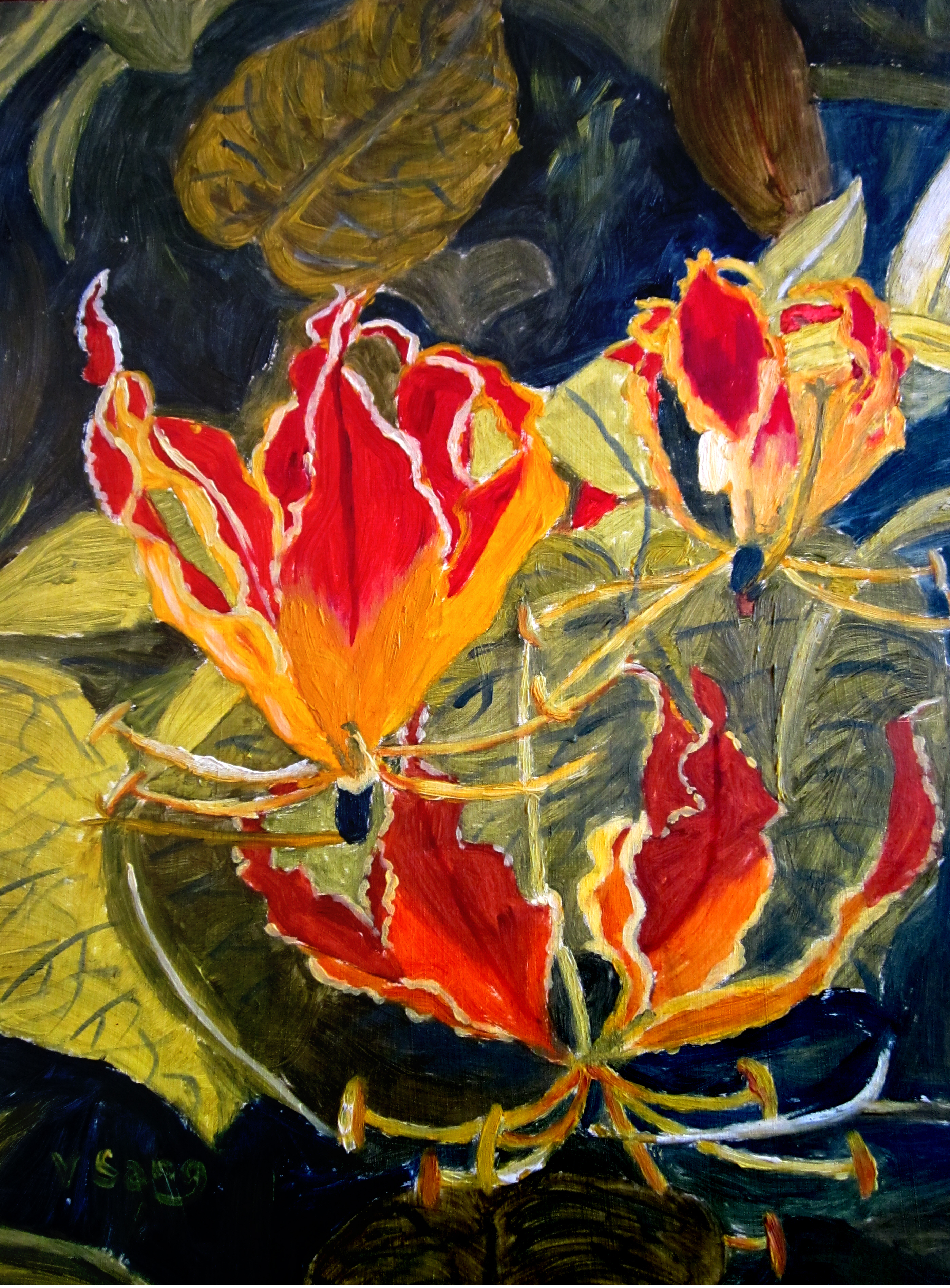
One of my paintings.
Gloriana Rothchildiana
Tuesday again. It’s the last Tuesday of the month and so here are some more commonly confused words. Some of these words are confusions of meaning and some are confusions of spelling, while some are both.
I know I said I’d have a particular plan for when I was going to post what, but I’ve forgotten it! How stupid can you get? I’ve even forgotten where I put the note that I wrote to myself. I can remember that the first Tuesday was an extract from The Wolf Pack and the third some of my other writing or that of another writer I like. (This includes my Mum’s poems, of course.) Now the third Tuesday seems to be grammar.
Anyway, here it is.
Here are a few more words that are often confused.
Council/counsel
‘Council’ is some sort of ruling body, as in the local town council or the General Medical Council.
e.g. The Council passed a new by-law to prevent dog fouling in the local parks.
‘Counsel’ is to give advice, or to act as a lawyer.
e.g. He gave me some good counsel about my problems.
Imply/Infer
‘Imply’ is what the speaker hints at without actually saying it in so many words.
e.g. Are you implying that Jack was the thief?
‘Infer’ is that which is deduced from the implication.
e.g. From what you say, I infer that you think Jack was the thief.
Literal/Virtual
‘Literal’ means that it actually happened, or that something is ACTUALLY the thing referred to.
e.g. The bird flew past me, its wings literally brushing my face.
‘Virtual’ means that it was AS IF the thing were happening.
e.g. The footballer virtually flew down the wing before putting the ball in the back of the net.
(the winger literally flying would be an awesome sight, as would, as we sometimes here when a player is playing well, ‘He’s literally on fire this afternoon.’ Poor lad!)
Convex/Concave
‘Convex’ is protruding outwards. A magnifying glass has a convex lens, one that is thicker in the centre than at the edges.
e.g. There was a convex protuberance on the wall that had to be sorted out before Harry could paint it.
‘Concave’ is going inwards, like a cave. Glasses for short sight are concave. They are thinner in the middle than on the outside.
e.g. Breathe out so that your stomach is concave.
There/Their
‘There’ is denoting a place.
e.g. Put the parcel down over there please.
‘Their’ is donating ownership. Something that belongs to them.
e.g. Is that their car in the car park?
A poem in answer to a challenge.
 A Roman Century
This poem was difficult to write. The challenge was to take the seventh book on your bookshelf, look at t he seventh chapter and take the seventh sentence in that chapter. At least I think it was that. It was close anyway. The you used that sentence to start a poem.
The book I found to be the seventh book was one on the Roman Empire and the seventh sentence in the seventh chapter was ‘The Roman Legion also had other skills.’ Not and easy thing to write a poem about. (I was tempted to cheat, but then thought that it was a good exercise anyway.)
Here is my attempt.
A ROMAN LEGION
A Roman legion also had other skills
As well as its ability in war.
As builders, Roman soldiers were not poor
And built a wall for Hadrian ’cross the hills.
When soldiers met a river, wide and deep
A bridge they built to get across the flow.
The soldiers toiled in sun of rain or snow
And if some died, well OK life was cheap.
Vercingetorix was a Celt from Gaul
Who won a massive battle, but in vain.
They soon lost all that they had gained
And Roman soldiers camped outside the wall.
The siege engines the Roman soldiers built
Bombarded all the walls around the town.
Their engineering capabilities shown
And Vercingetorix’s strength did wilt.
The soldiers built the roads so straight and true
Joining all their governed lands to Rome.
Where the Emperor did sit upon his throne
And that is why the empire grew and grew.
The soldiers sewed their clothing, built the roads,
And bridges, walls and siege engines as well.
They fought and conquered as the stories tell
And beat the Celtic peoples in their woad.
The legions helped the Empire last so long.
Fighters, engineers and builders, they
Worked hard and long, they toiled throughout the day
To make the Roman Empire wide and strong.
The Sunshine Blogger Award
This is an award that you pass on to another blogger and ask 10 questions of that blogger.
I think that’s the idea., anyway. The answers to the questions Lula asked me are on my blog if you are interested.

I am awarding The Sunshine Blogger Award to Clancy Tucker. I always find his blogs interesting and they brighten up my day.
Thank you Clancy.
I was awarded this by Lula Harp. I answered her questions and now am passing it on to Clancy.
Here are my 10 questions.
1. What is your preferred time of day for writing?
2. Do you have any place where you like to write?
3. What, if any, music do you like to write to?
4. Do you have any pets?
5. What is your biggest excuse for procrastination?
6. What season of the year is your favourite?
7. What do you like to do when you aren’t writing?
8. Do you have a favourite topic to blog about? If so, what is it?
9. If you could line in any other country apart from where you currently live, which country would that be?
10. Do you wear hats?
A 5 star review
I am putting in an extra blog this week because I’ve just received an email to say that the review below has been posted by John Thornton. I am most flattered by what he said. The email arrived yesterday at 4.15 or there about, so I don’t know if it’s gone live yet.
Thank you for your kind words, John.

5 Stars
“The Wolf Pack” is an original and well crafted fantasy novel. If you like novels like the “Earthsea Saga” by Ursula Le Guin or “When the Heavens Fall” by Marc Turner then I suggest that you may well enjoy “The Wolf Pack.” British style and spellings throughout. Not really a negative, just a difference to be noted.
Positives:
I found the characters well developed, and complex (in a good way).
The plot is unique and unusual. It is not easy to explain, but does unfold nicely as one reads through the book. I am trying to avoid spoilers, so I do not want to give too much away.
Dialogue is well written and each character has his or her own voice.
Negatives:
It took me a bit to “get into” the book, but that might be because fantasy is not my favorite genre. Some might call this “high fantasy” but I am never quite sure where the lines are on the various types of fantasy novels.
Otherwise a solid book. My rating, A-

