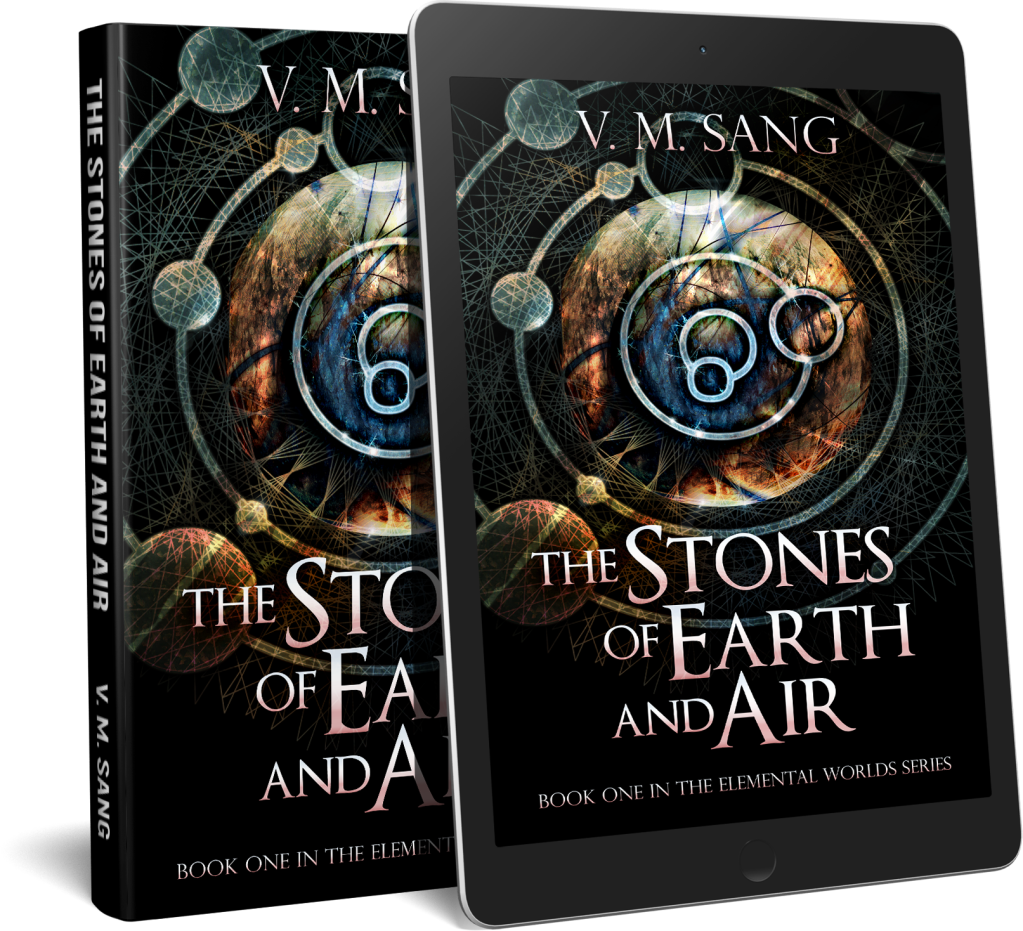
After finding the gems associated with the worlds of Earth and Air, Pettic needs to enter the final two Elemental Worlds to find the gems of Fire and Water.
In these two worlds, as before, he has to preform a task to help the inhabitants before the jewel will reveal its whereabouts.
But when he has found these gems, how can he rescue his friend, the Crown Prince of Ponderia? First, though, he needs to find the two missing gems.
In Ignis, the land of fire, he finds the magical creatures are having fewer and fewer offspring. Can he help them and find out the cause? And what can he do about it?
In Aqua, the land of water, he meets merfolk who have a problem. Their leader is dying because his magic staff has been stolen. Can Pettic find this staff and the culprit before it is too late?
I am pleased to say that the same narrator who narrated the audio version of The Stones of Earth and Air has agreed to narrate this book, too. He has finished the narration, and it is now with the publisher. I hope it won’t be too long before it’s available.
In the meantime, for those of you who can’t wait, the ebook version of The Stones of Fire and Water is FREE on Amazon from tomorrow (14th June) until Thursday 18th June.
Click on the link now, before you forget or you’ll miss this opportunity. You can get your book by clicking on the title, or the cover in the sidebar or the text.. This will take you to Amazon where you are.
I am always pleased to hear your comments. Add them in the comments box.
We are often told, as writers, that we should try to use all the senses in order to bring our stories to life. We have 5 senses (although some people say there is a 6th, and some stories deal with it, including some of my own) and it’s a good idea to change the word to describe the way the character experiences the sense.
We could say ‘He saw the dragon descending to its lair.’ But we could make it stronger by using a different word (or phrase). ‘He became aware of the dragon descending to its lair.’
In the above picture, we would be able to smell the vegetation, hear the birds singing and the rippling water. We see the green of the plants and the brownish colour of the water. We could dabble our feet in the water and feel the coolness, or the grass under our feet when we get out.
I’m not sure about taste, here, but if we know what we are doing, we could taste some of the plants. I know I’ve done so when I was young. the sweet taste of blades of grass when chewed or the nectar in the base of clover florets.
I’ve decided not to go any further with Carthinal’s tale at this time. I’ve submitted it to the publisher, and I don’t think they’ll be very pleased to have the complete novella available on the net. It will be some time before it is published, though, as they have another novella of mine in the pipeline.
I am also working on a third. This one is the story of Asphodel. I did originally publish it here, but there are significant changes to it, and so I don’t think that what is here is really comparable. So I will have to re-think what I am posting on the first Tuesday of the month.
To be going on with, here’s one of my paintings.
This is Cavendish, in Suffolk. Many of the houses in that part of the world are painted in pastel shades. This village has a large village green and the houses portrayed in this picture are alms houses.
I lived not far from this pretty village in the ’80s and we often passed through it on our way to the coast.
If you liked this painting, please feel free to reblog. But acknowledge me when you do, please.
What do you think of my painting? Let me know in the comments box.
Kevin is having a few problems with WordPress changing from Classic editor to Block editor. I hope WordPress sorts it out quickly. They obviously didn’t think of blind users when they started Block Editor. Most remiss of them!
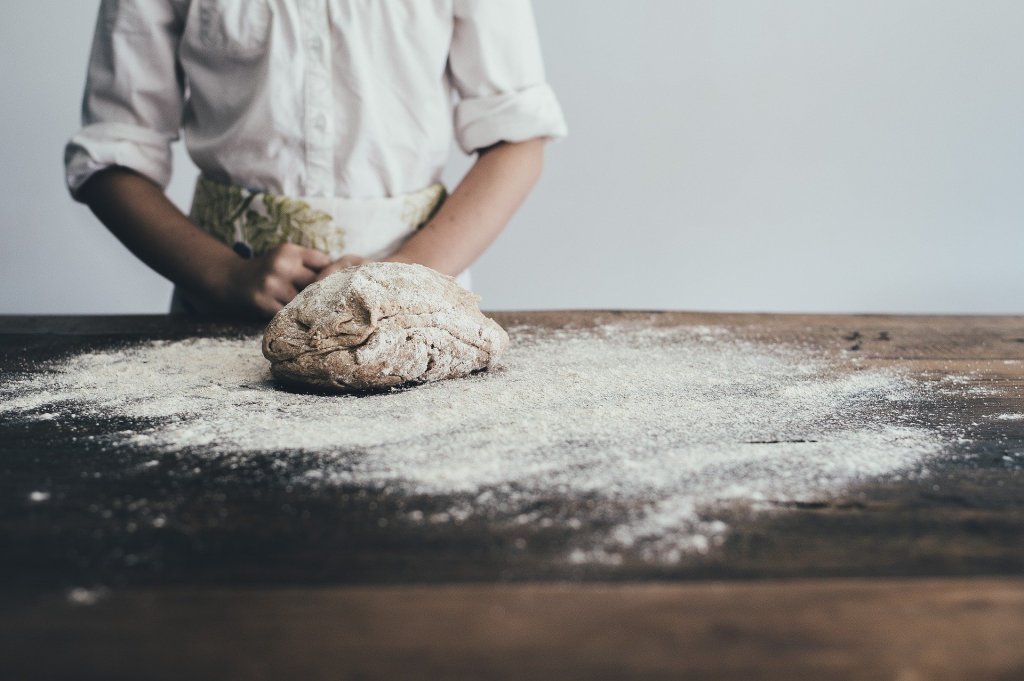
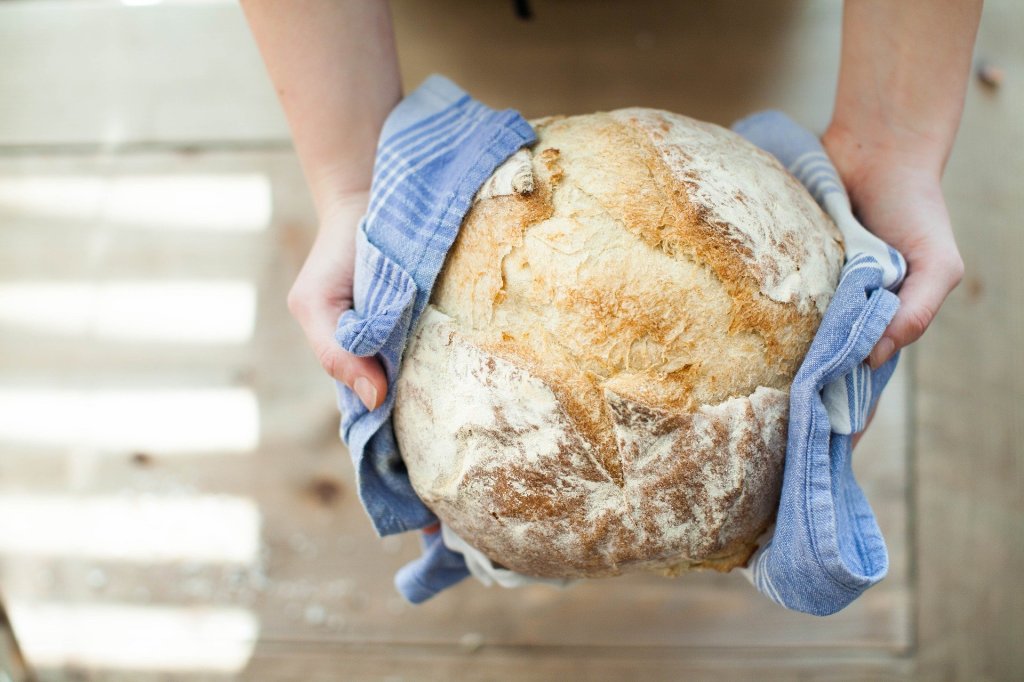
Before Covid-19 took over our lives and made it difficult to go out, except for essentials, few people made their own bread. I have always made it from time to time. I find it therapeutic, and the bread tastes so much better than the shop-bought stuff.
Hand-made is better than bread machine, too, in my opinion. I somehow feel that in a bread machine, it’s not really made by me. I stick in the ingredients and leave the machine to do the work.
However, when the lockdown came, everyone seemed to decide that this was the time to make their own bread (and cakes, probably biscuits, pies and everything else that needed flour). Flour vanished from the shelves, as did yeast, so I was stuck.
Amazon came to the rescue, however, and I got bread flour and yeast. (Both from the UK) I could only buy 16kg flour, so that’s a lot of loaves! I also bought some bread improver, too.
So we set off to make bread. We decided to experiment and wrote what we thought of each experiment.
First of all, I would like to mention the yeast. Of course, you can use fresh bakers’ yeast if you can get it. (I got some from Morrison’s before all this lockdown stuff kicked off.)
The problem with fresh yeast is that you need to use it fairly quickly as it only keeps 2 weeks maximum in a refrigerator.
Also, be careful when using dried yeast. Some is ‘quick’ or ‘fast-acting’ and some isn’t. If you have the fast-actingtype, you can simply sprinkle it on your flour and mix well in. For the other, non-quick, you need to activate it first in some warm water taken from the total amount you are going to use. If you like, you can add some sugar to help it get going, but not too much.
500g strong bread flour 350ml warm water (about 30C) 2 teaspoons sugar 7g dried yeast (activated if necessary with ½ teaspoon sugar) 5g bread improver (optional) 2 teaspoons salt.
Method.
Put the yeast into a cup and add ½ teaspoon from the sugar. Pour in about 50ml of warm (30C) water from the 350ml and stir with a fork. Put to one side and leave for around 10-15 minutes, or until it’s bubbling and frothy.
Carefully weigh the flour and put it into a large basin. Add the bread improver (if used) salt and the remaining sugar. Mix thoroughly together.
When the yeast is nice and frothy, pour it into the flour. Use a little of the warm water to make sure it’s all out of the cup, then add the rest of the water.
Mix until it comes together and makes a fairly sticky dough. Turn it out onto your work surface WITHOUT adding flour. If you put flour on your work surface, it will make your carefully weight amounts wrong.
Knead the dough. I used a technique from Richard Bertinet who is a professional baker. You can watch a video of how he kneads bread on YouTube.
When the dough is elastic, dust a large bowl, put the dough in and cover it with a clean tea towel. Leave in a fairly warm place for at least an hour. The length of time will depend on the warmth of the room. Wait until it has doubled in size.
Shape the dough and make rolls, round loaves, long rolls, or put it into a tin. Cover again with a tea towel and leave until doubled in size once again. The longer you leave it at this stage, the lighter your loaves will be. The yeast will produce more carbon dioxide and thus more holes.
Preheat your oven to its highest temperature (ideally around 250C). I heated mine to 230C which is as high as it will go. Heat for at least 30 minutes. I used a baking stone, already in the oven, but you can use an upturned baking tray, heated in the oven for the half hour.
I used a wooden slider thingy to get the bread off the tray it had proved on, but you can use whatever you have. Be very careful not to handle it as it will quickly collapse. Slide it onto your stone or tray and shut the oven door. I allowed it to cook for 10 minutes at the highest temperature then turned it down 20C as the first ones I made were slightly burned on the crust. Cooking time will depend on what you’ve made. Rolls will take around 15-20 minutes, but a large loaf can take up to 45 minutes. When cooked, the bread will sound hollow when tapped on the bottom.
You can get the ebook version of my first recipe book, Viv’s Family Recipes FREE from today until June 2nd. I have an interest in history as well as cooking and this book has recipes from the early part of the 20th Century until now. It is interesting to see how our tastes have changed during that time.
I’ve been wondering whether to publish another recipe book. This time it would be a yeast cookery book, I think. What do you think of that idea?
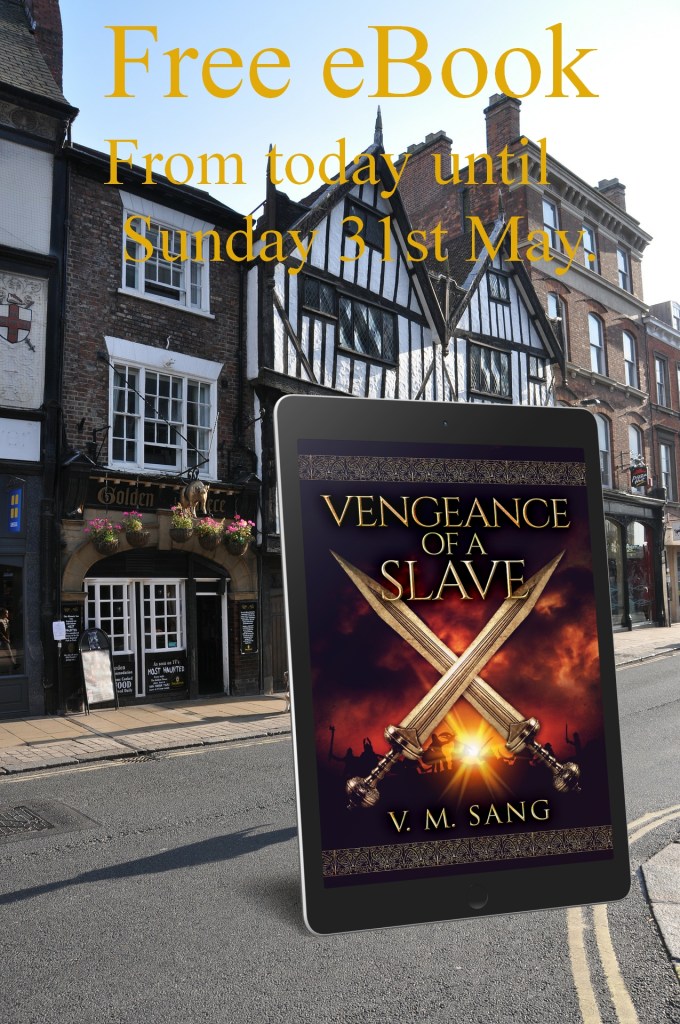
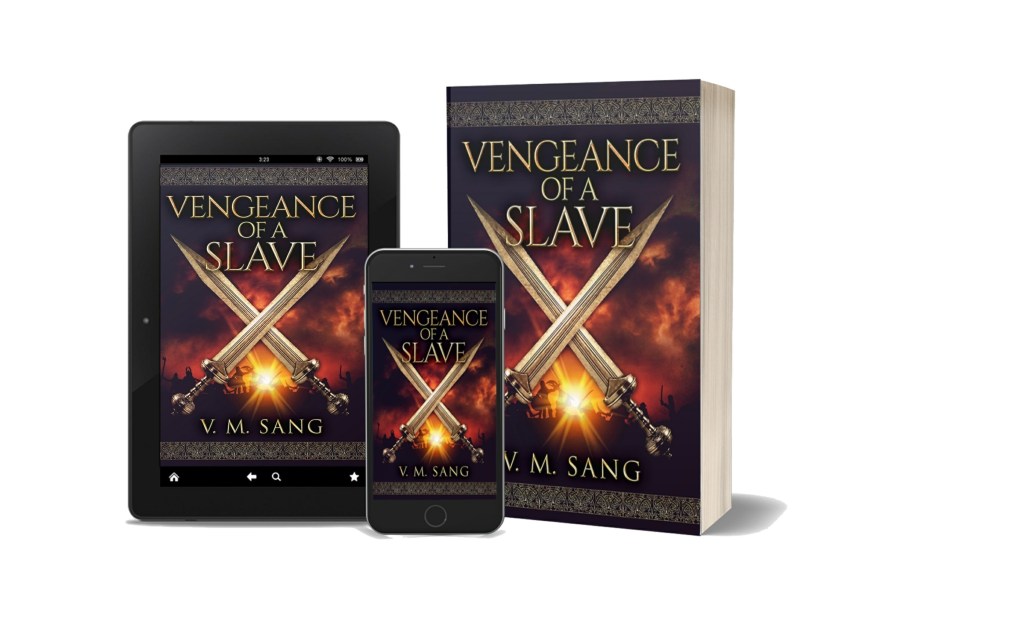
Forced to watch his father’s crucifixion and separated from his mother, orphaned six-year-old Adelbhert’s life forever changes when he is sold into slavery in Britannia.
Years of servitude fill his heart with malice and he resolves to escape, determined to rescue those he loves and deliver retribution to the Romans who wronged him.
But as new allies shed light on old perspectives, Adelbhert begins to question his path. Will he find true freedom, or allow his vengeance to consume him?
R. J. Krzak, Award-Winning Author, gave this review on Amazon
5.0 out of 5 stars
A Riveting Story Set in Roman Times
Vengeance of a Slave by V.M. Sang is a riveting story set during the period when Rome controlled Britannia. Follow the trials and tribulations of Adelbhert after he and his sister are taken by the Romans from their mother. They eventually end up as slaves in what is modern-day London. Adelbhert performs a nightly ritual to remind himself of the suffering he and his sister have endured, beginning with the crucifixion of their father. He vows to escape and punish those who have wronged him.
V.M. has created a moving story which will keep you turning the pages to find out how Adelbhert and his sister handle their new life. Experience their sorrow, anguish, and finally hope as they adapt to their changing situation. This is the first novel I’ve read of V.M.’s and it certainly won’t be the last! Well done and highly recommended!
Don’t miss your opportunity to get this book absolutely FREE Remember it’s for a limited time.
Click on the book cover in the side bar or the highlighted text to go to Amazon where you are.
If you take advantage of this offer, I would be grateful if you would post a brief review of the book. With so many books being published daily, it is difficult to get any individual book noticed. Reviews help in this, as well as helping readers to decide if a book is one they would enjoy.
This book is one of the books about the lawyer, Matthew Shardlake and is set at the time that Henry VIII wanted to divorce Anne of Cleves in order to marry Katherine Howard.
This is an exciting story and keeps you turning the pages. Just one more page. Oh, alright, just one more chapter. There are so many twists and turns in the plot that you simply must keep on reading?
Blurb
England, 1540: Matthew Shardlake, believing himself out of favour with Thomas Cromwell, is busy trying to maintain his legal practice and keep a low profile. But his involvement with a murder case, defending a girl accused of brutally murdering her young cousin, brings him once again into contact with the king’s chief minister – and a new assignment . . .
The secret of Greek Fire, the legendary substance with which the Byzantines destroyed the Arab navies, has been lost for centuries. Now an official of the Court of Augmentations has discovered the formula in the library of a dissolved London monastery. When Shardlake is sent to recover it, he finds the official and his alchemist brother horribly murdered – the formula has disappeared.
Now Shardlake must follow the trail of Greek Fire across Tudor London, while trying at the same time to prove his young client’s innocence. But very soon he discovers nothing is as it seems . . .
Story
Shardlake has, in the past, done work for Thomas Cromwell, and in this tale Cromwell sends for him to investigate the discovery of a mysterious substance, supposedly the mythical Greek Fire. Cromwell has promised a demonstration to the king, but unfortunately, the said Greek Fire has gone missing.
Things political are moving against Thomas Cromwell. The powerful Duke of Norfolk, Katherine Howard’s uncle, wishes a return to Rome, and his star is rising. This demonstration of Greek Fire (the Dark Fire of the title) would help Cromwell regain his position. But there are mysteries within mysteries here, and a time limit to find the stuff before the day of the demonstration.
At the same time as this, Shardlake has taken on the defence of Elizabeth, accused of murder, but whom Shardlake and her uncle believe to be innocent. Again, there is a time limit before her execution.
Characters
Matthew Sharadlake is afflicted with a twisted spine, and this causes him, not only physical problems, but he also meets with prejudices from people around him. However, in spite of this, he overcomes his physical problems, and does not let them cause him to become bitter.
He does have human flaws, though, which bring him to life as a real person, and we feel we can relate to him, and like him. His wit and intelligence get him through most things.
There are also other characters in the book who are also well-drawn. The man whom Cromwell sets to act as a help and protector of Shardlake, Jack Barak, is a complex character who is both educated and streetwise.
I cannot go through all the many characters we meet in these pages, but all are well-drawn and realistic.
Writing
The writing is excellent. I think I only discovered one typo and not grammatical errors in the whole book. Quite a breath of fresh air. Even in many traditionally published books I often find many typos, spelling mistakes and grammatical errors.
The research on the history of the time, and what life was like is exempliary. We can almost smell the rotting vegetables and other things in the streets and understand the horrors of Newgate prison. And the heat of the summer almost has us sweating along with Shardlake and Barak.
We feel along with Shardlake all his emotions and pains.
Conclusion
This is definitely a book to read if you enjoy mysteries set in past ages. I would recommend it to people who like mysteries wherever set, and also to people who enjoy books set in historical times. Perhaps not if your preference is for Historical Romance, though. Not much of that.
I’ve given it 5*
Please leave a comment in the comments box. It’s entirely free! I enjoy hearing what you think of my posts.
If you wish to join my email list to receive my quarterly newsletter, and news about new releases, click join in the left hand side bar.