All posts by V.M.Sang

I was born and educated in the north west of England. I trained as a teacher in Manchester and taught in Salford, Lancashire, Hampshire and Croydon. I write fantasy novels currently. I also make cards, knit, crochet, tat, do cross stitch and paint. I enjoy walking on the Downs, cycling and kayaking. I do not enjoy housework, but like cooking.

Creating Sound: Childhood Instruments and Memories

I was changing the toilet roll in the bathroom the other morning when I inexplicably thought about how toilet rolls were in the 1950s.

Yes, I’m that old.

Anyway, I thought about the old Izal toilet rolls. 

They were a bit like tracing paper. In fact, we sometimes used them as such. They were hard and very scratchy. Horrid.

‘What has this to do with music?’ I hear you ask.

Well, while it was not good for its original purpose, it was brilliant to use with a comb to make a paper and comb musical instrument.

For those who don’t know about this, you wrapped the paper loosely around the teeth of the comb and made a buzzing sound with your lips. This made the paper vibrate and make a sound. By altering the pitch, you could play a tune.

We used to take a piece of broad-leaved grass, hold it vertically between our thumbs. Blowing our thumbs made a sound. 

Admittedly, not a nice one!

Paper straws could also be made into a kind of noise-producing item. Cut the end of the straw so it made an inverted V shape and blow. This didn’t last long, though, as the end got wet and stopped working. Pitch could be varied by the length of the straw. A group could play a simple tune. (Theoretically!)

Blowing across the end of bottles was a good noise-maker, too. If you got different sized bottles, you could make different notes.

We also made noises by cupping our hands together and blowing between our thumbs. But raising the fingers of the top hand, we made different notes. Favourite was a cuckoo’s call.

Tapping a pencil on your teeth and moving your mouth would also change the pitch of the tap, and you could ‘play’ a tune.

The last one I remember took some organising.

You took a wine glass (your mother’s best worked well) and added a little water. You dipped your finger in to make it damp, then ran it gently around the rim. It made a ringing sound. 

If you added different amounts of water to several glasses, you could, with a lot of trial and error, get a scale, thus play a simple tune.

Admittedly, some of these can hardly be described as music, but still…

Did you do any of these things? Do you know of any other things we did in childhood to make sounds? Let us know in the comments.

If you would like to buy any of my books, simply click on the image in the sidebar and you will be taken to a page where you can buy in any format from your favourite online store.

The ebook of each of the series is free.

A Chilling Comparison.

Morgan has compared the rise of Hitler to that of Trump.

A Review of ‘From January to June’: Dive into Poetry

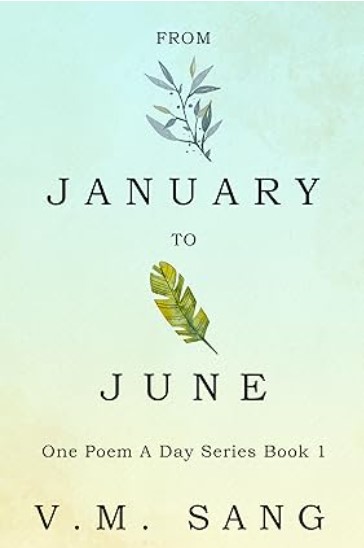
I recently looked at the reviews I received for my poetry book, From January to June ; One Poem a Day, and was delighted to find this.

From January to June (One Poem A Day Series Book 1)

imagemarjorie mallon

A variety of poems to enjoy

December 13, 2024

From January to June. V M Sang

As a poetry enthusiast I was keen to read V M Sang’s poetic observations: From January to June.

It’s a eclectic collection with a variety of topics such as Spring, Family, Communications (how they change through time,) music, travel, (France and UK,) amusing poems, and daily life.

Some of my favourite poems: Grandma’s Hands, Son, Songbirds, Teddy, Dark Creatures, Doorway, Home Sweet Home, New Mown Grass, The Internet, and I Am A Writer.

Something for everyone, some short, like this haiku.

‘The bees are humming.
Gentle breeze quivers the leaves
And a poet dreams.’

Some poems are longer, some telling a tale. A good way to discover more about the author and what makes them tick!

I enjoyed, and can recommend – 4 stars 🌟

And now to whet your appetite, here’s today’s poem from the collection.

February 17th

Another one from a prompt. This time it was to write a poem with the following words. Lavender, horn, gold, hooves, trot.

Unicorn

I heard a sound in the wood.
And thought, “What can it be?”
I kept silent where I stood
Hoping I would see
Something wonderful and rare.
Perhaps a shy and timid deer.
But there is magic in the air
And stranger beasts live near. 

A glimpse of lavender appeared
Between the beech trees tall.
My brow I furrowed. This is weird.
I could not work it out at all.
Then from the trees a unicorn
Trotted out so that I
Could see his unique horn of gold
And cloven hooves and clear, bright eye.

I held my breath to see this beast.
I felt my heart beat fast.
My mind was filled with thoughts of peace
As he trotted past.
He paused and took away my pain.
I knew not what to say,
But he shook his lavender mane
And trotted on his way.

If you would like to read more of my poetry, you can get the ebook for free. by clicking the button below or the cover in the sidebar.

It is available from your favourite bookstore in ebook, paperback or hardcover versions.

I would like to thank Marjorie Mallon for her kind review.

Do you enjoy poetry? What is your favourite kind of poetry?

Groundhog Day vs. Imbolc: Spring’s Weather Predictions

I know I’m a bit late with this, and it would have been better last week, but I already had a post scheduled. 

I was struck with the similarity of the US Groundhog Day with the ancient Celtic festival of Imbolc. 

It happens on the same day, more or less, and is the harbinger of spring. And just as the groundhog gives a weather forecast, so does Imbolc.

I think it’s probably easiest for me to describe Imbolc in an extract from my book, Vengeance of a Slave, where Ailbert and his sister, Awena, take part in their very first Imbolc after their escape from slavery under the Romans.

Soon it was Imbolc, the time when the young lambs began to be born. The villagers had much preparation to do, for they invited the goddess, Brigid, into their homes to bless them, and they prepared special food for this day. Awena, was delighted when the villagers chose her to help carry the image of Brigid around the village. 

She helped to clean the house with enthusiasm, sweeping out all the old rushes and piling them up outside ready to be lit into a bonfire. Ailbert laughed at her enthusiasm saying he had never thought of her as a domestic type. 

She stuck her tongue out at him in response. “It’s important everything is ready for Brigid.”

“What about the gods we worshipped in Londinium? Have you forgotten them? Jupiter, Juno, Venus and the rest?”

“They’re gods for the Romans.” She shook her head. “They’ve no use for the Britons. Only if we become Roman Citizens will they care for us, and that’s not going to happen. We’re now Britons and we must worship the gods that care for the Britons.”

She carried on sweeping while Ailbert continued walking towards the sheep pens to see if any lambs had been born. 

He met Madoc on the way and the boy told him in excited tones that one of the ewes had gone into labour and the lamb, or hopefully lambs would arrive very shortly. Ailbert quickened his steps towards the pens in the hope of seeing the actual birth. Being a house slave in Londinium he had never been present at the birth of any of the animals owned by the dominus and domina.

They arrived in time to see the ewe pushing out what turned out to be the first of two lambs. Ailbert frowned. He had not expected blood. The little lamb lay on the ground, wet, and the mother turned to look at him, for it was a male lamb. Ailbert watched as she began to lick him clean. The second lamb was born soon afterwards and she repeated the process. The lambs staggered to their feet and immediately began suckling. 

Ailbert smiled. He had witnessed a wonderful thing. New life being brought into the world and he ran off to tell Awena and Gwen the first lambs had been born and Imbolc was due to start.

At sunset that evening, the unwed girls carried the image of Brigid around the village. The villagers had made a crude image of reeds and the girls visited each house in turn, walked three times round it and then asked for admittance for Brigid. Each house opened the door and let the image and girls in. They gave them food and each householder added a decoration to the reed image.

For some weeks before, the women and girls had been busy making Brigid crosses out of reeds, and one hung over the door of each house.

As it was winter still, it soon got dark. Each household put out newly made clothes, and food and drink for the goddess. They also made a bed for her in the house, just in case she decided to visit. 

They ate and drank the foods made for this special day. They had a kind of porridge made from the starch left in the husks of the oats, soaked out and left to ferment. It tasted sour to Ailbert and Awena but they ate their share as it would have been discourteous to do otherwise.

The next morning, Gwen looked carefully at the ashes that she had raked smooth the evening before, to see any disturbances that might indicate that Brigid had visited in the night, but they were as smooth as they had been when they all went to bed.

Gwen led the way outside to be met with a frost on the ground and an overcast sky. “Ah! That’s good. A cold, miserable day means that the Cailleach is still asleep and not gathering wood for fires to keep her warm through the next cold spell.” She turned to the young people who frowned and looked at each other. Ailbert shrugged his shoulders. 

“Cailliach is winter personified. If today is bright and sunny, then she can come out and look for firewood and so keep herself warm for longer. If it’s cold and miserable, or rainy and stormy, then she’s asleep and will soon run out of firewood, so Brigid can bring the spring sooner.”

They, along with the rest of the village, made their way to the well. Here they walked round it in the direction of the sun and prayed to Brigid to bring health and prosperity. They gave offerings of strips of cloth and a few coins to the goddess.

Singing and dancing followed, as well as eating and drinking, and the day passed quickly, darkness coming early at this season, half-way between the winter solstice and spring equinox. Tired and happy with the prospect of a good season to come, the villagers retired to their beds.

Here’s the blurb.

Forced to watch his father’s crucifixion and separated from his mother, orphaned six-year-old Adelbhert’s life forever changes when he is sold into slavery in Britannia.

Years of servitude fill his heart with malice and he resolves to escape, determined to rescue those he loves and deliver retribution to the Romans who wronged him.

But as new allies shed light on old perspectives, Adelbhert begins to question his path. Will he find true freedom, or allow his vengeance to consume him?

And a review:

D. Peach

Ailbert keeps a running list in his head of all the reasons why he hates the Romans—they crucified his father, stole him as a child from his mother, and enslaved him. As he grows into his teenage years as a slave, the list gets longer. With the help of a network of Britons, he escapes, determined to exact his revenge, but not everything is as clear cut as he once thought.

The plot is straight forward, and though there are some tense moments, battling and mortal danger isn’t the point of the tale. This story has a strong moral message about the nuanced nature of people and how they treat and judge each other. Ultimately, it’s about a young man’s growth and the events that change his perceptions as he matures.

The pace is moderate with some repetition, but I was engaged throughout. The historical details seem well-researched, adding to the authenticity of the story. Point-of-view focuses on Ailbert for most of the book, with occasional shifts to other characters, and all main and secondary characters felt believable to me. Ailbert is particularly well-rounded and likable as the story centers on his thoughts and experiences.

Recommended for YA and adult readers who enjoy coming of age stories, historical fiction, and adventure.

If you want to read more about Ailbert and Awena, and how they escaped from being Roman slaves, click on the button below.

The book is available in ebook and physical book from your favourite online book store.

Do you enjoy historical fiction? What is your favourite era to read about?

Let us know in the comments.

Review of Tale of The Season’s Weaver by D. Wallace Peach

OVERVIEW:

Ms Wallace Peach has done it again. This is a wonderful book.

BLURB:

“Already the animals starve. Soon the bonemen will follow, the Moss Folk and woodlings, the watermaids and humans. Then the charmed will fade. And all who will roam a dead world are dead things. Until they too vanish for lack of remembering. Still, Weaver, it is not too late.”

In the frost-kissed cottage where the changing seasons are spun, Erith wears the Weaver’s mantle, a title that tests her mortal, halfling magic. As the equinox looms, her first tapestry nears completion—a breath-taking ode to spring. She journeys to the charmed isle of Innishold to release the beauty of nature’s awakening across the land.

But human hunters have defiled the enchanted forest and slaughtered winter’s white wolves. Enraged by the trespass, the Winter King seizes Erith’s tapestry and locks her within his ice-bound palace. Here, where comfort and warmth are mere glamours, she may weave only winter until every mortal village succumbs to starvation, ice, and the gray wraiths haunting the snow.

With humanity’s fate on a perilous edge, Erith must break free of the king’s grasp and unravel a legacy of secrets. In a charmed court where illusions hold sway, allies matter, foremost among them, the Autumn Prince. Immortal and beguiling, he offers a tantalizing future she has only imagined, one she will never possess—unless she claims her extraordinary power to weave life from the brink of death.

In the lyrical fantasy tradition of Margaret Rogerson and Holly Black, D. Wallace Peach spins a spellbinding tale of magic, resilience, and the transformative potency of tales—a tapestry woven with peril and hope set against the frigid backdrop of an eternal winter.

STORY:

Erith is the Weaver of the Seasons. She has inherited the job from her immortal, Charmed (magical) mother who decided to follow her mortal husband into the underworld on his death.

The young Erith is unconfident of her abilities, being only half Charmed. She doubts her magic is sufficient to weave the seasons.

It is winter, and human hunters entered the Charmed forest in pursuit of a stag. They killed some of the Winter King’s creatures, and now he is out for revenge.

Erith has to travel to the magical Isle of Innisholm to spread her magical tapestry, woven by her with her mother’s magic threads. At the equinox, the spreading of Spring’s tapestry will enable the change from winter to spring to take place. The Winter King will relinquish his throne to the Spring Princess.

Or will he?

Intent on punishing the humans, he captures Erith and destroys her tapestry, insisting she weaves only winter. This will cause the death of all living things, and eventually, as there is no one to believe in them, and to pass on their stories, the immortal Charmed, themselves.

Who can Erith trust? The Charmed courtiers? The Spring Princess? The Autumn Prince? The Summer Queen?

CHARACTERS:

Erith is full of doubt. She is very young to have this responsibility thrust upon her. We can understand how she feels. She is alone in the world.

She feels anger at her mother for leaving her to perform this task alone. This anger is mixed with love for her mother.

She is a character we can relate to. I think everyone has felt, to some degree, what Erith feels.

But she must find the courage from somewhere to stand up to the Winter King.

The Winter King is a typical depiction of winter. He has icy blue eyes and long white hair. His personality is cold and ruthless. He has little empathy for the humans he is destroying by his refusal to allow spring to arrive. Even when his actions are impacting his own people he will not relent.

The Spring Princess loves pastel colours. She has blonde hair and wears a dress with spring flowers on it.

She is slightly insipid, I thought, and does not have the courage to stand up to Winter King. She seems to think he’ll relent and all will be well.

The Summer Queen dresses in bolder colours than the Spring Princess, as befits a summer day. She doesn’t stand up to the Winter King, either, and doesn’t seem too bothered about what is happening.

The Autumn Prince is the only one of the season’s royalty who is on Erith’s side. He does all he can to help her, even if she doesn’t always appreciate it.

There are lots of other characters, many of whom are Charmed. I especially liked Erith’s hospet, a small, goblin-like creature who, in exchange for clothes and food, keeps the house clean and tidy.

WRITING:

Ms Wallace Peach writes like the Weaver of the title. Her prose and word choice weave magic, just as Erith weaves magic into her tapestry.

Her descriptions are beautiful. I could picture the cold beauty of Winter with the glittering ice and snow, and with Erith’s visit to the realms of the other Seasons’ rulers on the Isle of Innisholm, the delicate loveliness of Spring and the bountiful colours of Autumn.

I found no grammatical errors, nor typos.Definitely one to read if you are a fan of fantasy, and maybe even if you are not. The writing alone is worth it.

I give it 5*.

My ranking of books. In order to get a particular number of stars, it is not necessary to meet all the criteria. This is a guide only.

5* Exceptional. Wonderful story. Setting well drawn, and characters believable–not perfect, but with flaws. Will keep you up all night. No typos or grammatical errors.

4* A thoroughly enjoyable read. Great and original story. Believable setting and characters. Very few grammatical errors or typos.

3* I enjoyed it. Good story. Characters need some development. Some typos or grammatical errors.

2* Not for me. Story not very strong. Unbelievable and flat characters. Setting not clearly defined. Many typos or grammatical errors.

1* I hated it. Story almost non-existent. Setting poor. Possibly couldn’t finish it.

Some funny, some incredible and some to make you think

Beetley Pete has gathered these amazing memes. Pop over and have a look.

Discover Haikus & Poetry Inspired by Winter

I am currently reading D Wallace Peach’s latest book, The Season’s Weaver. It deals with a world plunged into perpetual winter. I will be reviewing it shortly.

It made me think of a Haiku I wrote. It’s still winter, and although we have no snow here, at least not in the south of England where I live, I know there is a lot of it in the US where many of you live.

Here is the Haiku.

Gently, silently
Throughout the night the snow fell.
A monochrome world.

And some more I wrote that you can find in my Miscellaneous Thoughts poetry book.

SNOW

Flakes drop gently down,
Turning all the land to white.
A magical sight.

Nothing can be seen.
Earth and sky blend into one
In the blizzard’s rage.

Waking in the dawn,
Mysterious light shines in.
It snowed in the night.

If you are interested in reading more of my poetry, you can go to a page where you can Miscellaneous Thoughts from your favourite online retailer by clicking on the link or the book cover in the sidebar..

It is available in different formats from ebooks to physical books.

Please leave a comment. Comments are GOOD.

Miira Tahn: A Sci-Fi Journey Through Life and Death. My Review of the book.

OVERVIEW.

This is an omnibus of three books, but it reads as one. I would not be able to say where one book ends and the next one begins. As a result, I would recommend reading the omnibus rather than an individual book.

BLURB

Because I couldn’t find the omnibus on Amazon to copy the blurb, here are the blurbs for the three books in the series.

In 2101, the average life expectancy is one hundred and ten. Miira Tahn, last Lady of Dhurai, is dying at just fifty-two. Faced with a slow, agonizing death, her only hope is Innerscape, a virtual paradise in which the Residents inhabit beautiful, digital bodies indistinguishable from the real thing.

Or so the brochures say. But even Eden had a snake, and once inducted, the Residents of Innerscape can never again return to the real world. If anything goes wrong, they’ll be lost in the dark forever.

Yet for Miira Tahn, even a tenuous hope is better than the fate that awaits her.

‘…sometimes you just have to close your eyes and jump…’

‘Miira’ is the first book of the Innerscape cyle and corresponds to Episode 1 of the original series.

Desperate to find a version of reality she can live with, Miira Tahn sets out to explore the digital world of Innerscape, but along the way she discovers there are other worlds open to her as well. The HUBs connect Innerscape to every location in the virtual universe, and some, like the gaming world of the Shogunate, prove to be a lot of fun. Back in Innerscape, however, a darker game is unfolding. Someone wants the Burned Man silenced, but only the AI knows which body is where, and it’s immune to threats. People, however, are so much easier to manipulate. Caught in a web of intrigue and deceit, Miira and her friends become pawns in a game where losing means death.

More alone than ever, Miira Tahn clings to the bonds of friendship, yet even there, nothing is quite what it seems, not even her own memories. Driven to search for answers out in the real world, she uncovers the one truth that can tear apart the tissue of lies surrounding the Burned Man. But is she strong enough to face the consequences? And what of the powerful people who would prefer the truth to remain safely buried? In Nabatea, the past finally collides with the present as Miira risks all to save a good man.

STORY

Miira Tahn is a  Refugee (with a capital R). She is old and severely disabled and so she has come to Innerscape. Here, her useless body is immersed in a tank and she is given an avatar of her young self. Now she, along with many others, inhabits a virtual world.

People from the real world can enter a tank and also enter Innerscape and interact with the avatars of the patients.

Miira forms a relationship with a young doctor, an expert in Innerscape. When it appears he has committed several murders, she finds it hard to believe the man she knew could do such things.

There is a mystery behind the killings, though. It appears that Miira is a possible intended victim, along with a mysterious man known as Alex Tang. 

This summary is quite difficult to write without giving away too much, so I’ll stop there.

CHARACTERS.

Miira Tahn is a likeable character. At first, she is rather staid, but her meeting with a young man, Jaimie, helps her. He introduces her to the world of virtual reality gaming, which she, surprisingly takes to.

Jamie Watson is an 18 year old who almost died 10 years previously in an accident. He is full of energy, somewhat brash, and is a perfect foil for Miira.

Kenneth Wu is the young doctor whom Miira finds herself drawn to. He is understanding and kind, and seems to reciprocate Miira’s feelings.

Peter MacAlistair is the CEO of Innerscape. He is devious and has something to hide.

These are the main characters, but there is a plethora of others. In fact, I found it difficult to remember who was who a lot of the time. Something of a downside.

WRITING

I didn’t come across many, if any, grammatical or spelling errors. 

However, I did find it slow going at the beginning. When the mystery kicked in, though, I got interested, and quite immersed. I was anxious to know if Miira could clear Kenneth’s name, and how their relationship would develop.

Having said that, though, I was left a little disappointed. Some things that had seemed important were left ‘in the air’.

We found out who Alex Tang was, and why ‘someone’ wanted him dead. He was a whistleblower, but we never found out what whistle he had blown.

Miira is a Refugee, but we weren’t told what she was a Refugee from (and why it needed a capital letter). It did seem important, and seemed to be linked to what the whistleblower had said, but no clear statement about it.

Someone in the government was involved, but it wasn’t made clear who, how or why.

Because of the slow start and the loose ends, I feel I can only give it;

3*

My ranking of books. In order to get a particular number of stars, it is not necessary to meet all the criteria. This is a guide only.

5* Exceptional. Wonderful story. Setting well drawn, and characters believable–not perfect, but with flaws. Will keep you up all night. No typos or grammatical errors.

4* A thoroughly enjoyable read. Great and original story. Believable setting and characters. Very few grammatical errors or typos.

3* I enjoyed it. Good story. Characters need some development. Some typos or grammatical errors.

2* Not for me. Story not very strong. Unbelievable and flat characters. Setting not clearly defined. Many typos or grammatical errors.

1* I hated it. Story almost non-existent. Setting poor. Possibly couldn’t finish it.

This is the first Scifi book I’ve read in a while. On the whole I enjoyed it, but for the comments I made in the review.

Do you enjoy Scifi? What is your opinion of books that leave loose ends?