Today is the 959th anniversary of the Battle of Hastings. This is probably the most important battle in the history of England. It changed our country forever. But before I begin, I would like to state that I’m not a historian, and so I might have some of these things wrong, especially where people have the same names!
Edward the Confessor was born between 1003 and 1005, the son of Æthelred the Unready and Emma, sister of Duke Richard of Normandy, He died in January 1066 and had been king from 1042.
The politics of this time is complicated, and so I will try to simplify it as much as possible. (This is to clear things in my own mind as much as anything!)
Æthelred the Unready (which means poorly advised) was deposed as king by the Danish king, Swein Forkbeard. He fought, but eventually fled to Normandy. Swein took the English throne.
When Swein died in 1014, his son, Cnut became king of England and Edward, his brother, Alfred and sister Godgifu, joined their parents in Normandy. Edward, Alfred and Godgifu remained there for 24 years and were looked after by their uncle, Duke Robert.
When Cnut died in 1034, he was succeeded by his son, Harold Harefoot, and later by another son, Harthacnut. Hartharcnut was, in fact, Edward’s half-brother, his mother, Emma, having married Cnut after the death of Æthelred.
Harthacnut died suddenly, and that left the way open for Edward. He sailed to England and became king. He wanted to unite the Danish people in England with the Anglo Saxons.
Edward became peaceful Man of God, hence the name ‘Confessor’ that was given to him.
In 1045, Edward married Edith, the daughter of the most powerful earl in England. Earl Godwin had gained his power under Cnut, and wanted to hold onto it. Marrying his daughter to the king was an excellent way to do so. But she was very much younger than Edward, and some said it ws more like a father daughter relationship. Whatever the case, they had no children and there is speculation the marriage was never consummated.
Because of his early life spent in Normandy, the king naturally wanted his friends from that time to join him. Earl Godwin saw his power begin to wane, and he had a big fallout with Edward and went into exile.
He did return, however, and patched up his differences with the king and they seemed to be of similar mindsets from then on.
but Edward and Emma had no children, so what was going to happen when he died? Well he had a nephew who had been in exile in Hungary (another Edward). King Edward sent for him, but he sadly died on arrival, leaving his son, still a young boy, as heir to the throne. This boy was known as Edgar.
Duke Robert of Normandy, had an illegitimate son called William, but no legitimate heirs as he never married. While on pilgrimage to Rome, he died, and his son became the Duke of Normandy, often known as William the Bastard. As he was a cousin to Edward the Confessor, he also had a claim to the English throne.
The Normans claim that Edward declared William to be his successor .
Harold Godwinson, son of Earl Godwin, was sent to Normandy to tell William, and he was captured by the French. William effected his release, and Harold swore loyalty to William.
In January 1066, King Edward died. It is thought that the queen, Harold Godwinson, who had now inherited his father’s title and lands, and Archbishop Stigand were present, and Harold claimed that Edward had nominated him as his heir. Of course, the Queen, being Harold’s sister, would more than likely uphold what he said.
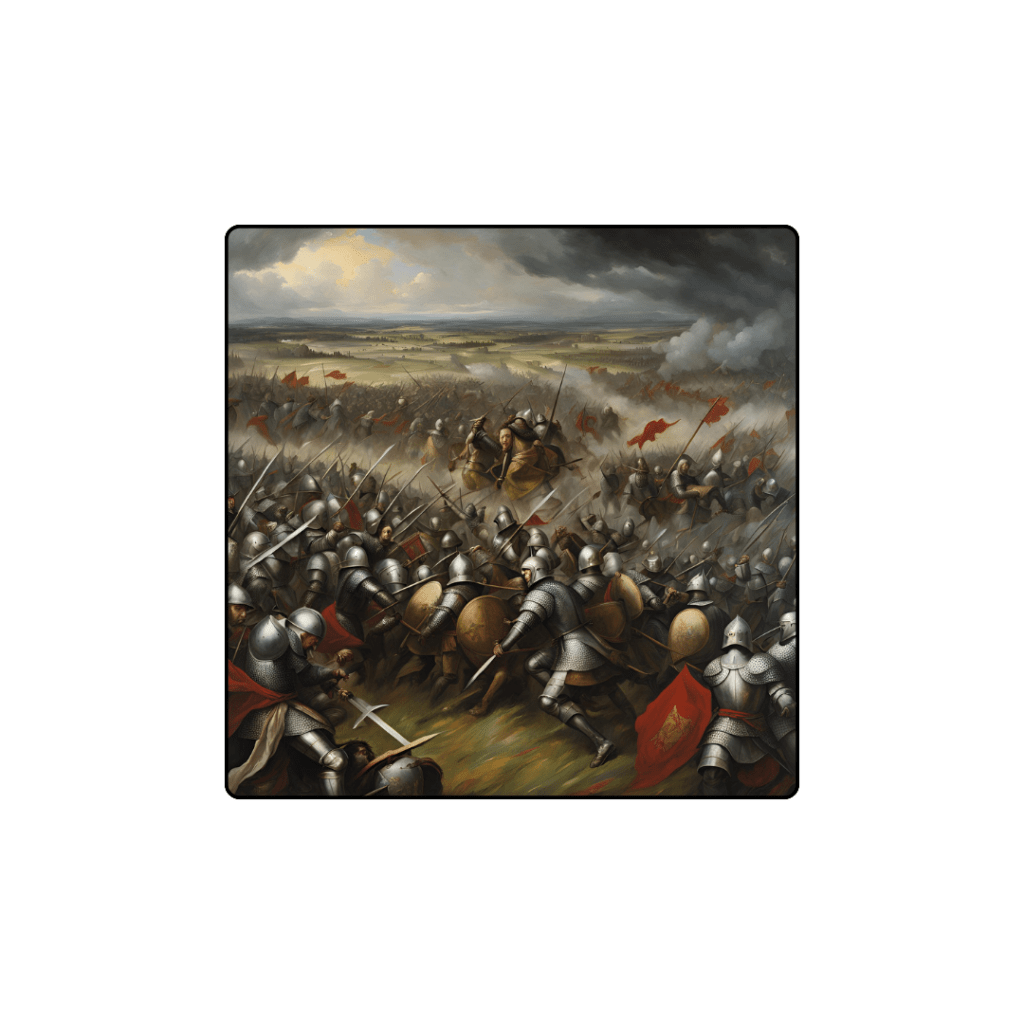
When this came to the ears of Duke William, it triggered his anger, and he began his plans for invasion, leading to the most famous battle in English history, the Battle of Hastings. (Which incidentally, didn’t take place at Hastings, but at Senlac Hill, at a place where there is now a town known as Battle.)
King Harold engaged in two battles in Northumbria. He was defeated in the first, but triumphed in the second, which occurred five days later, resulting in the deaths of the opposing leaders, his brother Tostig and Harald Hardrada, the King of Norway.
Harold learned that Duke William of Normandy had embarked on an invasion of England to lay claim to the throne.
William’s landing occurred on September 28th near Pevensey, at a location now called Norman’s Bay. His initial plan was to invade in August, but due to unfavourable weather conditions, he postponed it until September.
On landing, William established his camp within the ancient Roman fortification at Pevensey, from where he marched towards Hastings, ten miles away. Once in Hastings, he built a wooden castle from pre-fabricated parts brought with him. (Was this the first flat-pack?) 🙂
Meanwhile, Harold became aware of William’s invasion fleet during his southward march. Although he had left part of his forces in the north, he gathered additional troops en route to London, where he paused to muster more soldiers. From London, he made his way towards the south coast.
Most believe that the encounter between Harold and William occurred not at Hastings, for which the battle is named, but at Senlac Hill, which is now the town of Battle. Nevertheless, I have come across recent claims suggesting an alternative location for the battlefield.
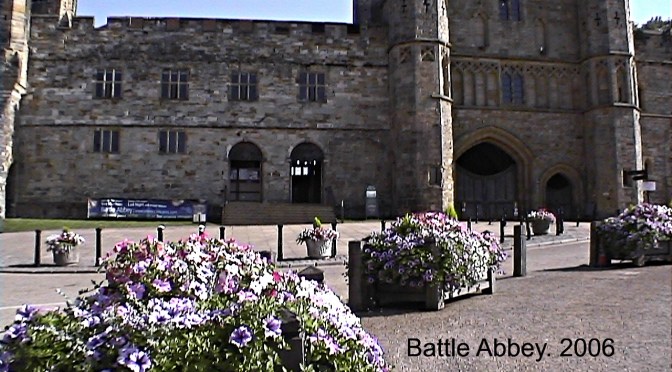
Archeological investigations at Battle Abbey, which is said to be built on the site of the battlefield, apparently show no indications of a battle taking place there. Medievalists.net cites a paper, “Heathfield Down: An Alternative Location for the Battlefield of Hastings, 1066,” by Rebecca Welshman and Simon Coleman. This paper suggests that the battle might have taken place at a place called Heathfield Down. (I also came across something that stated that this place is also known locally as Slaughter Common.)
“Welshman and Coleman also find importance in a passage from the Anglo-Saxon Chronicle (D text), which explains that “com him togenes æt þære haran apuldran, and Wyllelm him com ongean on unwær, ær þis folc gefylced wære.” (“[Harold] came against him [William] at the grey apple tree. And William came upon him by surprise before his people were marshalled”). They believe that the English forces would have gathered at this apple tree because it was a significant landmark. There was such a ‘hoar apple tree’ in Heathfield that served as a boundary marker.”
If you go on to read the article, you will find an interesting map to show how the coastline has changed since 1066, and a section on how the weather would have impacted the battle if it took place on Senlac Hill.
In my current WIP, Wrath of an Anglo Saxon, I haven’t bothered too much about the situation of the battle, but more about the battle itself and the aftermath. This battle had a huge impact on life in England and is considered the beginning of the feudal system, whereby there is a strict hierarchy with the king at the top. and the peasants, or villeins as they are sometimes called, at the bottom. (This is where we get our word ‘villain’ from, although now it had become perjorative in its use.)
Here is an extract from the work g. Please bear in mind that this is certainly not the finished version, but only the first draft.
Durstan has been knocked unconscious during the battle. When he regains consciousness, he makes his way to where the defeated Anglo Saxon troops have gathered. After being treated for a head wound, he sleeps.
Durston opened his eyes, only to close them again quickly.
Who made the sun so bright?
Gradually, he tried a tiny sliver. Not too bad. He parted his eyelids a bit more until they were fully open.
He reached to his head and let his fingers probe his injury.
It hurt, but like a bruise. It didn’t feel as if anything inside was damaged. He struggled to his feet. A bit of dizziness, but the trees were standing still now. He glanced at the sky. Still quite early.
He ambled towards where he met Earl Edwin yesterday. There was a lot of activity. A few more men had arrived, and as he watched, two more straggled in. Some of the men were seriously injured, and Earl Edwin ordered them to be carried to the healers.
Durston approached the earl. “My Lord, I am much recovered. I would like to gather those of my followers who survive and join with any counter attack.”
Earl Edwin turned to him. “Ah! Theign Durston.” He turned to a tall dark-haired man standing next to him. “Theign Durston was injured in the battle. I sent him to the healers. A blow on the head, it seems.”
“Well met, Theign Durston. I am Earl Morcar.”
Two men rushed up to the two earls carrying a man between them. They set him on the ground and bowed to the earls.
One of them panted, hands on knees. “My Lords, we found the king’s body and brought it here.”
Earl Edwin glanced at the corpse on the ground before him. “This man is not dressed like the king. He is dressed as one of the ordinary fighters.”
“When we found him, sir, he was dressed as a king should be, with the crowned helmet.”
Earl Edwin glared at the two men. “Then where is it now? Have you stolen it? Is it hidden for you to collect later and sell to the Bastard?”
The second man looked stricken. “No, my Lord. We wouldn’t betray our country.” He turned to his companion. “Tell him, Cenric.”
“We was searching for any survivors, my Lord, when we saw the king. We knew him by his helmet, see. I’ve never seen the king, so that was how we knew it were him.” He coughed. “He were obviously dead, but we knew we should bring him back here.”
His friend nodded. “But there were a lot of the enemy looking for their survivors, so we thought,’What if they catch us wi’ the king?’ We spotted a body close by. Been shot with an arrow right through his eye, he had.” He shook his head. “Poor bastard. Must have been a painful way to go.”
Cenric continued. “We took his armour and clothes and swapped them with the king’s, so no one would know that the body we had was King Harold.”
Earl Edwin knelt next to the body. “He’s pretty cut up.” He peered into the face and looked up to Earl Morcar “It’s Harold, alright. I knew him quite well.” He turned to the two men. “Well done. You will be rewarded. Go and find some rest while we decide what to do with him.”
Durston staggered. His head still hurt and standing listening to the two men and the earls had made him dizzy.
Earl Edwin turned to him. “You need to go home, Durston. We’re planning a retaliation to take our country back, but I don’t think you are fit to join us.”
Durston’s heart sank. His stomach felt filled with lead. He wanted to fight; to help kill William the Bastard and to see young Edgar Aethling on the throne. His feet dragged as he made his way back to where the injured were being tended.
Plonking onto a log, he sank his head into his hands.
Someone spoke. “Are you unwell, my Lord?”
He glanced through his fingers. It was Hrodgar, one of his loyal followers. He lowered his hands. “I’ve just been told I can’t help in resisting this takeover.”
“With all due respect, Lord Durston, I think the earls are correct. You were unconscious for a long time, I heard, and are still suffering the effects.”
Durston shook his head and immediately regretted it. Pain shot through his brain. He sighed. “I suppose you are right. I would be a hindrance, not a help.”
Hrodgar went away and returned shortly with a flagon of ale. Durston drank gratefully and stood. The dizziness had gone. “How many of our men survived? Do you know?”
“Only about four or five, I think.”
Durston groaned. All those others dead. They had families, too.
“Lord Durston.” A voice sounded through his thoughts.
A young man approached. Durston has seen him with the earls.
“Earl Edwin wants to see you, my Lord.”
Durston followed the young man to where he had been talking to the earl.
“I have a job for you, Durston,” the earl said. “We must take the king’s body away from here. There’s no saying what those Norman’s would do with it if they found it.” He pulled at his beard. “Since you have been injured in the fighting, I would like you and a few of the less seriously injured, to take the king’s body to Waltham Abbey. It was a place close to his heart. The king can be buried there with the correct ceremonies.”
Durston felt his heart sink once more. He was being sent away. Away from the defence of his homeland.
It will be a while before this book is published, but I’ll keep you informed as to its progress.
If you enjoyed this brief extract and would like to read more of my work, you can click on the book cover in the side bar to take you to the online retailer of your choice.
I wonder how correct the new ideas about the battle site are? What do you think?
I ‘ve started writing book 3 in my series, A Family Through the Ages. Book 1 was set in Roman Britain, Book 2 in Viking Britain, and now Book 3 begins with the Battle of Hastings in 1066, probably the most remembered date in British history. Not for nothing, as it changed this country vastly.
Anyway, to whet your appetites, here’s the first chapter. It contains some violence, as it deals with the Battle itself.
Please remember that this is a very early draft, so there might be mistakes.
Anger of an Anglo Saxon
CHAPTER 1
Durston stood with his shield locked with the ones on either side. A helmet covered his ash blond hair, and a breastplate made of hardened leather covered his torso.
He turned to the man on his left. “We’re in a better position. We should win this fight easily.”
Looking down the slope, he could see the Norman army gathering. There were many archers behind their infantry. He swallowed hard. The Anglo Saxon army did not have nearly as many. His legs felt weak and his hands shook. What if he were killed here? His son, just fourteen, would be the new theign. The lad did not have the experience to deal with the work.
Pull yourself together. Leola will help him. She’s competent. He smiled as he thought of his wife.
Taking a deep breath, he focused on the enemy.
His neighbour turned to him and grinned. “They won’t be able to use yonder horses against us. Shouldn’t be hard, this one. We’ve got the high ground. If we can kill that William the Bastard, they’ll run back to Normandy like rabbits before a fox. Should have this done by noon.”
The Anglo Saxon army had hurried south from defeating an attempted invasion by the Norse king and King Harold’s brother, Tostig, at Stamford Bridge. They were celebrating when the news of the invasion from Normandy came.
King Harold immediately demanded a forced march to the south coast to repel this new threat to his kingdom. On the way, they gathered more men, all willing to fight to protect their country from foreigners.
As Durston watched, a single person came out from the enemy lines.
The man sang as he brandished a sword. Durston could not understand the words, as they were French, but he understood the tone. The man sang insults and threats, underpinned by his sword waving.
As soon as his song ended, he ran towards their line. Durston’s eyes opened wide and he shook his head. The shield wall opened, a little to his left, and the singer was quickly cut down.
Then the battle began.
The twang of bowstrings filled the air, followed by the wizz of arrows. The men in the shield wall raised their shields as arrows fell like raindrops. The Anglo Saxon archers replied with volleys of their own, although they were fewer in number than the Norman archers.
Men shouted war cries, those who were hit screamed, arrows clanked on raised shields.
The two shield walls collided with a bang.
Men on both sides pushed as hard as they could, at the same time trying to spear those opposite.
The air was filled with the scentl of blood. Durston gasped as an enemy spear found a way through a small gap and cut his left arm.
He thrust back and was gratified to hear a scream of pain. “That’ll teach you to try to invade my country.”
The October sun rose in the sky as the fighting continued. Durston swallowed. It was thirsty work, this fighting. He glanced at the sky. Nearly noon. As he continued to thrust against the enemy shield wall he felt a tap on his shoulder. He dare not look round.
A voice. “Go get something to drink.”
He slipped his shield from its lock with those on either side and the man relieving him quickly took his place.
Durston staggered to the rear of the shield wall. He spotted a fallen tree trunk and sank onto it, leaned forward and put his head in his hands. He shivered uncontrollably. The hours in the shield wall took their toll.
“Here’s some ale.”
He glanced up to see a young man about thirteen years old, holding a flagon.
Reaching out, he swallowed it in one gulp. “Thank you.”
Someone handed him a chunk of bread and a slice of meat. He stuffed it into his mouth and stood. His legs gave way and he found himself sitting on the floor. Leaning against the log he had been sitting on, Durston closed his eyes. The fear came creeping back. He looked at the cut on his arm.
I hope that doesn’t turn bad.
He felt his eyes closing. In spite of the noise from the battle, he was drifting to sleep. Shaking his head, and ignoring his shaking legs, he pulled himself to his feet and staggered back to the shield wall. He relieved another man and locked his shield in place with the ones on either side.
Once back in the battle, the fear slipped away. Anger swept over him in its place. How dare these foreigners come to take over his country? His legs stopped trembling and his eyes opened wide. Showing his teeth, he grimaced.
The man in the enemy shield wall was also showing his teeth. He shouted a cry, but Durston did not know what it meant.
“For King Harold,” he shouted in reply.
Someone to his left cried out, “They’re running!”
Durston glanced and saw that the Norman shield wall had broken, and men were running down the hill. Someone shouted to keep the formation, but many of the Saxon defenders took off after the fleeing Normans.
Then Durston could see no more as he concentrated on his own battle.
The afternoon slowly passed. Men were relieved on the battlefield on both sides, but after they had shot most of their arrows, the Normans concentrated on the shield wall. They found it impossible to collect their spent arrows from beneath the feet of the two opposing armies.
Again, the Normans retreated. This time Dutston was aware that after running, and being chased, they turned on the Anglo Saxons chasing them and a hand-to-hand battle began. The Normans in front of Durston did the same. As they ran, Durston was unable to prevent his men from chasing.
“The cowards are running,” someone shouted.
“No, it’s a trick.” Durston tried to call his men back.
As he expected, the Normans turned on the chasing men. With the shield wall dismantled, the Norman cavalry charged. Durston threw his spear at one man bearing down on him. The spear hit his horse in the leg. The animal screamed and went down, throwing its rider.
Durston drew his seax. As the man regained his feet, Durston slashed at his face. Blood flowed as a long cut appeared from his ear to his chin. He screamed.
The downed rider staggered, giving Durston the chance to get in another slash. This one, however, only hit the man’s hauberk, but it did damage the chain mail that made it.
The man let out a grunt as the air was forced out of his lungs. He raised his sword, and Durston only just managed to dodge the downward slash as it narrowly missed cleaving his skull.
Another slash from Dursto’s seax caught the attacker’s leg. He went down, blood pouring from the wound. He screamed something Durston did not understand, but thought it was probably a curse. Before the man finished his curse, however, Durston’s seax slashed across his throat. His curse was never finished.
Durston took a breath. For the moment no enemy approached. He glanced to his right. There, a young man, one of his followers, was beset by two Normans.
He raised his seax, and shouted, “For King Harold.” He rushed at one of the men. This distracted him and he turned, allowing Durston to slash at his stomach. It opened, and the enemy soldier clutched his belly and fell, his guts spilling out and tangling around his feet.
Durston saw the young man dispatch his adversary before turning to look for another man to fight. He saw a man with a mace approaching. He raised his seax, but the enemy lifted his shield and blocked the cut.
The two skirted around each other, getting in the occasional hit on a shield, but neither getting the better of the fight. Durston’s legs began to shake, and it was more difficult to raise his shield or slash with his seax.
He looked at his opponent who was breathing heavily.
He’s exhausted, too.
At that moment, the Norman raised his mace and brought it down on Durston’s head.
***
Durston opened his eyes.
It was dark. His head hurt. He raised his hand to his head and felt something sticky.
Blood.
His helmet had gone. When did that happen? He placed his hands on the floor and raised himself to his elbows.
His head pounded.
Rolling onto his front, he struggled to his hands and knees. He closed his eyes briefly. It made no difference to the dark.
He raised himself to his knees and looked around. He could see very little. The darkness was like a blanket wrapping around him, determined he would not see anything.
Durston sat back on his heels, listening. Rustling sounded to his right. Something brushed against him. He swung his hand and made contact with a furry body. It squeaked as he bashed it away.
Rat. Nasty things.
Millions upon millions of stars covered the sky. Durston tried to decide the time by their positions. The sun had been still up when he was fighting. Someone must have hit him on the head. How long had he been unconscious? He estimated it was not yet midnight.
He managed to struggle to his feet. Dizziness threatened to overwhelm him, but he fought against it.
It was then he heard the singing. Must be our men singing their victory songs.
Staggering, he headed in the direction of the sounds. He passed hundreds of bodies, both Norman and Anglo Saxon. Horses, too. He felt sorry for the animals. They had not asked to come to fight. They knew nothing of the politics that caused this battle.
A shadow stood over a body. As Durston approached, it raised its head from its grizzly meal. Teeth bared, the wolf snarled. Blood dripped from its muzzle.
Durston backed away. “I’m not going to take your meal, revolting as I think it is.”
The wolf returned to eating the body of one of the fallen, whether Norman or Anglo Saxon, Durston could not tell.
Wolves, rats and foxes tonight. It’ll be crows, ravens and kites in the morning.
As he neared the camp where he heard the singers, Durston stopped. He crouched. He listened carefully. He recognised neither the songs, nor the words. Someone spoke.
Not Anglo Saxon.
The bastard Guillaume won the battle. How? We had the better position. And they ran away.
It came to him slowly. With his head pounding and his dizziness, his thoughts were sluggish, as though they had to wade through mud to get into his consciousness.
It was a trick. They feigned flight, then turned on us. They couldn’t beat us in the shield wall, so they broke it up by pretending to run.
Durston tried to raise himself from his crouch. He staggered and fell to all fours.
Blast. Did they hear that?
Someone shouted and Durston scrambled away, still on hands and knees. Then the shout stopped. Normal conversation resumed.
Must have decided I was a wolf.
When he was close to some trees, Durston stood. He leaned against a tree to get his bearings. Where was their camp? Had anyone returned to it? Would the Normans have found it and ransacked it?
He lurched in the direction of where the Anglo Saxon camp had been. When he arrived no one was there. Not even a horse. He felt the tears welling in his eyes. Dizziness threatened to overcome him.
No one? Was no one left alive?
A sound came from behind him. He swung round making the world spin. He drew his seax.
“Careful. You are in no condition to wield that safely.” The voice came from a stand of trees. A man stepped out. He smiled at Durston. “It’s good to see you, Lord Durston. I was afraid you had been killed.”
Durston frowned, staring at the man. “Do I know you?”
“No. Probably not, My Lord. I wasn’t one of your followers. I hold a farm not far from Alricking. When news came that Duke William had invaded, and King Harold’s army passed, I decided to join. To defend my country.”
Durston sank to the ground. “We lost.”
The man shook his head. “Yes, My Lord. We lost the battle.” He approached Durston and held out a hand. “The survivors are assembling a little distance away. Let me help you.”
“I suppose King Harold is organising an attack on the Normans’ army.”
The young man’s face fell. “King Harold is dead, My Lord. He fell in the battle.”
Durston groaned. “Who is in charge, now?”
“Lords Edwin and Morcar.”
Durston allowed the young man to help him to his feet and, with Durston leaning heavily on his arm, they proceeded through the trees.
I wish this headache would go. I can’t think clearly.
After what seemed to Dunston to be hours, they broke into a clearing. He glanced around and noticed many men. Some lay on the ground, moaning, some sat on the ground or leaned against tree trunks and others moved around the wounded, administering bandages.
“You found another survivor. Good. Now return and wait to see if any more turn up. When day breaks, come back here.” The man turned to Durston. “I’m Earl Morcar. You are?”
“Theign Durston, My Lord. Of Alricking.” He swayed on his feet.
“You are injured.” Earl Morcar called to a young man who was passing. “Help Theign Durston to the healers.”
The young man took hold of Durston’s arm. He guided him toward where healers worked on those injured. The scent of blood permeated the air along with the groans of men.
A woman covered in blood hurried over to them. “Another injured man?”
Durston glanced around. Cuts, stabs, bruises covered most of the men. One was missing an arm, and he saw two men with missing eyes.
The healer took his arm from the young man who escorted him. “I see you’ve a head injury. We’ll get it cleaned up in no time.” She paused as Durston staggered. “Do you have a headache?”
Durston nodded, then regretted it as his head pounded. “Yes, it’s the worst headache I’ve ever had.”
“Did you get a blow to the head?” The woman lowered Dunston to a seat on a log.
“I don’t know. I can’t remember much. I helped one of my followers who was beset by two men. Then a man with a mace approached me. The next thing I knew, I woke up in the dark. Beasts were devouring the dead. At least, I hope they were dead!”
The healer cleaned the wound on his head, which bled profusely, and told Dunston to lie down anywhere he could find a space. “I’ll bring you some willow bark tea if we’ve any left. Should help with your headache. You must rest,” She scurried away.
We can’t let these Normans win. I need to go back and fight them again. Is Earl Morcar organising a new attack?
He tried to stand, but his legs gave way as the clearing span around him. He decided he should take the healer’s advice and he lay in the space between the log he had been sitting on and an oak tree. Soon he was asleep.
 Dragons Rule OK. V.M.Sang (author)