From today, The Stones of Earth and Air will be free on Amazon until 18th September.
Don’t miss this chance to get your free copy of book 1 of Elemental Worlds.
From today, The Stones of Earth and Air will be free on Amazon until 18th September.
Don’t miss this chance to get your free copy of book 1 of Elemental Worlds.

Judas Iscariot. A name reviled down the ages. It was thought he committed suicide when he realised the enormity of what he had done in betraying Jesus Christ, but his punishment is far worse.
God condemned him to walk the Earth forever, never able to die.
Now he has been given a task. He has to look after a small girl until she passes her seventh birthday. Just a few days. that’s all. A simple task, you would think, but, of course, it’s never that simple. This is a special girl. One who will prevent Lucifer from entering the world.
Lucifer actively seeks the child, sending his devils in disguise. Murder and meyhem ensue…
I am not saying any more about the plot of this book. I don’t want to spoil it for you.
The character of Judas is well drawn. He is complex, as one might expect, having lived 2,000 years. The other characters are believable, too. There is the policeman who is forced to re-evaluate his religious beliefs when confronted with the evidence of his own eyes, and also the hooker dragged into the conflict, who shows courage she didn’t know she had.
Finally, Charlotte, the little girl. She is very much like a typical six-year-old, except for the fact that the horrors she witnesses do not seem to faze her. Yes, she is afraid, but a normal child of her age would be traumatised. But then, she’s not a normal child, is she?
The writing is good. The pace keeps you on the edge of your seat, waiting for the next event. At first, I thought I would not like the fact that it is written in the present tense, but as I got into the book, I realised it adds to the immediacy and tension of the story. It also helps wit flashbacks, which are written in the past. You know that this is a previous event.
There is one thing that I found a bit disconcerting, though, Towards the cmimax of the story, the author does rather a lot of ‘head-hopping’, jumping from one charachter’s point of view to another.
All in all, a good read,
I am probably an old person who does not understand the latest *or not so latest( fashions, but there are some that really confuse me. Here are a few below.
Ripped jeans. What’s that all about? I know I’m no longer in the first flush of my youth, but to me it looks scruffy. It also says you can’t afford a new pair of jeans and are too lazy to mend your ripped ones. A friend’s daughter went to visit her boyfriend’s sister. After they had left, the sister’s daughter said ‘I like Auntie …… It’s a pity she’s so poor.’ The mother asked her what she meant and the child said, ‘Well, her jeans are all ripped. she obviously can’t afford a new pair.’
Then there’s the trousers hanging off the bottoms of young men. This seems to be passing, but I still see a few of them. they look as though they’re little boys wearing their dad’s trousers. I saw one young man whose trousers were so low that he had to walk as though he had severe problems in order to keep them up.
Then there are tattoos. They are fashionable at the moment, largely, I suspect, because of the large numbers of footballers who sport them. The so-called ‘sleeves’ look, to me, like dirty arms. I often wonder what these tattoos will look like when the owners are no longer young and fit, and are becoming wrinkly and flabby.
So many people, not only the young, wear clothing unsuitable to the weather. I’ve seen young girls out in strappy tops when, although it’s been nominally summer, it’s not been warm. In fact occasionally it’s been cold and windy–temperatures below 15oC. Then there is the other end of the scale. People, often older people, wearing jackets and coats when it is above 30oC. I said not wonder some old fold die when it gets hot if they insist on wearing coats in the heat.
I’m sure I can think of other mysterious fashion quirks if I sat around thinking, but that will do for now.
Please leave a comment, either agreeing or disagreeing with me. And if you can explain why these things are attractive, all the better.
This month I have managed to prize an interview out of
Magister Robiam, the chief mage in the Mage Tower in 
Hambara.
Me: Thank you very much for allowing me this time in what must be a very busy schedule.
Robiam: Not at all, my dear. We must keep the press happy. Magic is still not fully trusted you know.
Me: After the Mage War and the Forbidding I suppose you mean. Arch-Mage Yssalithisandra told me about that.
Robiam: Yes. I can’t understand why it is taking so long for people to realise that
magic isn’t evil. It’s just a tool, and the users can equally put it to good or bad use. Just as a knife can be used to cut up food for the preparation of a meal, and also to kill or injure someone. The knife isn’t evil, just the user.
Me: Quite. You are a magister, sir. Tell me what that means.
Robiam: It is the highest rank that a mage can reach. When an apprentice passes
his or her tests, they are welcomed into the ranks of mages and go by the title
of simply ‘Mage’. The first year of their ‘mageship’ if you wish to call it that, is a
probationary year. They cannot ‘fail’ this year though. It is mainly to let people know
that this person is very newly qualified. Thus, folk know that their experience is limited
and not expect too much of them. The probation can be extended or shortened.
depending on the mage in question.
Me: What happens after the probation is finished?
Robiam: The mage continues to be a simple mage until, or if, they reach a certain
standard when they will become an Arch-Mage. Many do not progress beyond
being a simple Mage of course.
Me: And to progress to Magister an Arch-Mage must reach another, much higher
standard?
Robiam: You’ve got it; but the level for Magister is extremly high and few manage
to make it.
Me: So there are only 3 ‘levels’ in the magic profession?
Robiam: Yes. Of course, once there were many more. Newly-qualified mages were
known as a Conjurors, then they would progress to Magicians, Sorcerors, Wizards etc.
Me: Why was this scrapped?
Robiam: It was too cumbersome, and mages are rather fond of their independence. They are free spirits, if you like. They do not like to be regimented, and so it was simplified.
Me: Why not do away with ranks completely then?
Robiam: It was suggested, but the Magister in charge of the Tower at the time thought
that the general public should have at least some idea of the power of the mage they
were dealing with, and so it was decided to retain 3 ranks. (Although if you consider it,
there are really 4, including the probationary mages.)
Me: Thank you for making that clear, Magister. I was wondering, however, ahout those
who fail their mage tests. What happens to them?
Robiam: Unfortunately there are always a few who have a little magic but insufficient to pass the tests. We do not turn them out into the world to create havoc, which they could easily do. We make them associates of the Tower and they become entertainers, keep shops selling magic items, become adventurers etc.
Me: Thank you very much, Magister for your time.
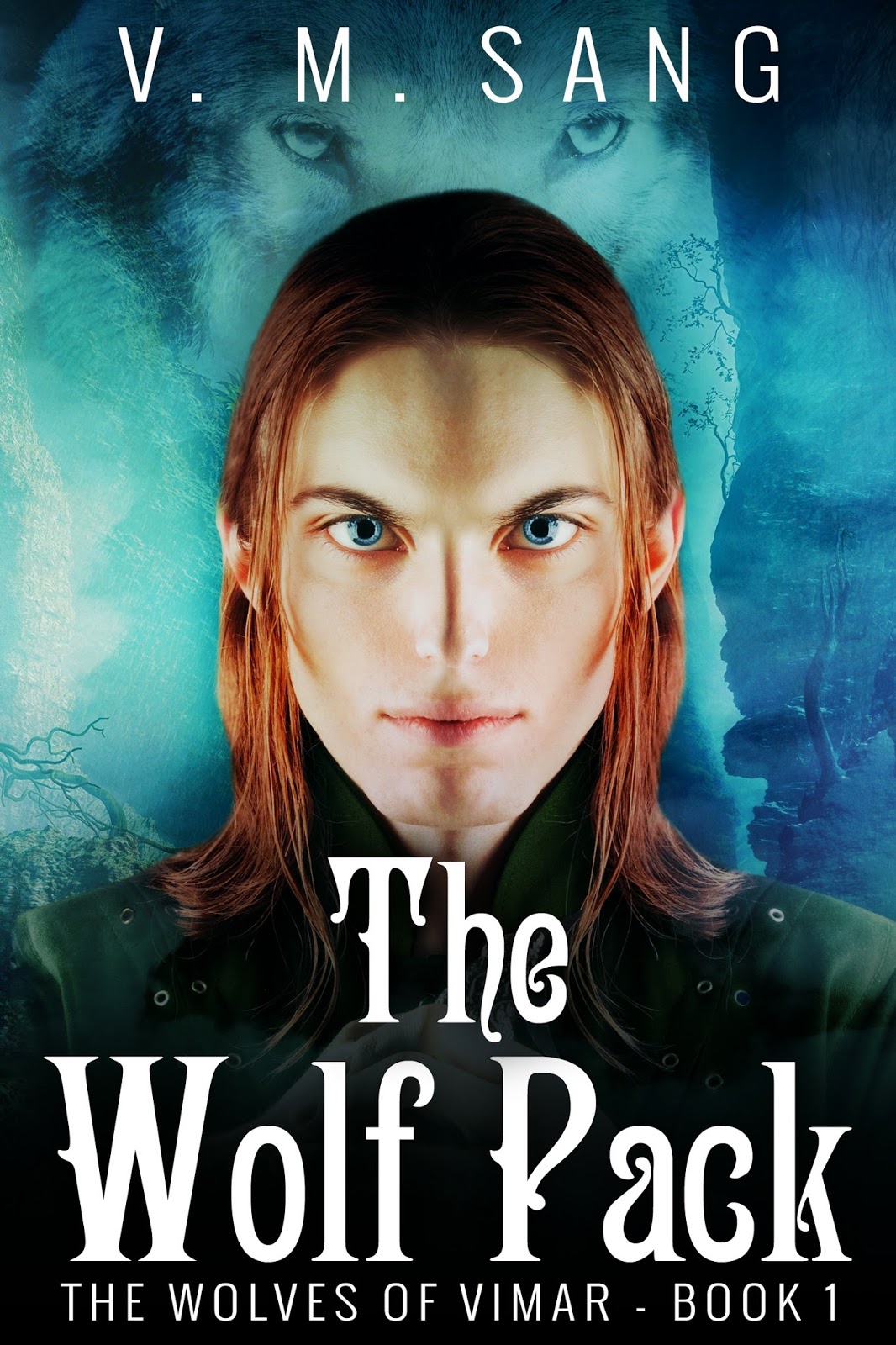
If you would like to know more about the magic on Vimar, the world in which Magister Robiam and the other people I’ve interviewed live, you can buy the first two books in the Wolves of Vimar Series, available from Amazon in ebook ot paperback formats. They are The Wolf Pack and The Never-Dying Man. Follow these links.
If you have read either or both of these books I would be most grateful if you would post a review, Reviews are important to authors because it is the main way that other people find their books. If you have done so, or are going to do so, Thank you very much.
The Stones of Earth and Air will be released next week. It’s book 1 in Elemental Worlds. Here’s a bit about it.

Pettic is the best friend of Torren, the Crown Prince of Ponderia. When Torric starts behaving out of character, Pettic sets about trying to find out why. He discovers that Torren has been kidnapped and a doppleganger put in his place.
He decides he cannot let his friend remain a prisoner, nor allow the cruel impostor to remain as Crown Prince and ultimately King as he would no doubt become a tyrant. Pettic therefore sets about rescuing his friend.
He discovers that Torren is imprisoned in a mini-plane created by a magician. The only way in is using four gems associated with the four elements, Earth, Air, Fire and Water.
There is a problem, though. Each gem has been hidden on one of the four Elemental Worlds. Pettic resolves to enter each of these worlds and find the gem. How can he find a single gem in a whole world, though? And he can’t return without the gem.
On each world, he has to perform a task to help the inhabitants.
Can he discover the gems, or will he remain trapped on one of the worlds? What are the tasks he has to perform, and can he get back and then enter the mini-plane and rescue Torren before the false prince becomes king?
English is a strange language. There are many words spelled the same but pronounced differently, also there are words pronounced the same, but spelled differently. then there are words that are the same in spelling and pronunciation but have different meanings, depending on context.
The strangest, in my opinion, are words ending in -ough.
We have:
Though, pronounced ‘tho’
Bough, pronounced ‘bow’. (although that in itself has different pronunciations)
Enough, pronounced ‘enuf’
Thought, pronounced ‘thort’
Through, pronounced ‘threw’
No wonder foreigners have some difficulty with it, although (another one, similar to ‘though’, here) it seems they are able to manage quite well if the number of foreigners who speak the language extremely well is anything to go by.
I was in an Italian restaurant in Germany and was greatly amused to see the German waiter speaking to a French customer in English. This also happened when I was in Croatia. The Croatian receptionist spoke to a visitor, whom I think was Russian, in English. These strange inconsistencies seem not to faze them, even if they confuse some native speakers!
I’ve just received the covers for Book 1 of Elemental Worlds. Here it is.

Let me know what you think of it.

That misty isle across the sea
Will always be a home to me.
The cliffs of white that guard our shores,
The rolling Downs, the bleak, cold moors,
The skylark with his liquid song
Soaring high above the throng
Of hikers, picnickers and such,
Whose hearts he never fails to touch.
The little streams and brooks do run
Through woodlands, glistening in the sun.
The little fish are swimming here;
A kingfisher is always near.
A flash of blue above the stream,
A dive–then gone, that silver gleam
Of minnows. Gone to feed his brood
In holes, all waiting for their food.
In cities where the pigeons fly
The wind-blown litter flutters by.
The cars and buses, cycles too,
Line up at lights, forming a queue.
The city’s clamorous roar assaults
The ears, but never, ever halts.
The busy folk all rushing past
They never slow, time goes so fast.
The little market towns do snooze.
The slightest little thing is news.
In pretty villages with greens
Are cottages with oaken beams.
The church bells echo o’er the fields
Calling us with merry peals
As they have done for many a year
Bringing hope and lots of cheer.
This land does not a climate boast,
Just weather, blown from coast to coast.
All in one day this land can get
All four seasons, sun and wet.
Though no extremes do us attack
Do not go out without a mac
For rain can come at any time,
Though rarely with a gale force nine.
The English folk are stubborn, too
As we evinced in World War two.
We do not push, but stand in line
Waiting patiently ’til it’s time.
We do not wail and wave our arms,
For such behaviour has no charms.
But when we’re roused, then just watch out!
We’ll demonstrate, wave flags and shout.
And so my country is unique;
Its people are not really meek.
An upper lip that’s stiff conceals
A wicked humour that reveals
Our lack of deference for power,
Our love for bird and bee and flower.
Abroad may have its charms, it’s true
But England’s magic’s ever new.
V.M.Sang
April 2014
There are two things that I want to tell you today. they are things that annoy me somewhat when I come across them. the first is how to create superscripts and subscripts.
So often I read 25C or H2O. They are both wrong. The Celcius scale is measured in degrees. and the formula for water needs the dropped 2 or it means, if it means anything, one atom of hydrogen and two of oxygen Which is an impossibility anyway.
This is a very simple thing to rectify. Simply click on ‘format’ on the toolbar and click on Font.
You will get the following window opening.

Check the superscript or subscript box, whichever you want and click OK. Then type what you want to be super- or subscripted. Go back to Format, Font and uncheck the bod. Click OK and you’re ready to go.
Unfortunately, WordPress does not recognise the superscript nor the subscript, and when I copied this into WordPress, it came out without these corrections. I had to remove the corrected words.
The other thing that irritates me when reading is when there is an apostrophe at the beginning of a word. (such as ’till, an abbreviation of until) So often, this comes out as ‘till, which is. of course a quotation mark and not an apostrophe. (A quotation mark that is not closed, either.)
In order to prevent this, it is very simple. You can fool Word into thinking it’s an apostrophe in the middle of a word by not pressing the space bar until after you’ve typed the two words.
EG. Wait here’till I arrive.
Then you simply go back and put in the space. Word will then keep the apostrophe the right way round.
Wait here ’till I arrive.
Both quite simple really, but are usually done wrongly, either because the writer knows no better, or through ignorance of the means to correct it.

For those of you who have never heard of Terry Ravenscroft, he is a writer of comedy. He has written for such people as Les Dawson and The Two Ronnies, and has also been the script writer for such shows as Alas Smith and Jones, Not the Nine 0’Clock News and many others.
This book does not fail to live up to the expectations such a CV would lead one to expect. It is full of humerous anecdotes of his escapades with his friend, Atkins.
Atkins seems to be just the same kind of person as Terry Ravenscroft and the two egg each other on to all kinds of misdemeanours from misleading someone in a charity shop to believe he had found a valuable piece of pottery to annoying cold callers on the telephone.
This is the second book Mr Ravenscroft has written about his life in retirement and I am looking forward to reading Book 3.
Definitely worth a read. I award it 4.5 stars, rounded up to 5 stars for Amazon.