Category Archives: history

Boudicca’s Revolt

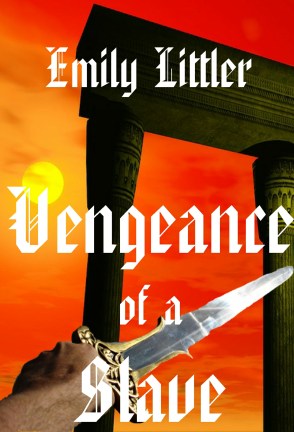
As you will know if you’ve been reading my pages, I also write under the name of Emily Littler. The novels (well, one to date and another on the way) I write under that name are Historical novels, and the first, Vengeance of a Slave, is set in Roman Britain. I thought it might be interesting to give a little background and so I am posting a few bits that I think you might be interested in. The first is about a woman who most will have heard of. Boudicca, sometimes known as Boadiccea, Queen of the Iceni in Eastern Britain.

boudicca-359043_1280

The year is 60 AD. Suetonius, the governor of Britannia is off on the island of Mona, putting down a revolt of the Druids there. This island, off the coast of North Wales, is a stronghold of the Druids. The Romans hate them. I suppose it’s because they refuse to worship the Roman gods, and deny that the emperor is a god.

I am of the Iceni tribe, and I have seen what has been happening. Our king, Prasutagus, has died, but, he made his will and has left our lands to his two daughters and the emperor, Nero, to govern together.

I suppose he thought he would secure the safety of the tribe by having the emperor himself a joint ruler. However, things seem to be turning out very differently.

After Prasutagus’s death, Nero decided he was going to be the sole ruler of our lands, and he has sent troops to annex them. Needless to say, this has angered Boudicca, Prasutagus’s queen. Nero has wilfully ignored her husband’s will.

Prasutagus was an ally of Rome, and this is how his last will and testament is being treated. Still, this is the emperor and his greed is notorious. Indeed, the greed of all the Romans for land and other goods is well-known.

Boudicca has made her anger known to the Romans. They are not pleased. I heard the soldiers took her and flogged her, then raped her daughters. I am worried about what will happen now. Queen Boudicca is a strong woman and I don’t think she will readily accept this treatment.


I was right. Boudicca is full of anger. She is planning a revolt. No, a war. She has gained the support of the Trinovantes, and it is said, some other tribes too, as well as the Iceni. They are marching to Camulodunum. The Romans have erected a temple there to their emperor, Claudius. And at our expense. The cheek of it. The Romans say their emperors are gods. Crazy folk, these Romans.

But we Britons have a great history. We saw Julius Caesar off when he came to conquer, so why not these Romans, and why not with Boudicca at our head?. She’s a great leader. She inspired her army with these words.

“It is not as a woman descended from noble ancestry, but as one of the people that I am avenging lost freedom, my scourged body, the outraged chastity of my daughters. This is a woman’s resolve; as for men, they may live and be slaves.”

Well, she did it. she managed to conquer Camulodunum. They say she razed it to the ground and slaughtered the inhabitants. Perhaps a bit violent, as many died who were not Romans. But that happens in War.

Boudicca besieged the remaining people in the temple of Claudius for two days. The Romans living there sent for help, but only 200 auxilliaries turned up, so it was easy to fight them off. Very few of them survived.
‘Londinium next,’ they said. ‘The army is going to do the same there as they did in Camulodunum.’ They didn’t expect the rest of the army to come marching down Watling Street from Mona in response. The Romans made for Londinium, but we were too many for the Roman army and so they left.

Londinium was not important enough, evidently, for the Romans to fight for it. In spite of the pleas of the population, mainly traders and merchant vessels. Suetonius, the commander of the army, left the city to Boudicca.

Our army reached Londinium, and finding little or no resistance, they razed that to the ground too, just like Camulodunum. Many of the population had left with Suetonius, but the army put those who had remained to the sword, then burned the buildings.

The same fate awaited Verulamium, a little further north. The slaughter was terrible, they said. Boudicca had no interest in taking prisoners even as slaves, but killed everyone in the most brutal fashions she could think of. They say that in the slaughter, of the three towns, between seventy and eighty thousand people were killed.

Boudicca and her followers made sacrifices of some of these people to the gods. Were the gods pleased? who knows. The following events don’t seem to suggest as much.


While Boudicca and her allies were slaughtering and burning, Suetonius was busy. He regrouped his army and he called on his own force, the Legio XIV Gemina, and some vexillationes from the XX Valeria Victrix. Although the Legio II Augusta di not come to Suetonius’s call, nevertheless he managed to amass around ten thousand men. Then they marched to meet our army.

Suetonius took a stand somewhere along Watling Street, in a small valley with a wood behind him. He was still heavily outnumberd by Boudicca’s forces, though. Our army, I was told, numbered about 230,000.

Boudicca made a speech from her chariot and fired up her army. She pointed out that the gods were with them because they had already routed one legion, She did not, of course, mention that it was not the full legion.

Well, a number of things were against our army that day. The terrain was narrow, being in a valley, and so we could not put any more men forward at a time than the Romans could. Then, in that valley, our chariots proved to be not very manoeverable.

At first, when we attacked, the Romans threw heavy pila at us. These were a kind of javelin, and they killed thousands of our men, rushing forward to engage battle.

Then they formed a wedge and forced our men back. They were highly disciplined, and our troops were not. We fought as every man for himself and all rushed forward as individuals, with no thought for co-operation with each other.

Then the men were forced back against the wagons where the women and children waited. That was another thing. The Romans did not bring their families to battle.

The long and short of it is that we were defeated, and heavily. Boudicca poisoned herself rather than submit to the Romans, no one knows what happened to her daughers. Perhaps they were taken as slaves, perhaps they, too, committed suicide, or perhaps, just perhaps, they might have escaped.

They say that after this battle, Nero was ready to abandon Britannia. Unfortunately, though, he didn’t. After the uprising, Suetonius started to conduct punitive operations, but Nero feared he would trigger a new uprising so replaced him. He replaced Suetonius with our current governor, Publius Petronius Turpilianus.

So that is where we are today. Under the rule of Rome. They, the Romans, say it’s good. We are at peace. they’ve stopped the inter-tribal wars and brought us what they say is culture. But we had culture before. It was just not the same as the Romans.

You can read my book, Vengeance of a Slave, set a little after Boudicca’s revolt.
http://mybook.to/vengeanceofaslave
 

Addition of a new page.

Hi, Everybody,

I have been writing historical novels under the name of Emily Littler. I currently have one pubished, called Vengeance of a Slave. I started a website in order to promote it and get it known that it exists. However, I’m finding it well nigh impossible to keep up with both this site and that one  so I’ve decided to add a page here dedicated to Emily’s novels.


New Historical Novel

I’ve just published Vengeance of a Slave, my Historical Novel set in Roman Britain, on Amazon. Since it’s a very different genre, I’ve written it under a pen name.

The book is available for pre-order and will be published on April 29th. You can pre-order it as you would an already published book, from Amazon.

If you want to have an idea of the book, then you can read an extract on http://emilynovels1.wordpress.com/ on Saturday of next week.bookcover2

Help Requested

bookcover2


I’ve written a book under the pen name of Emily Littler.

It’s a historical novel set in the time of Roman Britain. I decided to put it up on Kindle Scout. Kindle Scout is exactly what it says. Kindle scouting for authors who they then publish (rather than the author self-publishing.) They act just like the mainstream publishers in that they give an advance, (although small!) and do all the formatting and marketing as well as producing an audio version and foreign language translations.

In order to select the books, they hold a ballot. The book (s) with the most recommends will be accepted. All you need to do is click on the link below and then click on the button to nominate or recommend my book.

You can read extracts from it before you click, so you’re not nominating something you’ve not seen.

Please find a few seconds to help me. The link is below.

https://kindlescout.amazon.com/p/UZ8KQW66M6H8/

Thanks
Viv Sang

Update on my writing

vivs-high-resolution


Well, yesterday I heard that Viv’s Family Recipes is now available in a paperback edition. You can buy it from Amazon. http://www.amazo.com/ http://amazon.co.uk/ or your local amazon site.


I sent the manuscript of Elemental Worlds off to the editor, so things are beginning to move on that one. I think it’s the best one yet. No ideas as to when it will be availabe though. I’ll keep you in touch. We need to agree a cover, too. As soon as we pick one, I’ll reveal it to you all for comments.

On February 10th you can get The Wolf Pack free from Creativia, and on February 14th, Viv’s Family Recipes is also free. Take advantage of these offers and many more from 1st to 14th February. You can see the books at Sahara Foley’s website. http://saharafoley.com/creativia-publishing-free-books-from-february-1st-thru-the-14th-2017-creativia/

Charity Begins at Home?

orphan-1139042_640


I am responding to a post by Clancy Tucker that he posted on his blog, https://clancytucker.blogspot.com/. It was about The Peace Corps set up in 1961 by President Kennedy. The idea was to get young people to go abroad to countries that needed help and give that aid. Someone made the comment that he did not think there would be many volunteers from the current generation as they don’t seem to be into volunteering.

Be that as it may, my thoughts went to people here in the UK, not usually the young, who are against foreign aid. They often quote the Bible, although how many of them know they are doing so I’m not sure.

What they say is ‘Well, Charity begins at home, so we shouldn’t be sending all this money abroad in foreign aid. We should be spending it on our own people.’

They are interpreting this saying as ‘Charity begins (and ends) at home. This is not how I see it at all.

My interpretation is twofold.

people-1550501_640

 I see it as a message to parents to teach their children about kindness and love. If the parents don’t show kindness, love and helpfulness in the home, then the children won’t learn it. Thus, Charity begins at home, and as the children grow up with such a loving and caring background, they will then be able to extend that love to others.
 Then there is the other side of the same coin. If you cannot be charitable to those you live with, you cannot be charitable to those outside your immediate family.

That is how I see the saying. Unfortunately, too many disagree with me and rail against the help we send to poor countries.

Please leave any comments below.

Next week, as it’s the first Tuesday of the Month, I’ll be posting the next instalment of Asphodel’s story.

An Exciting Read

I am reviewing Dissolution by C.J.Sansom today. I bought this book because I read the third Shardlake book, having bought it in a Charity Shop, and enjoyed it immensely. I decided I like the character and wanted to know more about him, so  bought  the first two. I’ve yet to read the second one. I’ll review it when I do.

Review of Dissolution by C.J.Sansom

Blurb

It is 1537, a time of revolution that sees the greatest changes in England since 1066. Henry VIII has proclaimed himself Supreme Head of the Church. The country is waking up to savage new laws, rigged trials and the greatest network of informers ever seen. And under the orders of Thomas Cromwell, a team of commissioners is sent throughout the country to investigate the monasteries. There can only be one outcome: dissolution.

But on the Sussex coast, at the monastery of Scarnsea, events have spiralled out of control. Cromwell’s Commissioner, Robin Singleton, has been found dead, his head severed from his body. His horrific murder is accompanied by equally sinister acts of sacrilege.

Matthew Shardlake, lawyer and long-time supporter of Reform, has been sent by Cromwell to uncover the truth behind the dark happenings at Scarnsea. But investigation soon forces Shardlake to question everything that he hears, and everything that he intrinsically believes …

Review

This is the first book in CJ Sansom’s Shardlake series and I gave it five stars.

Shardlake is a lawyer at the time of Henry VIII. He is not what one might call a traditional hero. He is a hunchback whose infirmity often troubles him. He is also regarded with suspicion and superstition by those around him, but he is a clever man.

C,J,Sansom has captured the period very well in this work. There is a very real fear amongst the people that the new Protestant religion is threatening them if they are not seen to fully embrace it. The characters he has created are very believable with all the foibles of humanity throughout the ages.

The book is very well written and moves along at a fast pace, carrying the reader along with it. There are clues as to the murderer if the reader can manage to piece things together. I didn’t, and so was surprised at the ending.

I am looking forward to reading the next book in the series.

If anyone wishes to make a guest appearance on my blog, please message me. I would be only to pleased to welcome you.

20 commonly mis-spelled words

Here are some commonly misspelled words in English. 113biggestbookdubai

 Acceptable, not Acceptible
 Accessible, not Accessable
 Achieved, not Acheived
 Acquire, not aquire
 Analysis, not Analasis
 Business, not Busness
 Ceiling, not Cieling
 Consistent, not Consistant
 Definite, not Definate
 Discipline, not Disipline
 Exhilarate, not Exilarate
 Exceed, not Exeed
 Forfeit, not Forfit (or Forfiet)
 February, not Febuary
 Height, not hight (or hieght)
 Heirarchy, not Hierarchy (or Hirarchy)
 Independent, not Independant
 Inoculate, not Innoculate
 Leisure, not Liesure
 Liaise, not Liase

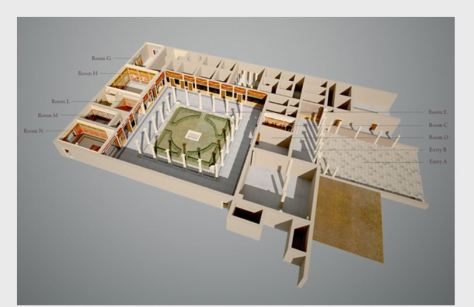
English is a very odd language as far as spelling is concerned. This is because it has words and roots from many other languages. There are still a few Celtic words, although not very many. Then the Romans came bringing Latin.

romanvilla

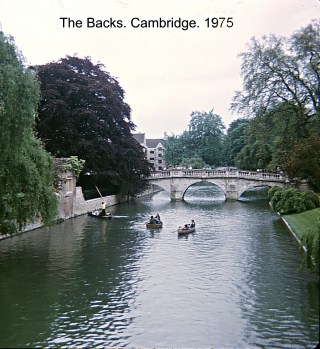
Latin was the language of scholars and it is only within living memory that it was a requirement to gain entry to Oxford and Cambridge Universities in England. The Roman Catholic Church used Latin in its services until comparatively recently, and many mottos are still in Latin.

080backscambridge

After the Romans left these isles, we were invaded by Scandinavian. These brought their own languages with them. Today, in Scotland in particular, there are many words similar, if not the same, as those in the Scandinavian languages. Dialect words often very old and date back to those languages.

There were also the Saxons. they brought Germanic languages to this country and we have many words that are very similar to the German equivalent. An example is Mutter, meaning Mother, and Haus, meaning House.

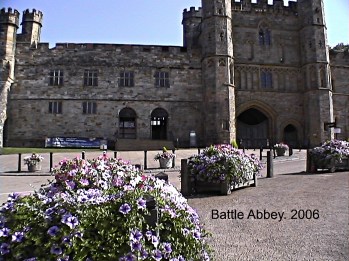
106BATTLEABBEY

After the Saxons came the Normans. They were, incidentally the last people to successfully invade these isles. This was in 1066. They brought French. The Normans became the ruling classes and spoke French. The workers spoke Anglo-Saxon. This explains why we have differences in the names of food we eat and the animals it comes from.

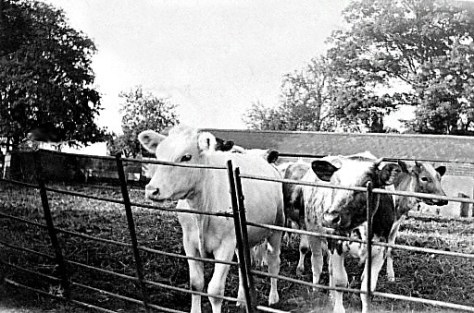
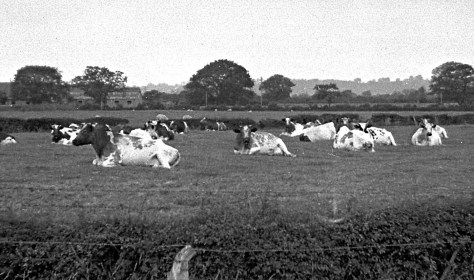
The French for a bull is Boeuf from which comes Beef. But in the field it is called a Bull, cow or in the plural, cattle.

060bluealbioncowscastletowncropped

The French for a sheep is Mouton, from which comes Mutton, but in the field it’s still the old word, sheep.

The French for a calf is Veau from whence we get Veal.

060calvescastletown
You get the picture.

Then Dutch engineers were brought in to drain what is now the Fens in East Anglia and they brought words with them. The British Empire was a source of words too, especially India.

So our language is something of a hotch-potch, hence the different spellings and pronunciation.

I will add to these words in a future blog. I hope you find this useful.