Category Archives: School

Why Don’t People Read More

This post was inspired by on posted by Charles Yallowitz last Tuesday.

To read what he says, click here.

I always loved reading from a very early age, but not always the books we read at school. Sometimes I did. We read The History of Mr Polly by H.G.Wells for ‘O’ level (aged 16), and it was interesting and funny.

When I went on to higher education I chose English Literature as a subsidiary subject (I think it’s called minor in the US) because I enjoyed reading.

One book we studied I refused to answer any exam questions on it (we had a choice) because I felt that analysing it would ruin it for me. It’s this analysis of books we read where I think we go wrong. Everyone has an opinion about a book from whether it was enjoyable to what it means. (Same with poetry.) Many books people read and don’t see any extra meaning; yet in school we force them to find meaning, even if there may not be one. One of the comments said that in an interview with Pinter, he stated that An Inspector Calls has no meaning beyond the straightforward story. Yet children are taught to look for one.

As a writer, I read many posts and books on the craft of writing. One thing that constantly crops up is Theme. It seems as though we all have to have a message. Well, I’m with Pinter. Why can’t I just write a story without having to have a message and deeper meaning?

Poetry is the same, in fact, more so. Oddly, the posts of mine that get the most views are when I post a poem. Yet poetry books, we are told, don’t sell.

I also think that teaching is the reason people don’t review the books they read. Memories of doing book reviews at school (usually of the books they read independently) are not good. It’s work, and not easy work, either. I have quite a lot of ratings that do not turn into written reviews. I prefer to ask my readers to leave a comment rather than a review. I think this is less intimidating. So what if I receive some that are just one line. That’s better than none.

I read to my children. One has grown up reading, and loves a good book. The other never reads fiction. Hardly any books, in fact, preferring to get stuff from the net. My daughter read to her children, but they don’t read.

The way we teach our children should be improved. Not every child can be taught in the same way, yet in the UK at least, everyone seems to be taught in an academic way. This goes for all subjects. Some children respond to that well, but others are turned off.

And how many people remember much of what they were taught at school? Maybe they’d remember more if they were taught it in a less academic way.

We are told how important reading is, but turn so many of our children off it.

Memories. 10 Games We Used to Play

Image by Silviu on the street from Pixabay

I wrote a post about my memories of my early days at school. That set me to thinking about the games we used to play.

At dinner time, we walked about 300 metres to the Church Hall where dinner was served. It was brought in, I think. I’m pretty sure it wasn’t cooked there.

After dinner we went outside to play.

There was a variety of games that we played.

First, there was what was commonly called ‘Mummies and Daddies’, or sometimes ‘House’. Someone would be Mummy, someone, Daddy and someone the baby. The baby would walk around in a crouched position. I can’t really remember what we actually did!

Other games involved larger groups of people. Here are some of them.

  1. The Farmer’s in the Dell. Someone was the farmer and stood in the centre of a ring. Then people would circle around singing a song in which the farmer chose, from the ring, a wife, a child, a nurse and a dog. Then ‘We all pat the dog’ and everyone would pat, in various degrees of hardness, the person who was the dog. The dog would then become the farmer.
  2. Down by the Waterside. Another ring game. The people in the ring would sing, ‘Down by the water where the green grass grows, There sits ——– washing her clothes. She sang, she sang, she sang so sweet and called for her playmate across the street.’ The person in the ring did actions according to the song, then called ‘——-, ——–, won’t you come to tea? Won’t we have a jolly time at half past three.’ The ‘friend’ then became the next person in the ring.
  3. What time is it Mr Wolf? One person would stand a distance away and turn their back. Everyone else was a few yards away. They would shout ‘What time is it Mr Wolf?’ and Mr Wolf would say a time. Suddenly the player who was Mr Wolf would say ‘Dinner Time and try to catch one of the others, who were all running away. If caught they would become Mr Wolf.
  4. May I? Similar to Mr Wolf, except the person was facing the others. He/she would tell each person in turn to do something to advance their position. 3 baby steps. 5 skips, 1 giant stride, etc. Before complying, the person told to move had to say ‘May I ?’ or go back to the beginning.
  5. Of course, there was the usual game of ‘tag’, which we called ‘tick’. And Chain Tick, where, when caught, the player joined hands with the others who had been caught, forming sometimes, a long chain that was difficult to avoid when it stretched over most of the playground!
  6. We also played a version called ‘Off Ground Tick’ where you cold not be caught if you were off the ground.
  7. We also played skipping with a long rope. I was hopeless at ‘running in’. Sometimes we had an elimination game where if you failed to run in, skip and run out, you were ‘out’. But we also had mass skipping in the rope.
  8. Playing ball against the wall, or catch, with a variety of ball games.
  9. And there was always ‘Jacks’ that could be played with stones as well as bought metallic 3D cross things. Bounce a ball and pick up the jacks before catching it. I think that was the general gist.
  10. Finally, marbles. There were two games we played with them. One we had to try to hit other people’s marbles. Any hit were yours. Then there was a game which involved getting the marbles into a hole. Someone won all the marbles in the hole, but I can’t remember how that went.

Image by InspiredImages from Pixabay

Did you play any of these games? Or did you play others. there may be some that I’ve completely forgotten, or maybe people in other countries played different games. I would be fascinated to find out what games you played.

Answer in the comments please.

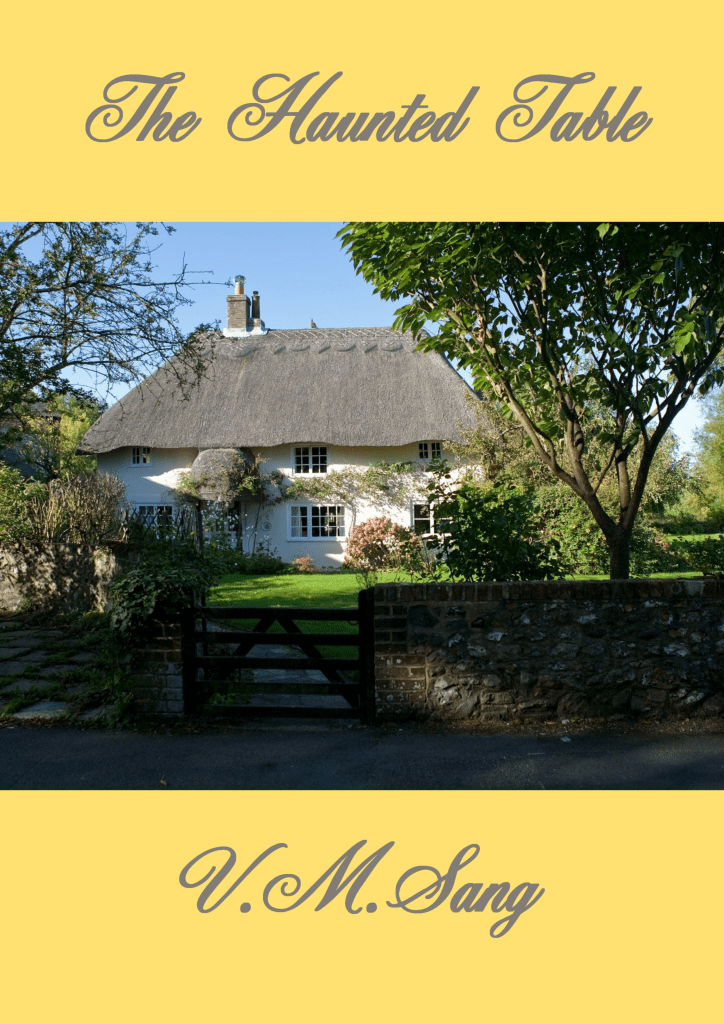
If you would like to receive an exclusive, free short story by me, called The Haunted Table, simply click the link. This will take you to the page where you can download it.

Maria and Tom have bought an antique table for the old cottage they have bought. When they hear strange noises in the night that sound like crying, they worry their house is haunted, but the sounds seem to come from the table.

They set about trying to find what is causing the disturbances. The answer is stranger than either of them had thought.

(Clicking the link will add your email address to my email list, but don’t worry, you can unsubscribe immediately if you wish. Nor will you get any spam. I only send out an email each quarter, or if I have any exciting news–like a new release.)

Memories 1. Early Schooldays

They say you always remember your first day art school. Well I must be strange as I don’t specifically remember that day.

My first school was nearly a mile from my home. I don’t remember being taken by an adult at all, although I must have been for the first few days at least. What I do remember is walking with a girl a few years older than me. I can’t see this happening now: a slightly older child being allowed to take a 5-year-old to school for nearly a mile!

I remember my first teacher. Her name was Mrs Rose, and she was lovely. She had white hair and was rather plump. At least, that’s the picture I have of her all these decades ago. We all thought she was as old as the hills. She loved her ‘babies’ as she called us.

Then I went up to Mrs Buckley’s class. She was as different as you could imagine from Mrs Rose. She was very strict and ruled her class with a rod of iron (almost literally.) If you got your sums wrong, you got rapped across the knuckles with a ruler.

The desks were double desks with an inkwell in the right hand corner of each half. We weren’t allowed to use ink, though, as we were only just learning to write and would have made a mess. Pencil was the rule. By the way, we were taught how to hold a pencil. I wonder if children are taught to do so today as many of the young people I see hold their pens in a most peculiar way. Not a way where you can have fine control. I’ve tried it.

I don’t think that there was a fixed timetable. It seemed that the teachers taught what they wanted whenever the fancy took them. I say this, because we never knew when we were going to have what was called ‘painting’. It was always in the afternoon. Sometimes we’d go in after lunch and find the desks pushed together so four could sit facing each other. When this happened, we went into the classroom and said ‘Oh good! It’s painting.’ We never knew when this treat was going to happen.

Another thing that we enjoyed, but only happened from time to time, as I remember it was ‘drill’. This would now be called P.E. Drill consisted of going out into the school yard and lining up in rows. It was a bit like you see on films of the 2nd world war when soldiers are training. Marching on the spot, star jumps, arms up, out, forward and back. Things like that. We never played any team games. But we enjoyed our drill. It was outdoors, at least.

Strangely, I don’t remember having any friends at this school, but I did have an enemy. One girl bullied me. She used to hit me if I didn’t do what she said. Some of the other children were sympathetic, but no one would even consider going to a teacher about it.

I will continue with my early school memories in another post.

Do you have any early school memories? Let us know in the comments box.

If you would like to receive an exclusive, free short story by me, called The Haunted Table, simply click the link. This will take you to the page where you can download it. This story cannot be accessed by any other means.

Maria and Tom have bought an antique table for the old cottage they have bought. When they hear strange noises in the night that sound like crying, they worry their house is haunted, but the sounds seem to come from the table.

They set about trying to find what is causing the disturbances. The answer is stranger than either of them had thought.

(Clicking the link will add your email address to my email list, but don’t worry, you can unsubscribe immediately if you wish. Nor will you get any spam. I only send out an email each quarter, or if I have any exciting news–like a new release.)

SAT drops scoring system, will award all students participation trophies

via SAT drops scoring system, will award all students participation trophies

In Defense of Grammar Schools

boy-160168_1280


There is a debate going on in the UK at the moment about education. As an ex-teacher I am interested in the arguments.

The Conservative Government wants to allow Grammar Schools to be re-established. Before the 1960s there was a system of Grammar Schools and Secondary Modern Schools.

In order to get into a grammar school, all children took an examination at age 11, in the final year of their primary school. It was called the 11+ examination. Those pupils who were in the top percentage got a place in the grammar school. I don’t know what that percentage was, but I have heard it said that the top 25% went to grammar schools.

home-1824815_1280

The grammar schools were academic schools, and they taught academic subjects. secondary moderns tended not to teach much in the way of languages, for example.

It is said that the future of children was settled at 11, and that was not good, because some children developed later. But the 11+ was not the end. There was a 12+ and a 13+ that pupils could take if they seemed to be developing in a more academic way.

At that time, the school leaving age was 15. The pupils who went to grammar school had to stay on until 16 so they could do the GCE ‘O’ level examination. A few pupils stayed on at secondary modern and did ‘O’ levels as well. If they did well in the examinations, they could then go on to the 6th form in the grammar school or at a college. I have several friends who did this.

During the 1960s, came the advent of the comprehensive school. These schools were deemed to be fairer than the old system. Each neighbourhood took in all the pupils from its catchment area. All went to the same school, regardless of their academic ability. This, it was said, was much fairer. It did not create an elite and a lot of ‘failures’ at the age of 11.

school-845196_1280

On the face of it, this seems to be fine, only I think there are a number of flaws in this argument.

The main one, I think is this. Pupils from a given area all go to the local comprehensive school. There is no examination for entry, so no feelings of failure by those who did not pass the 11+.
That sounds fine, but if the neighbourhood school is not very good, all pupils from that particular neighbourhood are being failed.

Children do not get the chance to meet children from a different background, either. They are living with these people, have been brought up in the area, either rich or poor, and so they do not get a rounded picture of society.

The idea was the opposite of this. Pupils attending comprehensive schools were supposed to see all the different types of people. Yes, they saw all the different academic types, but not people from different social backgrounds.

Comprehensive schools were supposed to prevent the feelings of failure by some pupils failing the 11+. I don’t think you can stop pupils from feeling inferior intellectually by lumping them all together. They can see the brighter pupils doing better than them in their academic work. That will make them feel inferior just as much as ‘failing’ the 11+.

One other thing brought about by the introduction of comprehensive schools, is that the education given is a watered-down academic curriculum, which is not suited to all pupils, and has lowered the academic standards for the very brightest pupils.

Grammar schools, they say, create an elite. This is supposed to be bad. In a perfect world, I suppose everyone would have the same academic capabilities, but everyone does not. There are some people who are much cleverer than others. Some say that it is solely due to their background how some people develop, and a middle class background is advantageous. This I would not dispute, but only to a point. There are middle class children who do not excel, and working class ones who do, in spite of their background.

They say that comprehensive schools help social mobility. How? Pupils live and learn in the same area with the same people and values.

In a grammar school, pupils come from all backgrounds and all areas of a town. They mix with each other and get to know something of the lives of each other. Pupils from working class backgrounds can get an academic education, and get away from the schools in their area where ambition is perhaps not so great.

Bright pupils who live in an area with a poor school can get away from that as well.

session-1989711_1280

It is said that grammar schools have more middle class pupils than working class ones. That is something that can be worked out. ‘They’ say that the exam can be coached and middle class parents are more likely to put up the money for coaching. Well, I went to a grammar school and was coached for the exam, but not by private tutor, which is the perception, but by my primary school. Encourage primary schools in working class areas to coach. Or develop an exam where coaching is no advantage.

There’s always an answer, and in my opinion, the advent of comprehensive schools has lowered standards. When I look at the exams I took at ‘O’ level and the exams pupils take at GCSE, there’s no comparison. We had to write essays. They just have ‘structured questions’, or fill in the blanks.

I see grammar schools as promoting social mobility far more than comprehensive schools in contrast to what the detractors say, that they are elitist and prevent it.

I would love to hear what you think of the grammar school debate.