Tag Archives: aspholessaria

Discover the Beauty of Spring Through Poetry

 I thought I’d write some poems about the seasons. Here is one about spring.

Spring is a lovely month. We’ve lived through the cold of winter and the seeming death of life. Many animals hibernate through the winter and are not seen; the trees are bare; the grass stops growing and many plants die back.

But with the spring, the sun gets warmer and life begins anew. It is an optimistic time of year.

Spring

Dandelions, like gold, cover the meadows.
Newborn lambs frolic in fields.
New leaves on the trees are casting their shadows
And winter’s cold grip quickly yields.

At the edges of woodland the primroses glow
And cowslips their scent fills the air.
Anemones dance when the breezes do blow
And birds sing with never a care.

Then bluebells and campions come into bloom
Their colour the blue of the sea.
The cuckoo, that herald of spring, will come soon,
His call echoing over the lea.

The song of the blackbird is like molten gold.
His notes are so pure and so clear.
Hearing him seems to banish the cold
And brings joy to all those who hear.

Robin is nesting, and other birds too,
The hedgehog is active once more.
The young of the deer and the badger and shrew
Play their games as in old days of yore.

The sun climbs higher and higher each day
Giving more of his heat and his light.
It sparkles like stars fallen into the bay.
All smile at the beautiful sight.

Hope and excitement come with each spring morn.
What blessings will come with this day?
New starts can begin once again with each dawn
And send us all hopeful away.

I hope you enjoyed my spring poem. It can be found in my poetry book, Miscellaneous Thoughts along with many more of my poems, both about the seasons and nature and a variety of other subjects.

If you would like to read more of them, you can click on the book cover in the sidebar, or click the button to take you to the online bookstore of your choice. It is available in ebook format as well as a ‘real’ book.

A Story About Wealth

Creating Sound: Childhood Instruments and Memories

I was changing the toilet roll in the bathroom the other morning when I inexplicably thought about how toilet rolls were in the 1950s.

Yes, I’m that old.

Anyway, I thought about the old Izal toilet rolls. 

They were a bit like tracing paper. In fact, we sometimes used them as such. They were hard and very scratchy. Horrid.

‘What has this to do with music?’ I hear you ask.

Well, while it was not good for its original purpose, it was brilliant to use with a comb to make a paper and comb musical instrument.

For those who don’t know about this, you wrapped the paper loosely around the teeth of the comb and made a buzzing sound with your lips. This made the paper vibrate and make a sound. By altering the pitch, you could play a tune.

We used to take a piece of broad-leaved grass, hold it vertically between our thumbs. Blowing our thumbs made a sound. 

Admittedly, not a nice one!

Paper straws could also be made into a kind of noise-producing item. Cut the end of the straw so it made an inverted V shape and blow. This didn’t last long, though, as the end got wet and stopped working. Pitch could be varied by the length of the straw. A group could play a simple tune. (Theoretically!)

Blowing across the end of bottles was a good noise-maker, too. If you got different sized bottles, you could make different notes.

We also made noises by cupping our hands together and blowing between our thumbs. But raising the fingers of the top hand, we made different notes. Favourite was a cuckoo’s call.

Tapping a pencil on your teeth and moving your mouth would also change the pitch of the tap, and you could ‘play’ a tune.

The last one I remember took some organising.

You took a wine glass (your mother’s best worked well) and added a little water. You dipped your finger in to make it damp, then ran it gently around the rim. It made a ringing sound. 

If you added different amounts of water to several glasses, you could, with a lot of trial and error, get a scale, thus play a simple tune.

Admittedly, some of these can hardly be described as music, but still…

Did you do any of these things? Do you know of any other things we did in childhood to make sounds? Let us know in the comments.

If you would like to buy any of my books, simply click on the image in the sidebar and you will be taken to a page where you can buy in any format from your favourite online store.

The ebook of each of the series is free.

A Chilling Comparison.

Morgan has compared the rise of Hitler to that of Trump.

Goldie’s Journey: From Hardship to a Warm Home. (Goldie and the Beare Family Part 7)

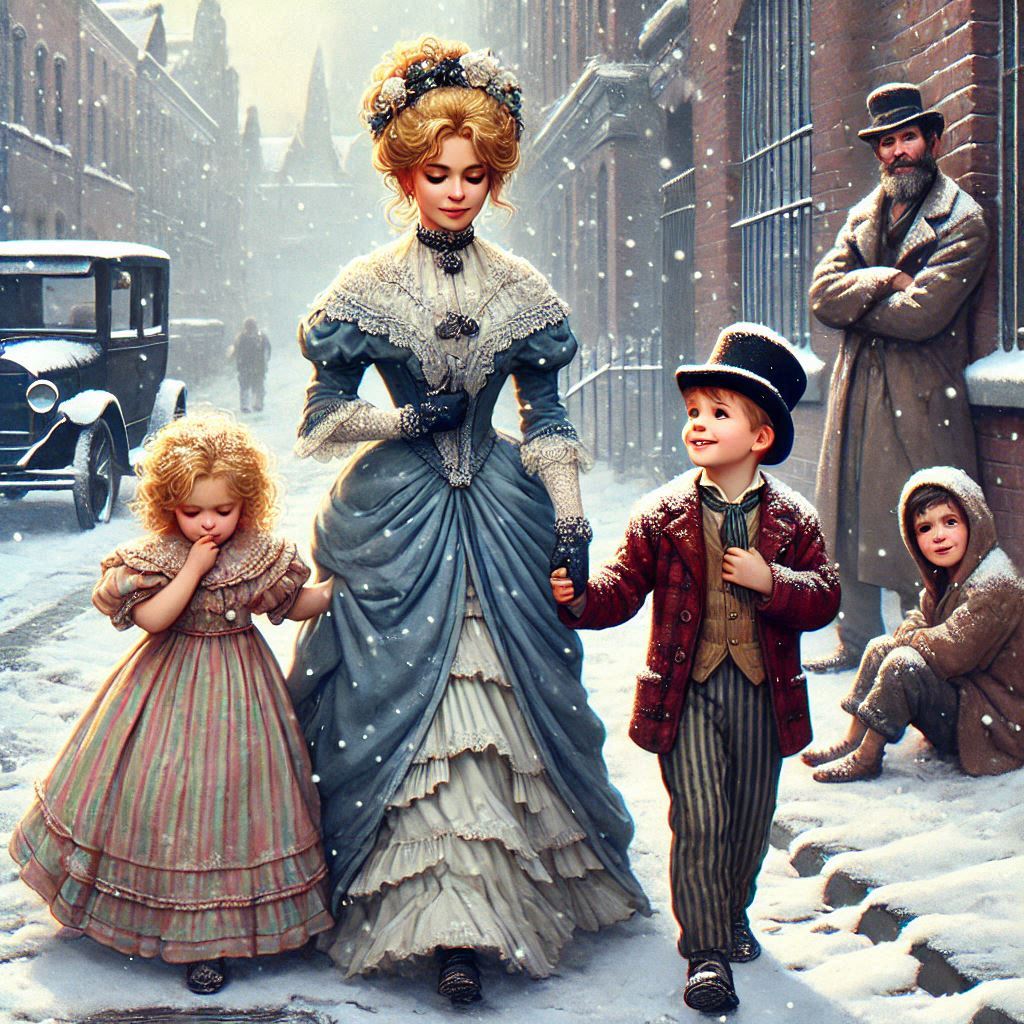
Image by V.M.Sang using Bing Image Generator.

Picture shows a well-dressed Victorian woman with small blonde girl and a slightly older boy walking along a snowy street. A ragged man and boy watch them pass.

Goldie could not believe what was happening. This must be a dream, and soon she would wake to hunger and cold, not to mention fear of Mr Smith. 

She sat on a small stool before the fire. Warmth. Lovely warmth. Even with no clothes on, she felt warm. Warmer than she ever remembered.

This was a beautiful house. She had never been inside a house like this. It was clean, with furniture that was not broken or torn. Thick curtains that would keep out the cold. Clutching Jacob Rabbit to her naked chest, she stood and wandered to feel them. Soft. Almost as soft as Jacob.

“Is this real?” she whispered to the rabbit.

The door opened and Mrs Beare came in. 

Mamma, she said I was to call her.

“I’ve borrowed these clothes from the vicar’s wife, Emily. She has a little girl about your age. Come and let me help you to dress.”

I’m Emily again. I have my proper name back.

Mamma dressed her in what looked like expensive clothes. She had always worn clothes passed on to the poor by richer folk. They had been worn out in places, and the fabric thin.

Mamma held up a white dress. “Arms up,” she said. 

When Emily complied, she dropped the dress over the child’s head. “Now turn around so I can do up the buttons.”

When the buttons were fastened, Mamma tied a blue ribbon around her waist.

The dress was not as long as Mamma’s. It came halfway down her calves. A hint of the frill around the legs of her bloomers peeped from below.

Mamma picked up a brush and teased out the tangles from her golden hair. “I can see why they called you Goldie. And you have a soft natural curl to your hair. It will be easy to fashion.” She held Emily at arm’s length. “You are exquisite. Now let us go and eat dinner before Mrs White has a fit.”

They left the sitting room and entered the dining room. 

 Mr Beare’s eyes opened wide. “I can’t believe this is the same little girl that was asleep in Harold’s room. She’s beautiful.”

Emily smiled and cast her eyes down.

Jane had set a fourth place, and when all four were seated, Mrs White entered carrying a platter on which sat a large goose. She was followed by Jane with a tray of dishes. The pair placed their burdens on the table.

“I’m sorry about the soup, Ma’am,” Mrs White said. “There was not enough to feed you all.” She glared at Emily.

Emily felt her face heating.

“That is all right, Mrs White. It wasn’t your fault,” Mrs Beare replied.

Emily squirmed in her seat and kept her eyes down. It was her fault there was not enough soup.

Mr Beare, Papa, carved the goose and served everyone.

There were potatoes, and a sauce made from some kind of green fruit. Mamma said they were gooseberries, so called because they were served with goose. Another dish had sprouts, and yet another had carrots.

After eating all these delicious foods, Emily had never felt so full in her life. She thought of the thin gruel she had eaten at Mr Smith’s, and grimaced.

After Jane cleared the remnants and dirty crockery, Mrs White returned with a plum pudding. She placed it carefully on the table and Mrs Beare served each of them. 

When they finished eating, Harold looked at her, and took a deep breath. “It’s Christmas, Mamma. We had our presents, but Emily hasn’t had anything.”

Emily grinned. “Yes, I have. I have a new home and family. That’s the best Christmas present ever.”

“But I want to give you something.” He pulled Jacob Rabbit from under the table. “You are now my little sister. You love Jacob, and so I’ll give him to you.”

His parents smiled.

After eating, the family repaired to the sitting room, Emily clutching Jacob Rabbit to her chest. Mamma sat at the piano and played Christmas carols, to which they all joined in singing. After a while, Papa got out the dominoes and they played until Emily ‘s eyes began to close.

Jane had made up a bed for her in her very own room. As she lay, her eyes closing, she believed this was the best day ever.

*****

Mr Smith stomped around the sparse loft room. “What d’you mean, no one’s seen ’er? She can’t just disappear.”

Jack spoke quietly. “P’rhaps she ran away after you beat ’er.”

“Then she’ll be ‘idin’ somewhere.” He turned to the other children. “All of you. Go out and search. Look in every corner, every empty ‘ouse, ware’ouses; everywhere you can think of.”

A few weeks later, Jack went up to Mr Smith, cowering. “I seen Goldie.”

Mr Smith grabbed the boy. “Where? Why didn’t you bring her back?”

“Couldn’t. She were with a well-to-do lady. Dressed nice, she were. Lady were ‘oldin’ her ‘and, like she were her mother or summat.”

Mr Smith sank into his chair. “Couldn’t be ‘er. A girl what looks like her. That’s who you saw.”

Jack shook his head. “Was ‘er a’right. Saw me, she did. Shook her ‘ead at me. Rekernised me for sure.”

“Well, we’ve searched for ‘er for weeks now. We need to get back to business. There’s no money coming in while you are all out searchin’. If that were Goldie you saw, she’s lost to us.”

The End

I hope you enjoyed the story of Goldie. Please let me know what you thought in the comments.

Finding Family: The Journey of Emily the Orphan. (Goldie and the Beare Family: Part 6)

Mrs Beare looked at the child, who had cowered away at the mention of the orphanage. She frowned. “What is it, child? Surely the orphanage is better than your Mr Smith?”

“Ma said it was a bad place. When I were bad, she said she’d send me there.”

Mrs Beare put her head on one side. “So you have a mother?”

“No. She went to heaven. Annie found me and took me to Mr Smith. She said I’d be one of her girls when I’m old enough.”

Mr Beare strode into the room. “That settles it. She must go to the orphanage. We cannot allow her to become a fallen woman.”

His wife sat on the bed with an arm around the little girl. She turned to her. “What’s your name?”

“Mr Smith calls me Goldie.”

“But what did your mother call you? Can you remember?”

 Mrs Beare had to lean forward to hear the whisper.

“Emily.”

“Well, Emily, tell me what you did for Mr Smith.”

“Begged. He said I’m pretty so people’ll feel sorry for me and give me more.”

“Emily, I will not let you go to either Mr Smith, or the orphanage. I have an idea, but I need to talk to my husband about it.” She stood. “Stay here. Harold, come along with us. Bring a toy to play with, but leave Jacob with Emily.”

“But, mother…”

Mrs Beare frowned. “Don’t argue, Harold. Do as you are told.”

He handed his rabbit to Emily with a sullen look, and followed his parents. “What if she runs away with him?”

“We will be outside the room. She will not be able to leave without us seeing her. Go and take your train into the sitting room until we call you.”

Mr Beare stood, head cocked to one side. “What is it, Grace? What’s going on in that head of yours?” He laughed. “I can’t see what alternative there is to the orphanage.”

“Oh, but there is, Albert. You know how I…we…wanted more children, but none came after Harold? Remember our prayers, asking God to help us? We thought that He had decided we should have no more children.”

Mr Beare nodded.

“Well, I think He has answered our prayers after all.”

“You mean… .” He looked at the bedroom door.

His wife nodded, a smile covering her face. “Yes. Emily. I think that God has sent her to us, both in answer to our prayers and to help her, too. I think we should adopt her.”

Mr Beare frowned and shook his head. “I’m not sure, Grace. Adopting a street child? She’s a thief. She entered our house and took things.” He gazed at his wife. 

“She took an opportunity that presented itself. She only did it from fear of this Mr Smith. She’s a beggar, not a thief.”

“It’s a big risk, Grace. Suppose Mr Smith still has some influence over her?”

Mrs Beare sighed. “If she’s living here with us I do not see how Mr Smith, whoever he is, can get to her.” She held onto her husband’s arm and gazed into his eyes. “Please, Albert. You know how I long for another child, especially a little girl. And here God has provided us with one. Are you going to reject God’s gift?” She opened her eyes wide and smiled at him through her eyelashes.

“You know I can’t deny you, especially when you look at me like that.” He bent and kissed her. “I won’t reject God’s gift, either.”

If it had not been unladylike, Mrs Beare would have jumped up and down.

“You realise we’ll have a difficult job getting her civilised?”

She grinned. “Yes, but I like a challenge.”

On entering the room, Emily was huddled in a corner of the bed, holding Jacob the rabbit tightly. She stared at Mrs Beare with wide open eyes.

Mrs Beare sat next to the little girl. “How would you like to live here with us, Emily?”

Emily frowned. “You want me to be a maid here?”

“No, no. I…we want you to be our little girl. Our daughter. We want to adopt you.”

“I don’t understand.”

“You will live here with us. We will give you clothes and food. You will go to school. You will have toys. You will have everything our son, Harold, has. He will be your brother.”

“Not go back to Mr Smith?”

“No.”

“And have a rabbit to cuddle, like Jacob?”

“Yes. And other toys, too.”

Mr Beare entered, looking severe. “You’ll have to be good, though. No more stealing.”

Emily put her hand in her pocket and drew out the brooch she had taken from Mrs Beare’s jewellery box. 

She held them towards Mrs Beare. “Sorry. Mr Smith would beat me if I had nothing to give him.” She hung her head as tears filled her eyes.

“You will call me ‘mother’, or mamma, if you prefer, and Mr Beare you will call ‘father’ or ‘papa’. But first we must get you clean and see to those wounds.”

Mrs Beare called Jane and told her to prepare a bath. When the hot water had been poured into the metal bath set before the fire, Mrs Beare washed Emily’s hair and gently sponged her back. Her clothes she gave to Jane with instructions to wash them, and to dry them as quickly as possible before the range. She then plastered a salve on the raw switch marks.

“What are we going to dress you in? You can’t walk around naked. It is indecent.” Mrs Beare thought for a minute. “Wait here, Emily, I won’t be long.” She left the room and sought her husband.

As she crossed the hallway, Jane rushed up the stairs.

“Ma’am, Mrs White says the dinner is ready, and will be spoiling.”

“Oh, Jane, tell Mrs White I’m sorry. We shouldn’t be too much longer. Try to keep it hot, please.”

Jane dropped a curtsey and went back down the stairs. 

Mrs Beare entered the dining room. “Albert, we can’t have Christmas dinner with Emily with no clothes. The vicar has a little girl about the same size as Emily. I’m sure his wife will not mind lending us an old dress of hers.”

Mr Beare rose and tapped his pipe on the side of the fireplace, where a fire blazed. “And you want me to go and ask.”

“Yes, please. She can’t put her old clothes back. Not only are they ragged, but they were filthy, so I had Jane burn them.”

“And I suppose I’ll have to ask for some underwear, too. All right. I’ll go straight away.”

Mrs Beare reached up and kissed him on the cheek, then returned to the sitting room and Emily.

If you would like to read more of my writing, you can click on the books in the sidebar. You will be taken to a page where you can choose your favourite on-line book store.

The Littlest Christmas Tree. A Poem

This is from the second book in my 2 book series of poems, ‘One Poem a Day.’ The first one is called ‘From January to June’ and the second ‘From July to December.

This poem is from Book 2 and is today’s poem.

Image by V.M.Sang and Bing AI

December 16th.

As it gets nearer to Christmas, Christmas trees are going up everywhere. Yes, I know some have been up since November! Here’s a poem about one.

The Littlest Christmas Tree.

The other trees looked oh, so tall
To him, who was so very small.
And now it is the time of year
When everyone is filled with cheer.

Some men came for the tallest tree.
They took him with them, full of glee.
He was going into town.
In Market Square he’d wear a crown.

The littlest tree watched on as folk
Bought others. He was full of hope
That soon he would be picked to go
To a home to put on a show.

But people passed him by and said,
“That one’s too small. That one instead.”
His branches drooped. He felt so sad,
Until a man came, with a lad.

Most other trees had long been sold.
The little tree stood in the cold.
“Look, there’s a small one,” said the lad
As he turned towards his dad.

“It will just fit in our hall.
We can’t have one that is too tall.”
And so they came with spade and dug
Around his roots, all in the mud.

The littlest tree went home with them.
The lights and baubles gleamed like a gem.
He was so happy in that home
With all the love around him shown.

But Christmas passes soon away.
Then there came that dreaded day.
They took away the lights and balls.
“What happens now?” was all his thoughts.

He saw the tall trees passing by
On lorries, going off to die.
Their needles withering and brown
On their proud branches, drooping down.

Fear now filled the littlest tree.
“Is that what’s going to happen to me?”
But then the Dad came with a spade.
“I’ll not throw that for which we’ve paid.”

He dug a deep hole for the roots
And tamped it down with his big boots.
“We’ll let him grow, and then next year
We’ll bring him in again. Don’t fear.

And so the littlest tree was glad
That he’d been bought by this kind dad.
For now he has nothing to fear.
He’s decorated every year.

If you enjoyed this poem, and would like to read more, you can buy from the online store of your choice by clicking the cover below or in the side bar.

The books are available as ebook, hard back or paperback.

Here is the blurb for book 1

Take a lyrical journey through the first half of the year with V.M. Sang’s FROM JANUARY TO JUNE.

This anthology captures the essence of everyday life, nature, and the world around us through the versatile medium of poetry. From haiku to narrative poems, and the humor found in limericks, From January To June is a diverse collection of poetry.

A calendar in creativity, a diary in verse; this collection is the perfect companion for daily reflection and inspiration, providing a poem for each day that resonates with the diverse experiences of life.

And the blurb for book 2

The second book of poetry in V.M. Sang’s One Poem A Day Series takes us through summer to midwinter.

Each day there is a poem to read. These poems are often related to the season, for example, Harvest, or the first flight by the Montgolfier brothers, and of course, Christmas.

The poems are varied in type and length. There are haiku, haibun and tanka, limericks, sonnets, odes and narrative poems among the collection. Some poems are comments on serious subjects, while others are amusing and entertaining.

Many of the poems in this collection are in the traditional vein, so if you enjoy this type of poetry, this book is for you.

The Story of Goldie: A Journey Through Poverty Part 2

Artwork by me and Bing AI

“Come on.” Jack dragged her out of the door, pinching her arm as he did so.

“Ow!” Goldie shook him off as they descended the stairs. “What’ll happen to Peter?”

“Get switched. Prob’ly have a meal stopped, too. Shouldna ’ave kept money back. Mr Smith likes switchin’ ’e does. Don’t give ’im any chance to switch you. Do as ’e says, right and proper, and you’ll be a’right.” 

Goldie looked around. “What’s this place? Who lives in these rooms?”

Jack shrugged. “Mr Smith lives in one. Annie in another. The rest are Mary and her girls.”

“Mary said she wants me for one of her girls when I’m grown. What do her girls do?”

Jack paused on the stairs. “They’re whores. Know what them is?”

“I think so. A whore lived near us, before mamma died.” She sniffed and ran a hand across her face leaving a dirty smudge. “Lots and lots of men visited her. Mamma said she sold her body to them.” She screwed her face up. “I didn’t understand what she meant.”

They reached the door and Jack led her into the street. Rubbish blew past them, and the wind whipped Goldie’s hair into her eyes. A scrawny cat jumped onto a wall opposite.

Jack turned right along the street. Tall tenement blocks of houses rose on either side, cutting out the sunlight and making a corridor for the wind.

Goldie pulled her threadbare cardigan closely around her as she followed Jack along the familiar streets. As they passed one house, she paused, snuffling back tears. She turned to the boy. “I used to live there.” She pointed at the house. “We lived in a room at the back.”

“Did you have brothers an’ sisters?” Jack took her arm and pulled her away.

Goldie shook her head. “Papa went to heaven when I was very little. Mamma worked in a mill. She said I’d work there soon.” She sniffed. “I don’t want to work in a mill. Some of my friends got hurt real bad. They had to go under the machines to get bits of cotton. They call them sca…scave…scavengers.”

“Did you run away?” Jack asked.

Goldie nodded. “Mamma got poorly. She was being sick all the time and pooing. Our room smelled real bad. Then Mamma went to be with Papa in heaven.” She began to cry.

“Then Annie found me. I was very hungry and cold and she promised me somewhere to sleep and food to eat if I worked for Mr Smith.” Working for Mr Smith would be better than the mill.

Even if Mr Smith were a hard man, and it seemed he was, if she were a good girl and did as she was told, she would not get the cane.

Jack continued to lead her through the streets of the town.

Following, she found herself in a part of the town she did not know. The children sat on the ground opposite a church. 

Bells rang from the steeple calling the people to worship. 

Goldie noticed the gravestones surrounding the building. Her mother would not have the luxury of such. Goldie did not know what happened to her mother’s body. People came and took it away. 

A woman arrived to take her to the orphanage. The little girl had a fear of that place. Her mother had often threatened to send her there when she was angry.

Goldie looked around. This was where the ‘posh’ people lived.

The street was clean. Goldie looked at the houses. Most were tall with three stories above road level, and some had steps leading to a basement. Doors opened and people dressed in their best clothes flocked towards the church.

The men wore black or dark brown suits with white shirts and colourful cravats. High black hats were the height of fashion and every man sported one, removing it before entering the building.They shepherded their wives dressed in more colourful attire, although still fairly sober for church. Most of the dresses had bustles, but a few of the older women still wore the wide, hooped crinolines. Like the men, all wore hats.

They hustled their children into the church, barely looking at the two ragged children sitting opposite.

Goldie’s face fell. “What will happen if we don’t take anything back to Mr Smith? Will he switch us?”

Jack patted her on the back. “Don’t worry, Goldie. When they come out, they’ll feel they should do something for charity and then they’ll give us money. I ain’t never been here on a church day when I got nothing.”

The few passersby sniffed as they walked past, and one or two crossed the road. A couple dropped a few small coins in the children’s hats, but it was a  pitifully small amount. Then the church doors opened. The people spilled onto the road. A carriage drawn by a bay horse drew up and a family climbed inside.  The carriage trotted away.

People chattered outside the church. Goldie noticed the congregation beginning to disperse and was about to give up hope of anyone giving them alms. 

It was then that Jack stood. “Please spare a coin. Me and me sister is ’ungry. We ain’t ’ad nuffin to eat since yesterday morning.” He reached out a hand as a couple passed.

The woman searched in her bag and tossed a penny to the pair.

A little girl looked at Goldie. “Mamma, we can’t let such a pretty little girl starve. Give her something.”

The mother puckered her brow. “How do we know they will spend it on food? You know what these beggars are like.”

The girl looked shocked. “Mamma! You heard what the vicar said. ‘Jesus said when you feed one of these poor people, you are feeding me.’ And he said, ‘Suffer the little children to come unto me.’ Jesus would not have left them begging without giving them something.”

The girl’s father came up to them. “She’s right, you know.” He felt in his pocket and dropped a coin into the hat. Then he shepherded them away.

Jack looked into the hat on the floor. His eyes opened wide. “A shilling! He gave us a whole shilling!”

During the next few hours several more people gave them money, and when the daylight began to fade, they made their way back to the house where Mr Smith lived.

When he saw how much they had gathered, his face almost split with his grin. “I knew you would be good as a beggar, Goldie. Now go and get something to eat.”

I hope you are enjoying this serialisation of my story inspired by Goldilocks and the Three Bears.

I love hearing from you. Please leave your comments in the comments box.

If you would like to read some more of my writing, click on the book cover in the side bar to take you to a page where you can buy from the retailer of your choice.

Celebrating Halloween with Poetic Fun

Image by ApplesPC from Pixabay

As it’s Halloween today, I thought I’d write a little poem to celebrate it. We don’t do as much for Halloween in the U.K. as the people of the US do, but it’s beginning to creep in here. This year I’ve noticed a few people have decorated their houses.

Halloween

Witches gather their broomsticks
Putting on pointy hats.
Devils creep out from hell
As spiders build their webs.
Ghosts walk the streets
And skeletons leave their graves
Jack O’Lanterns grin
With fiery eyes that glow   

A cold wind blows the leaves
As we shiver in our homes.
The darkness seems to creep
Beneath the gap below the door.
Ghostly sounds are heard.
And the doorbell rings
We huddle together in fear.
What horrors await outside?

We creep towards the door
And open it with care.
The ghosts and skeletons jump
Towards us with a screech.
The witches cackle loudly,
Jack O’Lantern held up high.
Then come the words we know


Image by Nisse Andersson from Pixabay

This is a new poem, but if you enjoyed it and would like to read more. simply click on the image in the side bar.

Currently, Next Chapter, my publisher, has discounts for people who buy 2 or more books in a series from Google Play Store

  • 2 books: 20% discount
  • 3 books: 30% discount
  • 4 or more books: 40% discount

No coupon code is needed for these discounts: all customers who find Next Chapter books in the Google Play Store are able to use these discounts (as long as they buy 2 or more books in any one series at the same time).

Here’s a link to my One Poem a Day series if you are interested.

Woodland Inspiration: A Free Verse Poem

Rebecca Cunningham has challenged us to write a poem about a favourite place with alliteration.

It is to be free verse and no more than 50 words. So here’s my offering.

Woodland ways
Wend past flowers.
Winding paths walked
Without worry.
Wind whispers to willows
Waving branches.
White wood anemones 
Water at the heart of the wood
With wavelets kissing the shore.
Woodpecker, willow warbler
Wing through trees.
Wonderful. 

And here’s a link to Rebecca’s website so you can view the other poems.

Click here