Tag Archives: writing

I Am Earth.

After some protests in Germany in February, over the destruction of a village to make way for the expansion of an open cast coal mine,I thought of a poem I wrote a couple of years ago, called I Am Earth (found in Miscellaneous Thoughts) and decided to write a sequel.

The Ancient Greeks thought that the Earth itself was a goddess called Gaia who, along with Uranus, the sky, created all living things. In I Am Earth, she bemoans what humanity has done, and threatens us with destruction. Here she is telling us what she is doing to bring this about.

I Am Earth (2)

I am Earth.

I am your mother.

I gave you birth.


I told you

What will occur.

And now you will rue.


You ignore me

And take little heed

Of my anxious plea.


So I send you rain

To flood all your homes

And give you pain.


I send the drought

So no crops will grow.

There’s famine, no doubt.


I heat the world

And many will die

From the heat I have hurled.


Winds I will send

In hurricanes now.

Your lands they will rend.


Yet you will not learn.

To me you are deaf

So the world I will burn.


Fires in the summer;

Deep snow in the cold.

You get dumber and dumber.


My skin I do shiver

And make buildings fall

As the ground it does quiver.


I will belch forth fire

From deep in my heart.

Make Earth like a pyre.


Will you now learn?

Don’t exploit my wealth.

Or you I will burn.


I AM DESTROYING YOU.

You can buy my poetry book, Miscellaneous Thoughts, from your favourite retailer, in ebook and physical book form.

The poems are in a variety of styles, some serious and some amusing.

If you purchase it I would be ever indebted to you if you would leave a little honest comment on what you think of it. You can post on any of the retailers.

Why Don’t People Read More

This post was inspired by on posted by Charles Yallowitz last Tuesday.

To read what he says, click here.

I always loved reading from a very early age, but not always the books we read at school. Sometimes I did. We read The History of Mr Polly by H.G.Wells for ‘O’ level (aged 16), and it was interesting and funny.

When I went on to higher education I chose English Literature as a subsidiary subject (I think it’s called minor in the US) because I enjoyed reading.

One book we studied I refused to answer any exam questions on it (we had a choice) because I felt that analysing it would ruin it for me. It’s this analysis of books we read where I think we go wrong. Everyone has an opinion about a book from whether it was enjoyable to what it means. (Same with poetry.) Many books people read and don’t see any extra meaning; yet in school we force them to find meaning, even if there may not be one. One of the comments said that in an interview with Pinter, he stated that An Inspector Calls has no meaning beyond the straightforward story. Yet children are taught to look for one.

As a writer, I read many posts and books on the craft of writing. One thing that constantly crops up is Theme. It seems as though we all have to have a message. Well, I’m with Pinter. Why can’t I just write a story without having to have a message and deeper meaning?

Poetry is the same, in fact, more so. Oddly, the posts of mine that get the most views are when I post a poem. Yet poetry books, we are told, don’t sell.

I also think that teaching is the reason people don’t review the books they read. Memories of doing book reviews at school (usually of the books they read independently) are not good. It’s work, and not easy work, either. I have quite a lot of ratings that do not turn into written reviews. I prefer to ask my readers to leave a comment rather than a review. I think this is less intimidating. So what if I receive some that are just one line. That’s better than none.

I read to my children. One has grown up reading, and loves a good book. The other never reads fiction. Hardly any books, in fact, preferring to get stuff from the net. My daughter read to her children, but they don’t read.

The way we teach our children should be improved. Not every child can be taught in the same way, yet in the UK at least, everyone seems to be taught in an academic way. This goes for all subjects. Some children respond to that well, but others are turned off.

And how many people remember much of what they were taught at school? Maybe they’d remember more if they were taught it in a less academic way.

We are told how important reading is, but turn so many of our children off it.

How I became a writer, and some of the books that led me here.

Image by Lubos Houska from Pixabay

I’ve always been a writer, although I didn’t understand that until late in my life. I wish I had realised earlier, but I didn’t. Nothing I can do about the past, but I can make up some of the time now.

I’ve always loved stories from being tiny. I can still remember my favourite story. It was about two little pandas called Pink and Ponk. I can still quote the first few lines, but I do remember the story quite clearly.

Later, when I could read myself, I devoured Enid Blyton books. Early on it was Noddy and The Faraway Tree. Later I loved Shadow the Sheepdog. I remember that the first ever story I wrote was about a dog, inspired by this story. I was only young–probably about seven or thereabouts – because my spelling was a bit dodgy.  I spelled ‘of’ as ‘ov’ , all the way through.

I also really enjoyed her Famous Five books, and the Adventure series. And although I read a couple, I was never really enthusiastic about Mallory Towers books.

Another book I loved reading was Black Beauty, about the life of a horse. It told of his life from his early days with his mother, through different owners, some good, some bad, to his retirement. 

When I graduated from the children’s section of the library, I discovered Jeffrey Farnol and Mary Webb. Later, I read many Agatha Christie books, and other books in that genre, and I loved Georgette Heyer and other historical novelists.

Of course, there were the classics. I always loved the Brontë sisters’ books, especially Wuthering Heights. 

I remember making a little fairy out of grass and telling my younger sister stories about him/her. 

At school, I loved it when we were given a title, or first line to write about. I can’t remember any of the stories I wrote then, but in my teens I wrote a very bad romance that I read to my friends. They said they liked it, but I suspect they were just being kind.

At Teacher Training college, I began my poetry writing. I had my first ever publication in the Manchester University Institute of Science and Technology magazine. The poetry era ended until I was teaching in 1990 when I wrote a poem for the staff Christmas party. I had to write one every year, by popular demand, after that. Sadly these have all been lost except the one in the UMIST magazine.

I loved reading Science Fiction, too and read all the well-known writers.

Then I found Fantasy. A young boy, by the wonderful name of Fred Spittal, asked me if I’d read The Lord of the Rings. He was reading it, but said I should start with The Hobbit. I found it in the college library and from then was hooked on fantasy.

I won’t go into all the fantasy books I’ve read. It would take too long.

Since writing Book 1 of my Wolves of Vimar series, I have published almost a dozen books. I have also drifted into historical fiction and begun writing poetry again. My first published poetry book is called Miscellaneous Thoughts.

So you see, I have always been a writer, but didn’t know.

Do you remember books that influenced you as a child? Tell us about them in the comments section.

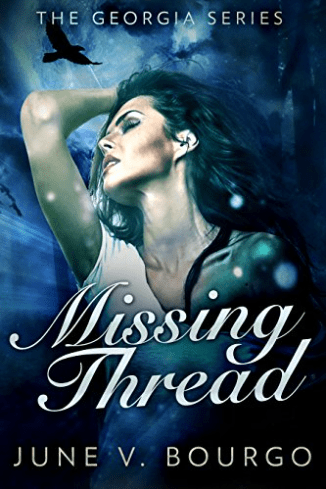
Review of Missing Thread by June V. Bourgo

Overview.

This is Book 3 of the Georgia series by June V. Bourgo. Although it is the third book in the series, it can be read as a stand-alone novel. Anything that occurred in the previous books that is needed in this one is explained.

Story.

Georgia is a young woman who has gained fame by writing about her previous experiences. In this book, Georgia goes to a writer’s conference where she is to speak. While there, she uses a hire car to visit places, but is caught in a torrential rainstorm. She is forced off the road by a vehicle and into the river. Although she manages to escape the car, she is swept away and into a nearby lake.

Fortunately, she is rescued by a man and taken to hospital, almost dead and suffering from hypothermia.

Eventually, she recovers consciousness, but with no memory of who she is, or her life before waking in the hospital.

The story tells of how Georgia, helped by her husband and daughters, struggles to rebuild her life with, to her, total strangers.

Blurb

After a strange accident, Georgia awakens from a coma to a sea of faces she has no memory of, in a place she doesn’t remember.

Returning to a home she doesn’t recognize, Georgia struggles to mend the strained relationship between herself and her family, and rediscover a life she can’t recall ever having.

Through life-changing events and a mental struggle that challenges the very core of their family, Georgia realizes that her accident is linked to something in her past. But can she put the pieces together and learn the truth?

Characters.

I found I liked Georgia and her family, and was rooting for her to regain her memory. Ms Bourgo does an excellent job of drawing a picture of a woman with no memory of her past life, and the anguish she goes through as she tries to rebuild her life with total strangers. We feel Georgia’s confusion and her anxiety that she won’t be able to love the stranger who is her husband and the two little girls who are her daughters.

Georgia’s husband, Sean, is another character I could relate to. Sean does his best to be understanding and patient, but on occasion, as would we all, things get too much for him.

The two girls behave like most intelligent children would. Confusion and anxiety that their mother will no longer love them if she can’t remember who they are.

 I don’t want to spoil things for you and so I will say no more.

Writing

As said earlier, Ms Bourgo does an excellent job of making us feel like Georgia in her predicament. She gives us a sense of Georgia’s panic when in the sinking car, and how she feels about her unknown family.

Sadly, there are typos and grammatical errors, and while they were irritating, and did on occasion throw me out of the story, I think the story is so good, they did not detract too much.

I gave the book 4*.

My ranking of books. In order to get a particular number of stars, it is not necessary to meet all the criteria. This is a guide only.

5* Exceptional. Wonderful story. Setting well drawn, and characters believable. Not perfect, but with flaws. Will keep you up all night. No typos or grammatical errors.

4* A thoroughly enjoyable read. Great and original story. Believable setting and characters. Very few grammatical errors or typos.

3* I enjoyed it. Good story. Characters need some development. Some typos or grammatical errors.

2* Not for me. Story not very strong. Unbelievable and flat characters. Setting not clearly defined. Many typos or grammatical errors.

1* I hated it. Story almost non-existent. Setting poor. Possibly couldn’t finish it.

I enjoyed this story as much as the previous two. Have you read it? Did you enjoy it if you have? Let us know in the comments.

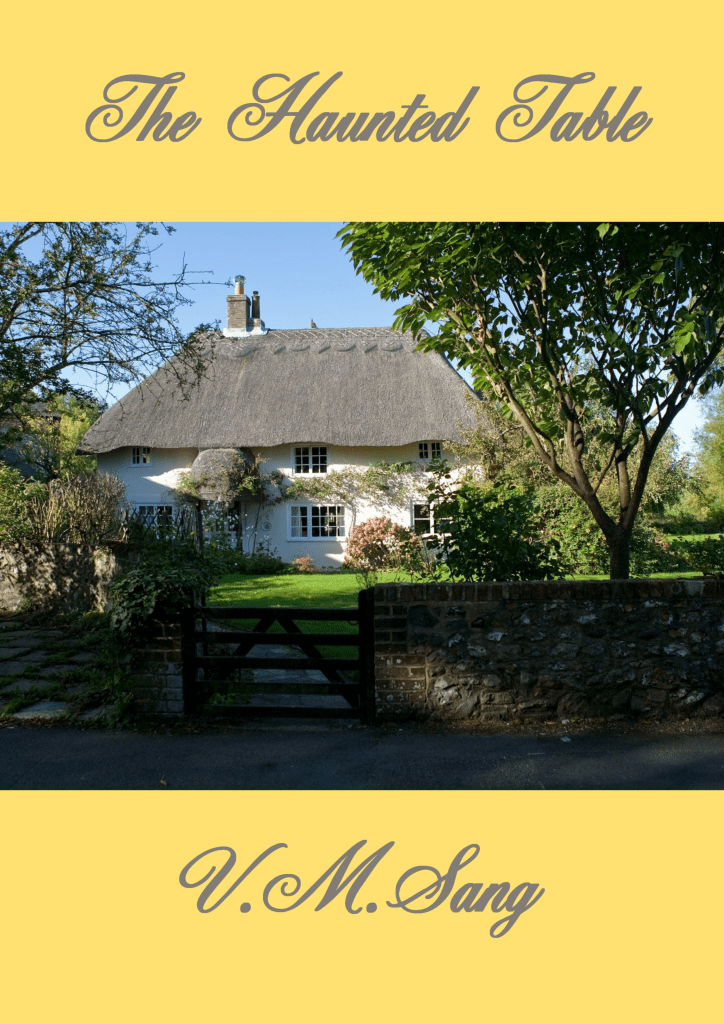
If you would like to receive an exclusive, free short story by me, called The Haunted Table, simply click the link. This will take you to the page where you can download it.

Maria and Tom have bought an antique table for the old cottage they have bought. When they hear strange noises in the night that sound like crying, they worry their house is haunted, but the sounds seem to come from the table.

They set about trying to find what is causing the disturbances. The answer is stranger than either of them had thought.

(Clicking the link will add your email address to my email list, but don’t worry, you can unsubscribe immediately if you wish. Nor will you get any spam. I only send out an email each quarter, or if I have any exciting news–like a new release.)
Spring Cleaning–A poem.

Image by congerdesign from Pixabay

Not my favourite job to do, but when the sun shines in, it makes the dust more noticeable. So it’s a job that has to be done.
And the satisfaction at the end makes it all worth while.

Spring Cleaning.

The sun is now shining making everything light

So it’s time to make our homes shiny and bright.

Let’s pick up our dusters and polish all day

Till every speck of dust goes away.

We’ll clean all our paintwork and make it as new

And polish silverware so your face you can view.

Then wash all the curtains and clean all the floors

And see if we need some more paint on our doors.

‘Spiders beware, don’t you build any webs.

We’ll knock them all down with our brushes,’ I said.

Sweeping and polishing all of the day

Until the last smidgen of dirt’s gone away.

Now stand back and look at all we have done.

A shiny and perfect home. We have won.

Have you done any spring cleaning yet? I’ve washed my dining room curtains and cleaned out my kitchen cupboards. Still a lot more to do!

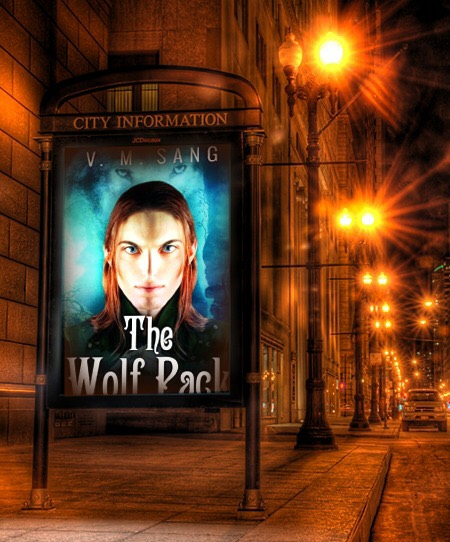
The Wolf Pack book 1 of The Wolves of Vimar series

All Carthinal wants is admission to the ranks of the mages. Traveling from Bluehaven to Hambara, where his rite of passage is to take place, he doesn’t expect to end up on a quest to find the long-lost sword of the legendary King Sauvern. With strangers he meets on his journey, Carthinal sets out on the seemingly impossible quest. Followed by Randa, the snooty aristocratic daughter of the Duke of Hambara, and the young runaway thief Thad, Carthinal and his companions face tragedy and danger. Watched by the gods and an implacable foe, they will have to accept help from the least likely sources and face their innermost fears. As the fate of their world hangs in the balance, they realize that this is more than an adventure. This quest will change them all.

This book came from a Dungeons and Dragons scenario I wrote for my D & D club at the school where I worked. I had been buying scenarios, then I thought I could write one myself. I wrote one from which this series has emerged.

I played Dragonlance, both as a player and a DM, and when I discovered that Weiss and Hickman had turned it into a series, I thought, ‘Why not?’ Thus The Wolves of Vimar series was born.

I only intended it to be one book, but it sort of grew into what will eventually be a five-book series. I’m unsure that my players will recognise it now, although some things are the same, such as searching for Sauvern’s Sword (Book 1) and the name of the antagonist.

HERE’S A REVIEW FROM AMAZON

Discerning Reader

5.0 out of 5 stars A solidly done, and crafted fantasy novel.

Verified Purchase

“The Wolf Pack” is an original and well crafted fantasy novel. If you like novels like the “Earthsea Saga” by Ursula Le Guin or “When the Heavens Fall” by Marc Turner then I suggest that you may well enjoy “The Wolf Pack.” British style and spellings throughout. Not really a negative, just a difference to be noted.

I found the characters well developed, and complex (in a good way).

The plot is unique and unusual. It is not easy to explain, but does unfold nicely as one reads through the book. I am trying to avoid spoilers, so I do not want to give too much away.

Dialogue is well written and each character has his or her own voice

To purchase from the seller of your choice click on the book cover in the sidebar, or on the button below.

The book is available as:

ebook, paper back, hard back, large print, pocket book and audio book.

The ebook is free on all platforms except Amazon where it is 0.99 (pounds or dollars.)

10 Fun Things You Didn’t Know About Me.

  • I recently passed my Grade 5 piano exam.
  • I love growing plants from collected seeds. I collected fallen tree seeds in Amiens and have loads of little baby trees coming up. Don’t know what to do with them!
  • I make all my own cards—birthday, wedding, birth congratulations, Christmas.
  • I enjoy walking in the countryside. I live in an area that is good for that. Both hills and flat areas.
  • I like cooking and baking. I have written a recipe book which includes many very old recipes from my grandmother, dated 1909.
  • I don’t enjoy housework, although it has to be done.
  • I learned to tat when I was at school. It’s a dying art. We moved to a new school and the cookery rooms weren’t finished, so we did craft instead. The teacher offered to teach us to tat. I and my friends took her up on it.
  • I have been using computers since the very first pcs came out. It was called a PET and we still have it, although it no longer works. This was in 1979.
  • I hate crowds and cities, although I didn’t used to worry about it. I prefer the countryside.
  • My family has farming roots. Dairy farming. My sister was still farming until last year.

What is interesting about you that we didn’t know? Let us know in the comments.

Feel free to share with your friends. Please link back to my blog if you do.

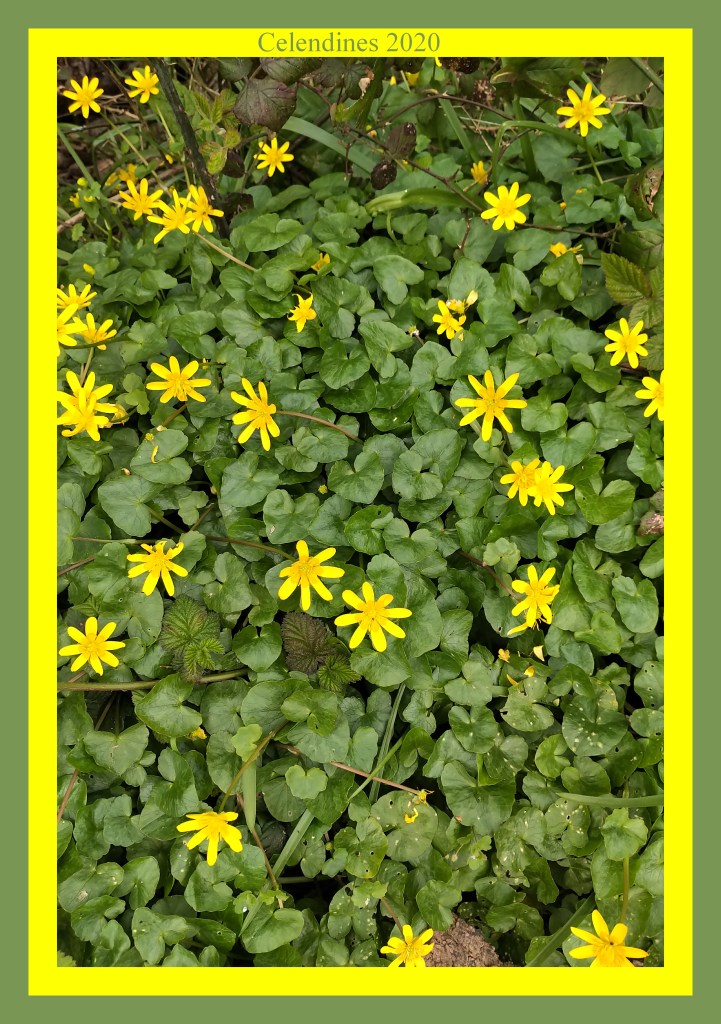
British Wild Flowers. The Lesser Celandine.

Lesser celandines are one of the earliest wild flowers to appear, blooming from late January until the end of April.

They are small, growing to a mere 2-3 inches, but form masses of flowers. They look gorgeous when in bloom. A veritable carpet of yellow stars.

They are found on banks, at the edges of woods and paths, in grassland. In fact, almost everywhere. One might be tempted to put some in the garden, but think twice. Although they are lovely little flowers and bloom when there isn’t much else, they can be invasive.

They spread from tiny tubers which grow in the leaf axels. Rooting them out can be a problem as it can help them to spread! My suggestion is to enjoy them where they are. I did see some for sale in a local garden centre. They were lovely with unusual dark, reddish leaves. Very tempting.

I understand, from reading on the net, that their leaves are a rich source of vitamin C. Useful at a time when, in past ages people hadn’t had much green vegetables during the winter months and may have been suffering from scurvy as a result. I have no experience of eating these leaves, and so cannot recommend them as a salad vegetable. ALWAYS CHECK FOR TOXICITY BEFORE EATING ANYTHING GATHERED FROM THE WILD.

Here’s a little poem to the celandine.

Celandines

Little stars litter the grass.

Have they fallen from the sky?

They are shining when I pass

Reflecting sun’s rays from on high.

Celandines are here to say

Winter’s gloom is nearly past.

Spring is really on the way;

Warmth will soon be here, at last.

Bright and cheerful little flowers

Covering the woods and banks  

Creating lovely yellow bowers.

We should all be giving thanks.

I hope you enjoyed this little post about one of our early spring flowers. Feel free to share it with anyone you think might find it interesting, but please link back to this blog if you do.

If you want to read more of my poetry, you can buy my first poetry anthology, Miscellaneous Thoughts, by clicking on the book cover in the side bar or the title in this paragraph.

I just looked at my poem on the preview, and the breaks between the verses does not appear even though I added them when writing. this always happens and I wonder why. Does anyone know why?

Please leave your comments in the comments box. I love hearing from you.

Pettic. A poem

This is not a poem that appears in a book, but it’s about a character in the Elemental Worlds duo.

Pettic

Pettic was a farmer’s son who loved to plough the land

Until one day his life did change in a dramatic way.

He was chosen from many lads to obey Prince’s command

And go to live in the palace, far, far away.

He was to be companion, confidant and friend

To Prince Torren, the Crown Prince, the king’s son and heir.

And with the Prince, his lessons he also would attend.

But then the Prince disappeared, nobody knew where.

So Pettic chose to go in search of his dear friend.

He visited strange worlds like nothing he had seen

And faced great dangers, helped the folk, their lives he did defend.

And found what he was looking for when he did intervene.

For in four lands he had to find four gems that were the key.

Will young Pettic find all that is required 

To find Prince Torren and set him free? 

If you wish to know the answer to the last question, you can find out by reading The Stones of Earth and Air, which is free as an ebook on Amazon, and The Stones of Fire and Water. Follow these links to buy at your favourite store.

St Patrick’s Day

Image by Jill Wellington from Pixabay

Today is St Patrick’s Day. Here’s a poem in tribute to him. I’m a bit late posting, I know, but I had to write it first! Of course, he didn’t really banish the snakes from Ireland, but it’s a good story.

St Patrick 

A boy was captured and taken for a slave

Across the sea, but he remained brave.

A shepherd in Ireland for six long years

He escaped and ran home to family cheers.

A Christian he was, and hearing God’s call

Was ordained as a priest to the joy of all.

God called once again that he should go

Back to Ireland to preach, and so

He sailed once more across the sea.

And converted many to Christianity 

And with his staff he gave a command

And all the snakes left that land.

On March seventeenth, in the year four sixty

He passed into Heaven on that isle so misty.

He’s remembered still by the Irish folk

On the isle  of Ireland where he spoke

And all round the world where Irish dwell

They still remember, and his story they tell.